
There’s no instruction manual for repairing century-old hardware, let alone modifying it for different purposes. And the older something gets, the less likely it is that someone who worked on it in-period will be around to offer advice. While the Internet has become a disappointment in so many ways, it can still live up to its promise as a way to connect with people and get information that would otherwise be unavailable.
Dominic Chinea, a former set designer and cast member of the BBC show The Repair Shop, is working on something ambitious. As documented on his YouTube channel, Chinea is building an aero-engined race car in the style of the specials that were popular on the Edwardian-era British racing scene. He’s combining a 1912 Rochet-Schneider chassis with a 1917 Liberty V12 airplane engine into something eligible for vintage racing—specifically, the Goodwood Members’ Meeting. That means using only period-correct components and techniques, which presents a major issue.
Just after World War I, airplane engines were coveted by racers for their power density. They produced much more power for their weight than automotive engines of the time. They were also pretty easy to get ahold of. The Liberty engine was mass produced for the war effort, so there were plenty of leftovers; however, the V12 was too long for the chassis, so Chinea decided to cut it in half and weld it back together as a V8. The Liberty engine block is really two large pieces—an upper half containing the cylinders and a lower half containing the crankcase and sump—but for this video Chinea focused on just getting the top half back together.
What made this extra difficult is that the block is comprised of cast aluminum produced to 1910s-era quality standards. Aluminum is already more difficult to weld than steel, and this cast stuff was full of impurities that literally bubbled to the surface as Chinea tried to weld the two halves of the block, contaminating the welds and causing them to crack.
Chinea did eventually make a breakthrough of sorts. Around the 20-minute mark in the video, he explains how after the initial failures he switched things up by using wet rags to cool the material while welding very short sections at a time. Then he had to repeat the process on the inside, with less space to work with. And once he welded up the inside, the outside cracked. Out of ideas and welding gas, he issued an engagement-friendly call to action asking if anyone in the comments had any advice.
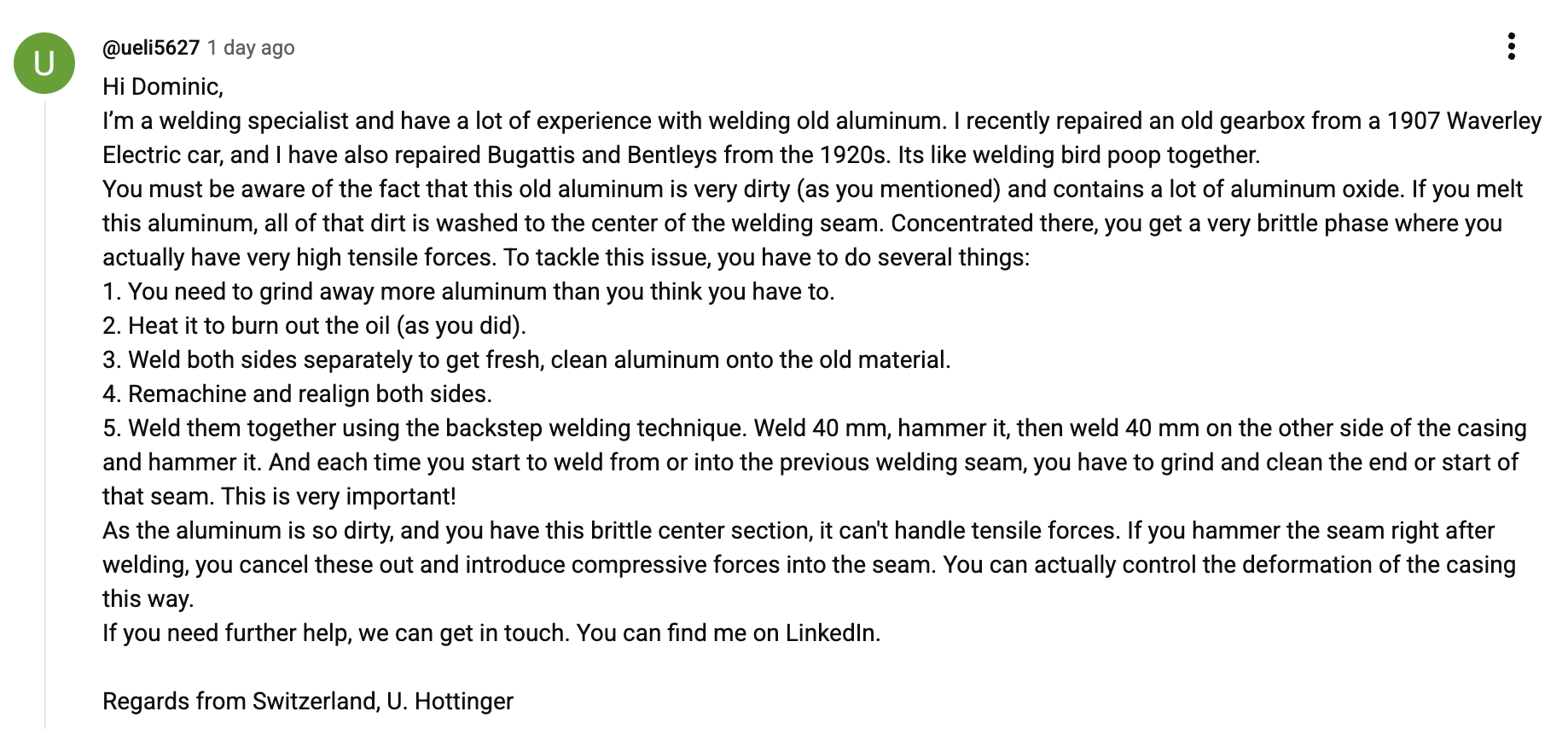
Luckily for Chinea, this was one of the rare times when the comments were actually helpful. Experts from all over the world jumped in offering advice. A welder from Switzerland with experience working on 1920s Bugattis and Bentleys diagnosed the problem as excess aluminum oxide, and offered some tips on how to deal with it. An 80-year-old former locomotive engineer advised drilling small holes to prevent cracks from propagating. An ex-fabricator for a hydraulic ram manufacturer seconded that, and added that building up the material with smaller tack-style welds might help.
It’s great to see people coming together to offer ideas for this unusual project.
The post Welding This 109-Year-Old Engine Back Together Has Turned Into a Community Effort appeared first on The Drive.