
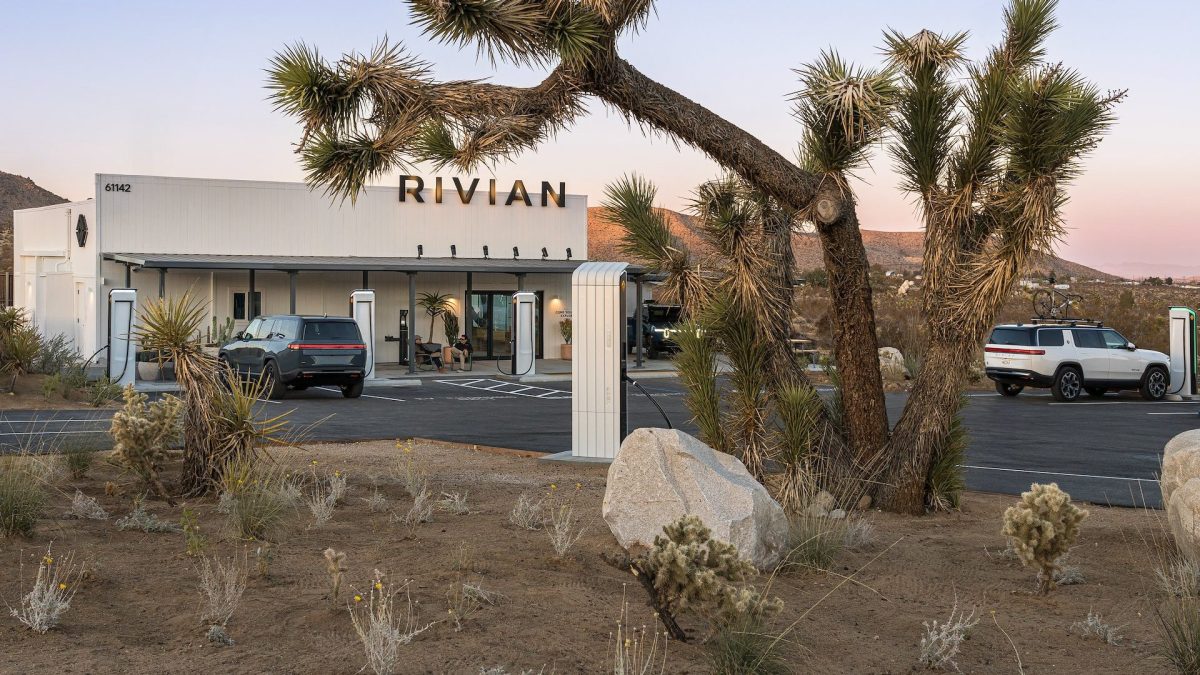
- Rivian intends to broaden its charging network. CEO RJ Scaringe aims to create one of the largest networks in the U.S.
- Present growth is consistent but not swift. Expansion will speed up with the introduction of the power cabinet 2.0.
- Competition and reliability are essential. Scaringe stresses the importance of having multiple dependable networks.
- Considerable growth anticipated in a few years. Major expansion linked to new product releases from the Georgia facility.
Key takeaway: Rivian is strategically positioning its charging network for significant growth in the upcoming years to compete with Tesla and enhance EV infrastructure.
AI assisted, editor reviewed
Electric car charging stations are about to be busier than ever, making the ongoing development and expansion of charging networks crucial. Rivian recognizes this, has a plan, and ambitious objectives.
In Park City, Utah, Rivian Founder and CEO RJ Scaringe stated in an exclusive interview on The Drivecast, “our aim is to establish one of the largest [charging] networks in the United States.”
Tune in to the full discussion starting when Scaringe addresses the Rivian Adventure Network (RAN), its growth, timelines, and its current status below.
Scaringe reaffirmed the commitment to enhancing Rivian’s charging network, indicating, “It’s a fairly straightforward buildout as it stands, meaning the pace at which we’re adding new RAN locations.”
Despite the launch of the mass-market, more affordable R2, Rivian will not rush the rollout of the RAN network, according to Scaringe. However, a change will eventually occur.
“Currently, we have approximately, I guess I should recall the precise figure, around 150 RAN locations. But that will continue to increase. The substantial inflection point where we expand more rapidly is anticipated with the rollout of what we term our power cabinet 2.0. This upgrade will enhance all the power electronics that support the charging dispensers. The rationale behind waiting for this major ramp-up is that the power cabinet 2.0 has been optimized for cost and installation ease,” Scaringe elaborated.
If that sounds like the Rivian R2 of charging networks, your understanding aligns perfectly with Scaringe. “Exactly. So when considering network expansion, we prefer to delay significant investment until the timing aligns with product launches from our Georgia facility. This won’t happen in the immediate future; we anticipate continued growth over the next two years, after which we will observe a more pronounced increase in our buildout rate. However, our objective remains to be one of the largest networks in the United States,” Scaringe stated.
Scaringe acknowledged that competition is beneficial, as having multiple charging options is advantageous, but uptime and reliable functionality of chargers are critical. “As you already noted, there are currently two networks boasting exceptional uptime—Tesla, which has an outstanding network, and ours. Tesla’s network is considerably larger, while ours is about 4% or 5% the size of Tesla’s. As we look towards the future, having more than one excellent network in the U.S. will be vital. We would embrace having others and aspire for universally accessible charging with over 99% uptime and convenient locations. Unfortunately, the timeline for achieving this has taken longer than many of us, myself included, anticipated,” Scaringe mentioned.
How long it will take for electric car chargers to line the interstates like gas stations is uncertain, but it will be several years before Rivian makes a substantial investment in its charging network. Then the flow of energy will truly begin.
Have a tip regarding a pain point? Reach out to us at [email protected]