
OS Giken is a prestigious name in the Japanese aftermarket scene. Founded in Okayama in 1973, the company produces performance components such as clutches and limited-slip differentials. If you’re looking for some laid-back weekend viewing, you can now observe the meticulous craftsmanship behind one of the firm’s most celebrated creations.
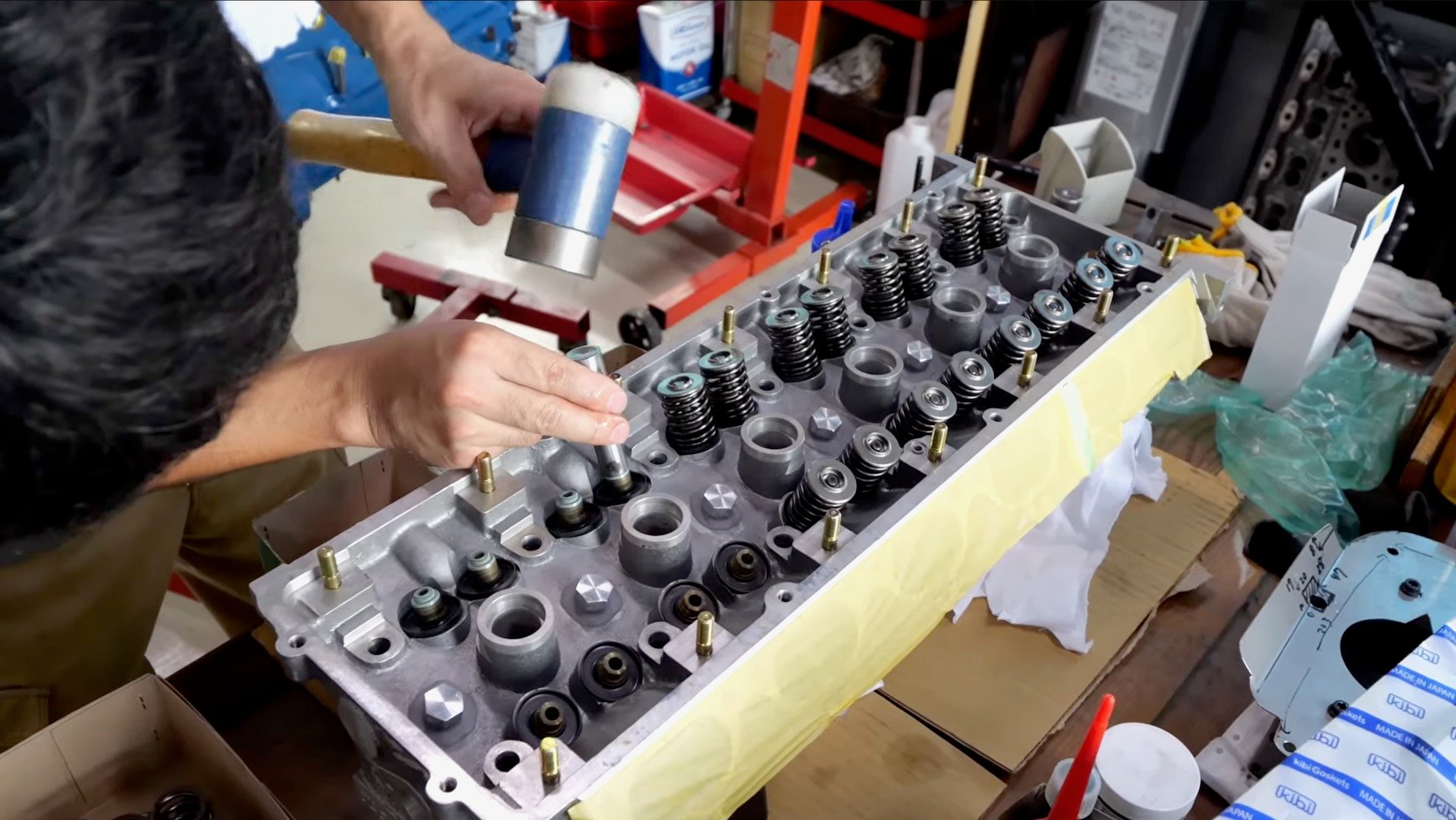
An approximately one-hour video uploaded to the YouTube channel Inside Japanese Factories showcases the assembly of an engine for OS Giken’s S30 Z project car. The L-Series inline-six engine features OS Giken’s TC24-B1Z head, a modern reproduction of the dual-overhead cam TC24-B1 head developed by the company’s founder Masaharu Okazaki in the 1970s. A mere nine of the original versions were produced, as stated by a Japanese-language article released by the firm. The component was resurrected as the B1Z in 2017, incorporating updates to utilize advancements in manufacturing developed over the last fifty years.
Although OS Giken’s factory hosts a range of contemporary technologies, including CNC machines and CAD-equipped computers that are standard in modern manufacturing settings, it doesn’t embody the pinnacle of fully automated efficiency. Similar to the Watanabe wheel factory, OS Giken operates on a smaller scale, employing just a few workers who predominantly work by hand. The engine assembly, in particular, resembles the methods employed by small racing shops.
For those with the time to spare, this is an excellent instructional demonstration on engine assembly. The build process commences with a thorough cleaning of an original L-Series block, followed by the inclusion of new components. The video guides viewers through each stage of the procedure, from crankshaft installation, attaching pistons and connecting rods, to head porting and polishing, and finally, testing the completed engine on a stand before fitting it into the Z.
How This Japanese Workshop Constructs Racing Engines from the Ground Up
Due to the absence of computerized wrenches monitoring the torque for each bolt as seen in modern assembly lines, every aspect of this engine is executed slowly and carefully. Prior to ignition, the engine is rotated to ensure optimal oil distribution, while two mechanics attentively listen for any irregularities during the initial moments of operation.
The entire assembly process spanned four months, partly because it served as a side project apart from OS Giken’s principal work in manufacturing individual components. However, hearing that inline-six engine roar undoubtedly justified the investment of time.
**Japanese Racing Workshop Shows Engine Assembly Method**
In the motorsports arena, the core of any high-performance vehicle resides within its engine. Japanese racing workshops have established a reputation for their precise craftsmanship and innovative design. This piece delves into the detailed process of engine assembly as illustrated by a prominent Japanese racing shop, emphasizing the techniques and technologies that play a role in the performance and dependability of racing engines.
**1. Engine Design and Preparation**
The journey of engine assembly commences with careful design and preparation. Engineers and mechanics work together to pinpoint the specifications predicated on the engine’s intended application, whether it be for circuit racing, drifting competitions, or time attack events. Aspects such as displacement, power output, and torque characteristics are meticulously evaluated. Computer-aided design (CAD) software frequently aids in crafting detailed plans, facilitating accurate calculations and simulations.
**2. Component Sourcing**
Once the design is confirmed, the subsequent phase involves choosing premium components. Japanese racing shops typically acquire parts from trusted manufacturers reputed for their performance and durability. Essential components comprise:
– **Engine Block:** Serving as the engine’s foundation, usually made from aluminum or iron, selected for its strength-to-weight ratio.
– **Pistons and Connecting Rods:** Lightweight yet strong materials are favored to endure the harsh conditions of racing.
– **Crankshaft:** A vital piece converting linear movement to rotational motion, often forged for enhanced strength.
– **Cylinder Head:** Engineered for optimal airflow, the cylinder head is crucial for performance, incorporating features like larger valves and improved porting.
**3. Precision Machining**
Precision machining is a hallmark of engine assembly. Each component goes through meticulous machining to guarantee exact tolerances. CNC (Computer Numerical Control) machines are commonly utilized to achieve the necessary specifications. This includes:
– **Boring and Honing:** Cylinder bores are machined to exact diameters to ensure a flawless fit for the pistons.
– **Decking:** The engine block’s surface undergoes machining to yield a flat mating surface for the cylinder head, ensuring a tight seal.
– **Balancing:** The crankshaft and rotating assembly are balanced to reduce vibrations, essential for high-revving engines.
**4. Assembly Sequence**
With all components machined and ready, the assembly phase kicks off. This process demands a high degree of skill and meticulous attention. Crucial steps involve:
– **Installing the Crankshaft:** The crankshaft is carefully positioned in the engine block, followed by the addition of main bearings.
– **Connecting Rods and Pistons:** Each piston is outfitted to its respective connecting rod, and the assembly is subsequently placed into the cylinder bores.
– **Cylinder Head Fitting:** The cylinder head is secured onto the engine block, with gaskets ensuring a snug seal to avert leaks.
– **Timing Components:** Timing belts or chains are fitted to synchronize the camshaft and crankshaft movements, vital for engine efficacy.
**5. Tuning and Evaluation**
Post-assembly, the engine undergoes tuning and evaluation. This stage is crucial in optimizing performance and ensuring reliability. The engine is generally tested on a dynamometer, enabling technicians to track power output, torque, and air-fuel ratios. Adjustments are made within the engine management system to fine-tune performance metrics.
**6. Quality Assurance**
Quality assurance holds significant importance in the engine assembly process. Each engine goes through strict inspections to confirm it meets the workshop’s high standards. This involves leak checks, verifying torque settings, and conducting performance assessments. Any inconsistencies are rectified before the engine is approved for installation in a race vehicle.
**Conclusion**
The engine assembly process within a Japanese racing workshop represents a fusion of art and science, necessitating expertise, precision, and a dedication to performance. From the design phase to final testing, each step is critical in constructing an engine capable of enduring the demands of competitive racing. As technology advances, Japanese racing shops continue to lead the charge in innovation, pushing the limits of engine performance.