
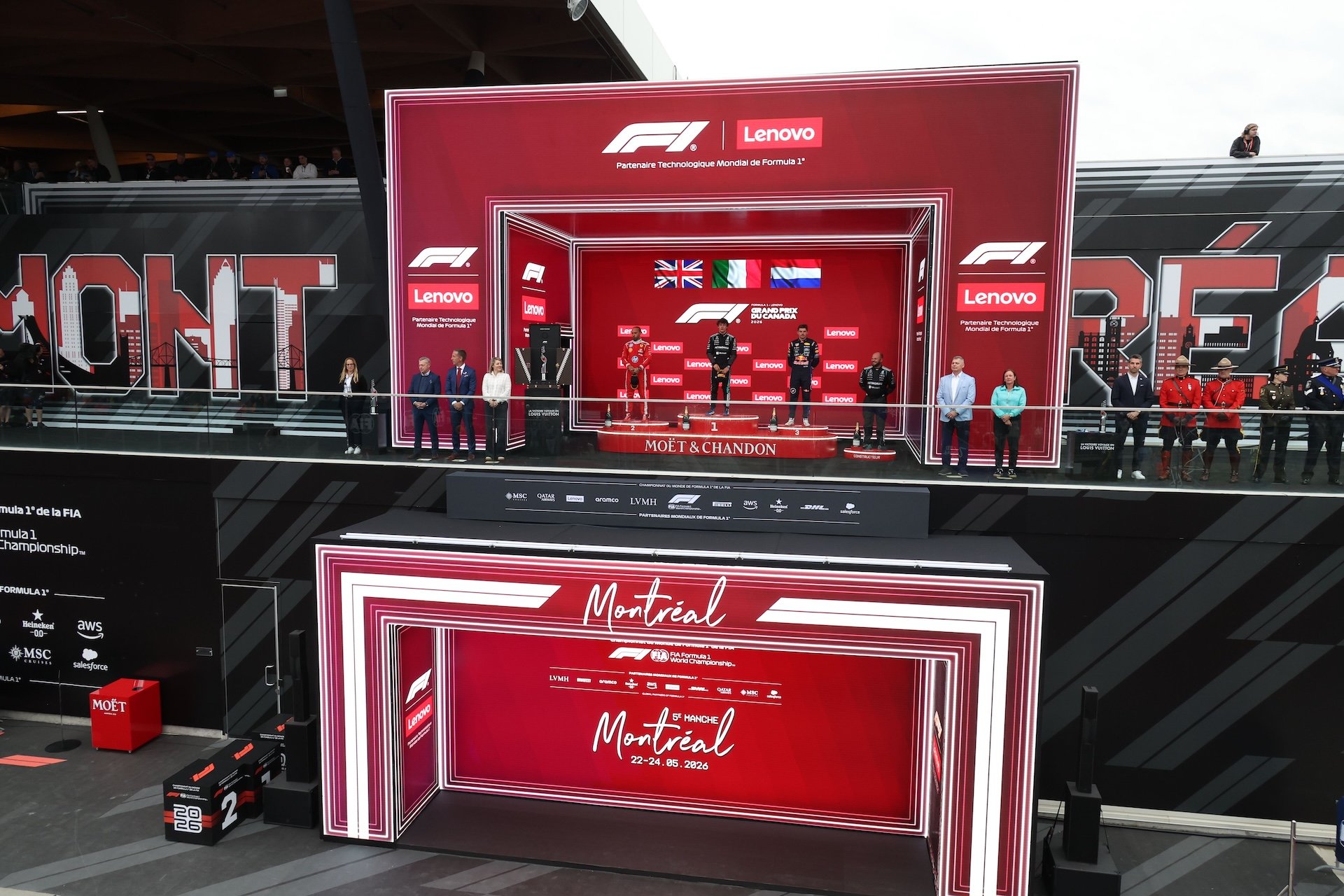
For most of its history, Formula 1 has been a global sport, primarily driven by its television broadcasts. While attending in person is important, the majority of fans first experience the allure of F1 through TV. This generates interest and fosters lifelong fandom. During my visit to the Canadian Grand Prix last month, I discovered that packaging one of the world’s most intricate, technologically advanced, and logistically complex sports for a global audience of 820 million is quite challenging. This is where Lenovo steps in.
Lenovo serves as the official technology partner of F1; however, in an era when there’s an “official chocolate of F1,” it’s easy to be skeptical of these partnerships. This skepticism was my initial impression until I learned how this tech firm contributes to the F1 spectacle for both fans and teams. Furthermore, after witnessing operations behind the scenes at their on-track Event Technical Center (ETC), I realized just how everyone, including myself (!), gains from these two major brands collaborating.
I witnessed a real-time, practical test of the tech infrastructure at the racetrack, involving the deployment of both the Safety Car and Medical Car to navigate the circuit while the teams responsible for broadcasting, Timing & Scoring, and in-car telemetry conducted simulations in preparation for the significant day. It was both fascinating and intense. Sadly, due to the confidential nature of the activities within the ETC, I wasn’t allowed to take any photos or videos, so the images you see were provided by Lenovo.
Infrastructure
Before any tests like the one I attended can be conducted, any TV broadcasts, and indeed any actual laps by F1 cars, Lenovo and F1 must implement a significant amount of tech infrastructure at each track. You might assume that, since many of these are permanent circuits, substantial infrastructure is already in place. However, F1 operates under such precise conditions that it requires exacting standards and uniformity, whether in Australia or Las Vegas, necessitating the transportation and installation of most sensors, wiring, TV cameras, and networking days before the Grand Prix.
Some of the outrageous statistics I learned pertained to the installation of sensors and wiring across the circuit. Have you ever wondered how the Race Director determines if a car jumped the start or even moved a millimeter when it should remain completely still as the lights go out? It’s not solely reliant on the car’s transponder or telemetry since those would need to be requested for review. There are sensors literally embedded a foot into the ground just beneath the grid brackets for each car. They are not visible on TV because the holes are filled with tarmac on top, but they exist.
Along with 32 miles of wiring, countless internet routers, lighting systems (for night races or safety scenarios), relay points, and HD TV cameras, I started grasping the magnitude of what must occur behind the scenes to ensure everything is ready for the first lap of Friday Practice.
Event Technical Center (Traveling)
I’m not a tech expert, but even I can appreciate the enormity of the ETC, which is the largest and most sophisticated traveling facility of its kind globally. It contains 750 pieces of equipment operating 40 custom software systems, mainly for broadcasting, timing, communication, scoring, and wirelessly transmitting large data sets with minimal lag. Over a race weekend, it processes 350,000 to 400,000 timing transponder passing events, produces 750 to 800 pages of official digital documents, and generates about 300 to 400 GB of data per track outing. In total, Lenovo asserts it processes approximately 8 terabytes of data each racing weekend, including broadcast and telemetry data, which is connected in real-time to the ETC’s central hub, the Media & Technology Center in the U.K. More on that shortly.
Entering the ETC felt quite impressive, akin to stepping into a blend of Dr. Evil’s lair, an airport control tower, and a government situation room. Security is stringent; access is restricted to select individuals. The interior is dimly lit to maintain cool temperatures amid all the servers and computers, with only the screens and small lights illuminating the space. There are multiple compartments, each separated by sliding doors, ensuring teams can have private areas within the roughly 80 feet by 50 feet ETC tent.
Most impressively, everything is completely packed up by Sunday night and shipped by Monday following the race, at the latest. To my surprise, while there are two outer structures (high-end circus-like tents) to allow travel before back-to-back races, there is only one ETC in terms of technology equipment, meaning F1’s shipping partner, DHL, must handle it with exceptional care as it travels globally.
Additional statistics: Lenovo’s virtualization platform offers the capability to operate 1.4 THz of computing power via 512 CPU Cores, 8.2 TB of RAM, and 100 TB of flash storage.
While the ETC plays a crucial role, the real magic unfolds at the M&TC in Biggin Hill, U.K. This brand-new, state-of-the-art production and technology facility handles tasks like remote racking and color correction for all broadcast cameras. It distributes the global TV feed to over 180 territories worldwide. Furthermore, it is pivotal in processing in-car telemetry data for teams to strategize and make informed decisions. Collectively, the ETC and M&TC transfer over 650 terabytes of data per event weekend, with bandwidth peaking at around 8.5 Gbps as an event commences.
The MT&C operates over 180 bespoke software systems composed of more than 4 million lines of code, 70 virtual machines delivering 1.7 THz of processing power across 640 CPU cores, 5.9 TB of RAM, and 105 TB of flash storage. Regarding transmission lag, Lenovo has succeeded in reducing data latency for F1 teams by as much as 0.3 seconds (as recorded at the most geographically distant races on the schedule), although they haven’t disclosed where that started.
Interesting fact: Because unforeseen issues arise occasionally, the ETC and MT&C can back each other up if something goes awry. When that happens—and it does—Lenovo and F1 manage to continue broadcasting worldwide seamlessly. To put it another way, even when problems occur, the audience remains oblivious.
Car-Team Telemetry
Each F1 vehicle is outfitted with over 300 sensors that generate an overwhelming amount of data. To offer concrete figures shared by Lenovo instead of vague terms, an F1 car produces 1.1 million data points every second that are shared simultaneously with the teams, F1, and the FIA. Whether it’s Mercedes strategizing on Antonelli’s tactics, or the stewards examining in-car data during a pit stop or yellow flag situation, these sensors wirelessly relay critical data to the relevant parties for necessary decision-making. Sometimes these decisions lead to race victories, while other times, as seen in Monaco, they result in penalties for speeding in the pit lane.
“With 22 cars on the grid, we’re receiving more telemetry data than ever. That’s why, at the start of the 2026 season, we chose to refine our processing of essential car information such as engine performance, suspension health, gearbox and fuel status, G-forces, and even the driver’s control actions,” explained Chris Roberts, Formula 1’s IT Director. “A 0.3-second difference might appear minor, yet it can decisively impact a sport where precision is measured in thousandths of a second.”
Even as a seasoned fan (and journalist), witnessing the behind-the-scenes operations that allow millions, including me, to enjoy F1 on the track, at home on TV, or on their devices—and not to mention teams at their headquarters—was truly remarkable.
It’s astonishing to appreciate the technology and individuals enabling all of this, and I hope that after this, you gain a better understanding as well.
Email the author at [email protected]
### Investigating the Mobile Broadcast Studio for Global F1 Races Each Weekend
The realm of Formula 1 (F1) racing encompasses more than just rapid cars and exhilarating competitions; it involves a detailed synchronization of technology, logistics, and media. Central to this operation is the mobile broadcast studio, an integral facility that guarantees fans across the globe can feel the thrill of F1 events in real-time. This article explores the complexities of mobile broadcast studios utilized during F1 weekends, focusing on their importance, technology, and the obstacles they encounter.
#### The Function of Mobile Broadcast Studios
Mobile broadcast studios act as the nerve centers for live television coverage of F1 events. These facilities house cutting-edge technology enabling broadcasters to capture, produce, and transmit high-quality video and audio feeds from the racetrack to audiences around the world. The primary aim is to deliver an immersive experience that draws fans closer to the action, no matter where they are.
#### Essential Elements of Mobile Broadcast Studios
1. **Production Trucks**: At the heart of the mobile broadcast studio is the production truck, which contains all necessary equipment for video switching, audio mixing, and live broadcasting. These trucks are equipped with high-definition cameras, graphic systems, and communication tools that facilitate smooth production.
2. **Camera Systems**: F1 events employ various camera angles to showcase the action from multiple viewpoints. This includes onboard cameras on cars, aerial drones, and fixed cameras positioned around the circuit. The production truck manages the integration of these feeds into the broadcast.
3. **Graphics and Data Integration**: F1 broadcasts are renowned for their rich graphical elements, including real-time statistics, driver details, and race analyses. Mobile broadcast studios utilize advanced graphics systems to overlay this information on the live feed, enhancing viewer engagement.
4. **Audio Equipment**: High-quality audio is crucial for capturing the race’s sounds, including engine roars, team communications, and commentary. Mobile studios are fitted with sophisticated audio mixing consoles and microphones to ensure clarity and depth in sound.
5. **Transmission Technology**: To provide live coverage, mobile broadcast studios rely on a range of transmission technologies, including satellite links, fiber optics, and 5G networks. These technologies guarantee that broadcast signals reach viewers swiftly and reliably.
#### Logistics and Obstacles
Establishing a mobile broadcast studio for an F1 event requires meticulous planning and synchronization. Each race weekend demands transporting the production truck and equipment to different locations across the globe, often under tight deadlines. Major challenges include:
– **Time Pressures**: The equipment setup and testing must be finalized within a limited timeframe, frequently just days before the race.
– **Weather Factors**: Outdoor broadcasts are vulnerable to climate fluctuations, potentially affecting equipment and transmission quality.
– **Technical Challenges**: Ensuring that all systems operate flawlessly during live broadcasts is paramount. Technical malfunctions can hinder the viewing experience and tarnish broadcasters’ reputations.
#### The Future of Mobile Broadcast Studios
As technology advances, mobile broadcast studios are expected to incorporate even more cutting-edge features. Innovations such as augmented reality (AR) and virtual reality (VR) are on the horizon, promising to further enhance viewer engagement. Moreover, enhancements in data analytics and artificial intelligence may facilitate more personalized viewing experiences, customizing content according to individual preferences.
#### Final Thoughts
Mobile broadcast studios are vital components of the Formula 1 racing experience, allowing fans to connect with the sport from anywhere in the world. Through advanced technology and meticulous organization, these studios ensure that every race weekend is a fantastic display of speed, strategy, and excitement. As F1’s popularity continues to expand, the role of mobile broadcast studios will become increasingly vital, paving the way for innovative broadcasting solutions in the future.