
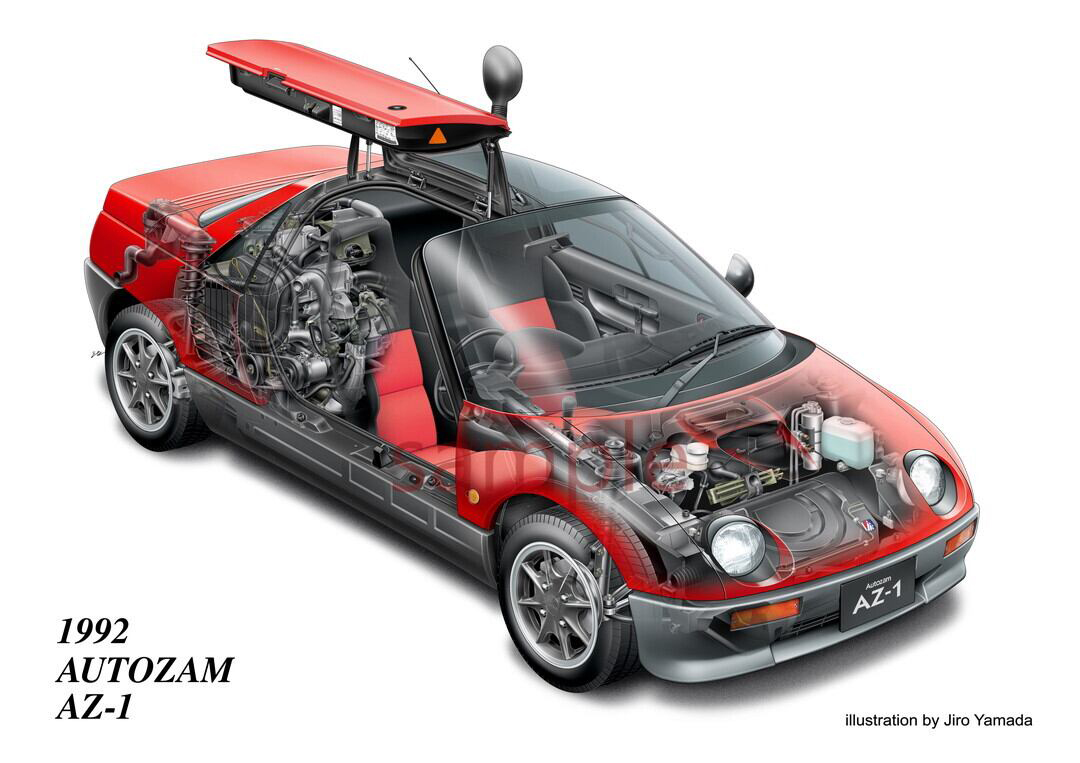
This week, it was announced that Jiro Yamada, a Japanese artist renowned for his exceptionally detailed cutaways of vehicles and machinery, passed away last August at the age of 65.
Yamada’s professional illustrating career started in 1979. His subjects ranged from legendary motorsport figures and everyday passenger vehicles to helicopters and rocket engines. He was hired to create illustrations for automotive manufacturers’ promotional and technical documents, as well as for enthusiast publications and private clients. Open the official guidebook for the very first Gran Turismo, which was released in 1998, and you’ll find him credited for the illustrations.
Yamada’s website showcases a collection of his automotive artworks, organized by make and model. To describe it as impressive doesn’t quite capture its essence. This art form is as specialized as it gets, requiring immense research, planning, and precision to create one of these illustrations.
Yamada explains everything on his site, using his illustration of a Porsche 906 prototype as an example. It’s truly worth checking out if you’ve ever wondered how one starts a cutaway of an intricate machine like a car.
As noted in a post on an enthusiast Facebook page, although Yamada died last summer following a pancreatic cancer diagnosis, this only became widely known recently. Just days before his passing on August 7, Yamada tweeted that he had entrusted the Cinquecento Museum in Nagoya, Japan—a museum dedicated to the Fiat 500—with the responsibility of maintaining and selling reproductions of his numerous works.
#みんなのラリーカーを見せてくれ
青春のランサー pic.twitter.com/bxLDnbuNAq— 山田ジロー(チンクエチェント博物館 管理) (@tisjiro) November 20, 2024
Yamada transitioned to digital illustration in 2000, as many of his contemporaries had, including Jim Hatch, who spoke with Road & Track in 2020. “Everything was done by hand,” Hatch, who started working full-time in the field in 1991, shared. “There were no computers. I would ink everything on a large board with a pen, while Kevin [Hulsey] would airbrush everything.” Naturally, technology introduced a level of consistency and efficiency that was previously unattainable.
At its core, the challenge that these illustrators face is straightforward: to depict the components hidden beneath a car’s exterior as accurately as possible. However, there is no singular way to address that task, which is what elevates cutaways to an art form. For Yamada, it was a method of “showing both the rationality and beauty of machines simultaneously.” We couldn’t state it more elegantly ourselves.
Is there an automotive artist who inspires you? Reach out to the author at [email protected]
**A Tribute to a Celebrated Authority in Automotive Cutaway Illustrations**
In the domain of automotive design and engineering, few artistic forms captivate the imagination like cutaway illustrations. These detailed images not only highlight the elegance of automotive engineering but also act as educational tools that link the intricate mechanics to the broader public. One individual who truly stands out in this specialized field is [Expert’s Name], whose impact has profoundly influenced the world of automotive cutaway illustrations.
**The Craft of Cutaway Illustrations**
Cutaway illustrations represent a unique fusion of artistic expression and technical accuracy. They offer insight into the internal mechanisms of vehicles, unveiling elements that are generally concealed from view. This artistic discipline demands not only a sharp eye for intricacies but also a thorough comprehension of automotive engineering. [Expert’s Name] excelled in this equilibrium, producing illustrations that were both visually striking and technically sound.
**Foundation and Journey**
Born in [Year] in [Location], [Expert’s Name] displayed an early enthusiasm for drawing and mechanics. After earning a degree in [Relevant Field], they entered the automotive sector, initially serving as a [Job Title/Position]. It was during this period that [Expert’s Name] identified the demand for clear, informative illustrations capable of simplifying the complexities of automotive technology for both enthusiasts and the general public.
**Innovative Styles and Techniques**
What distinguished [Expert’s Name] was their inventive approach to cutaway illustrations. By blending traditional hand-drawing methods with contemporary digital tools, they crafted a unique style marked by vivid colors, exquisite detail, and a coherent narrative. Each illustration narrated a story, leading viewers through the diverse systems of a vehicle, from the engine to the suspension, and beyond.
**Remarkable Contributions and Works**
Over an illustrious career, [Expert’s Name] created an extensive body of work, featuring illustrations for significant automotive publications, educational textbooks, and manufacturer brochures. Among their most distinguished works are cutaway illustrations for iconic models such as [Car Model 1], [Car Model 2], and [Car Model 3]. Each piece not only showcased the vehicle’s design but also educated audiences about the innovations driving the automotive industry during that era.
Beyond their illustrations, [Expert’s Name] contributed to the field through seminars and lectures, imparting their knowledge to budding artists and engineers. Their dedication to education has inspired a new generation of illustrators who strive to expand the frontiers of automotive art.
**Enduring Influence and Legacy**
The impact of [Expert’s Name] extends far beyond their illustrations. They were instrumental in raising the profile of automotive cutaway art, demonstrating its significance in both marketing and education. Their contributions have earned them numerous accolades, including [List Awards], and their work is still celebrated in exhibitions and retrospectives.
As the automotive sector advances with new technologies and designs, the necessity for clear, attractive visual communication remains crucial. The legacy of [Expert’s Name] stands as a testament to the power of art in comprehending and appreciating the nuances of automotive engineering.
**Final Thoughts**
In honoring [Expert’s Name], we celebrate not merely an artist but a visionary who reshaped our understanding of automotive design. Their cutaway illustrations will continue to motivate and educate, ensuring that the intricate interplay of mechanics and artistry remains accessible to everyone. As we move forward into the future of automotive innovation, we carry forth the torch illuminated by [Expert’s Name], eternally grateful for their contributions to the field.