
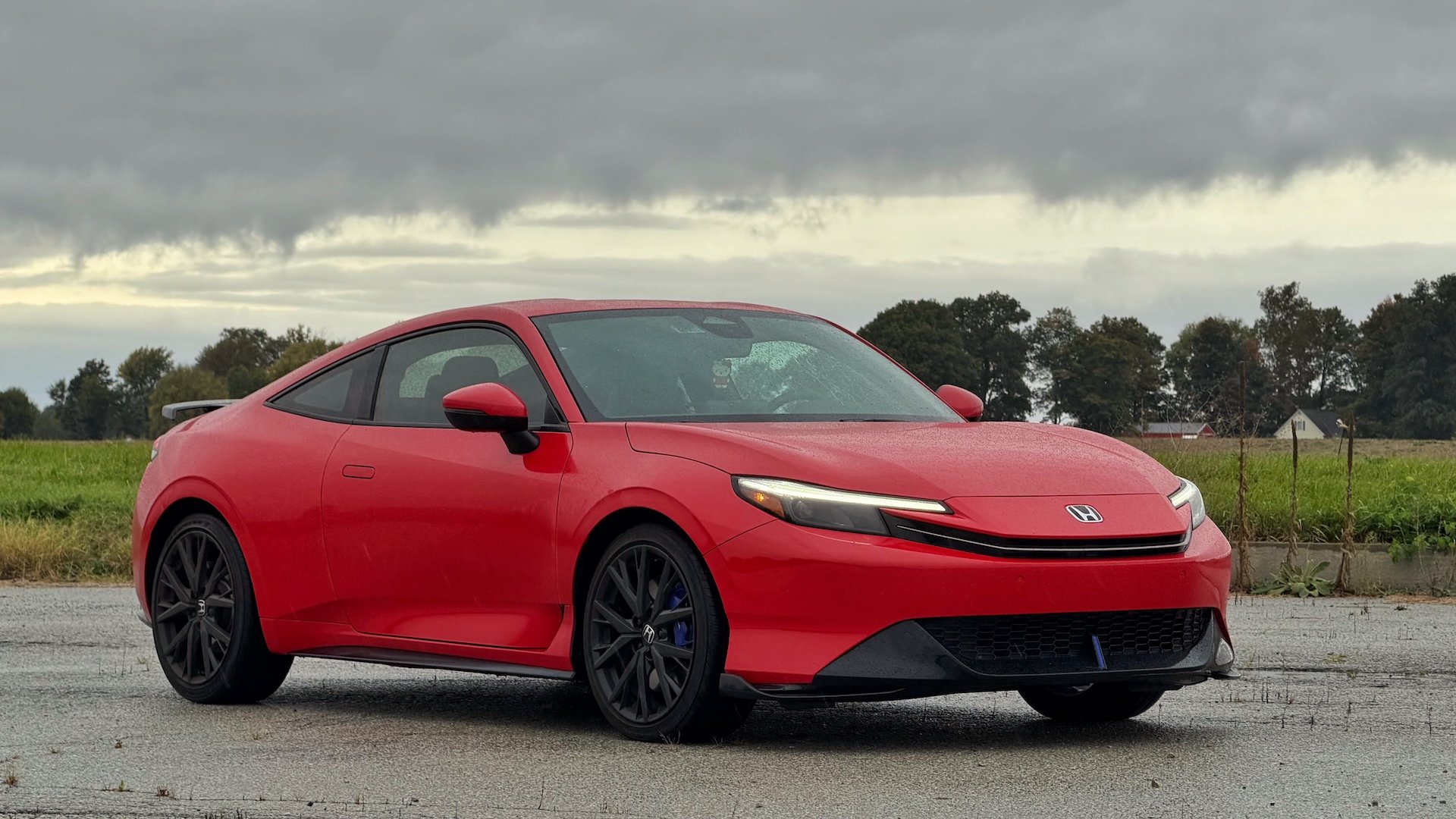
Honda Prelude long-term evaluator, prompting me to take the scenic route home after a morning gym or school trip. What aspect is this? Its maneuverability.
As previously noted in other posts about this Prelude, the car has some shortcomings, primarily related to design and value. I plan to explore these areas further down the line; however, I’ve also pointed out that in terms of driving enjoyment and performance, this vehicle truly excels.
Most automotive enthusiasts will concur that a car’s dynamics are more crucial to overall enjoyment than its horsepower. They will agree that driving a slower car at higher speeds offers significantly more thrill than driving a fast car at lower speeds, and additionally, they’ll acknowledge that more power doesn’t necessarily equate to better performance. Yet, when a sporty coupe like the Prelude enters the market with 200 hp, vigorous hybrid torque, and handling acumen on par with top hot-hatches, those same enthusiasts disparage it—99% of them without ever having seen one, and nearly all of them without ever having taken it for a spin.
This week, I took extra effort during my morning errands to understand how the Prelude performs under less-than-ideal conditions, and it has been quite enjoyable. My tester is fitted with standard Goodyear Eagle Touring all-season tires, not the optional Continental ExtremeContact Sport 02 summer tires (which I plan to install next Spring), so there’s ample grip even at 48 degrees with a light rain. However, invoking that hybrid torque mid-corner allows you to easily slip into a controlled front-wheel drift that the suspension, chassis, and electronic systems will enable you to manage excellently without the car losing its composure.
While my area of Indiana lacks exhilarating roads, we do have plenty of rural roads, and, due to rapid suburban growth, numerous wide, two-lane roundabouts in isolated areas (for now). With the Prelude, I explored a few of them with both traction control engaged and disengaged to observe its responses. Regardless, it felt anchored and never strayed from its path; the only difference lay in how actively I had to work the steering wheel to maintain that connection.
Late braking into corners is seamless thanks to the OEM Brembo brakes, which provide strong initial bite and ample pedal feedback. When I begin to steer into the roundabout, the car feels stable and follows my commands precisely. Even with traction control active, there’s enough grip to nearly floor the accelerator upon exiting the corner with minimal fuss, perhaps just a brief flash of the traction control light on the dashboard. If you repeat the same maneuver but jab the throttle during the turn-in (as you might to encourage the rear of a RWD car to slide), the car still allows for a controlled spin of the front tires that you can sustain with appropriate steering input and throttle.
Do the same with traction control off and S+ Shift engaged, and things liven up considerably. Approach and braking feel similar, but forcing a downshift into first or second gear will cause the front end to try to push wide into the corner. Jabbing the throttle before that happens will correct the course while quickly spinning up the tires thanks to the surge of hybrid torque (40 lb-ft more than the Si), and you can easily complete a lap of the roundabout with the front tires spinning in a long, controlled arc—or at least I imagine I could, because of course I would never do this on an empty public road in the countryside.
With the stability systems disabled, I had to maneuver the wheel quickly and accurately to keep the vehicle tight on a sharp circle; otherwise, it would start to push outward. It seems the rear might break loose and widen its angle if I increased speed, but I wasn’t inclined to explore that with solid, tall concrete barriers on the outer edge.
Pair this with the somewhat cheesy, artificial (but very realistic-sounding) engine noises emanating from the speakers, and the Prelude makes you feel like a champion, whether traversing a minor roundabout or a winding country lane. As I’ve stated previously, the car is incredibly capable and well-connected in dry conditions, but now that I’ve had the opportunity to enjoy it in wet, rainy scenarios, it’s impressive how much grip it can provide. Most importantly, it doesn’t take itself too seriously. It’s just as enjoyable to drive as an economical Fit or a luxurious S2000; it doesn’t have to be a stiff coupe simply because it boasts a sophisticated hybrid drivetrain. It possesses character.
Next on the agenda is winter, which brings snow. We’ll see how that unfolds.
Previous Installments
Contact the author at [email protected]
**Investigating the Honda Prelude’s Performance in Wet Conditions: Insights for Doubters**
The Honda Prelude, a sports coupe produced from 1978 to 2001, has earned a reputation for its performance, handling, and durability. Nonetheless, skeptics frequently challenge its effectiveness in adverse weather conditions, especially rain. This article examines the Prelude’s performance in rainy settings, highlighting its design, handling traits, and driving dynamics to provide insights for those hesitant about its abilities.
**1. Design and Engineering**
The Honda Prelude was crafted with performance and driver involvement in mind. Its low center of gravity and well-balanced chassis augment stability, which is essential for navigating slick roads. The Prelude’s aerodynamic design aids in reducing lift, boosting grip and control during poor weather.
**2. All-Wheel Drive and Traction Control**
Certain iterations of the Prelude, notably those with the Honda ATTS (Active Torque Transfer System), provide enhanced traction performance. This system distributes power between the front wheels, enhancing grip during wet conditions. Although it isn’t an all-wheel-drive vehicle, the ATTS technology provides better handling and stability, addressing some concerns that skeptics may harbor regarding wet traction.
**3. Tire Selection and Maintenance**
Tires significantly impact a vehicle’s performance in wet weather. The Honda Prelude, akin to any sports vehicle, greatly benefits from high-quality tires suited for rainy conditions. Adequate tire care, encompassing tread depth and inflation, is critical for peak performance. Drivers who prioritize high-grade all-season or performance tires with excellent wet traction can considerably enhance the Prelude’s handling in rain.
**4. Handling Characteristics**
The Prelude is famed for its responsive steering and nimble handling. In rainy circumstances, this responsiveness can be both beneficial and challenging. While the car is capable of precise cornering, drivers need to remain vigilant, as abrupt actions can result in lost traction. Knowing the vehicle’s limits and adopting smooth driving practices can help reduce risks associated with wet conditions.
**5. Driver Experience and Skill**
In the end, the driver’s expertise and proficiency are vital to the Prelude’s performance in rainy scenarios. A knowledgeable driver who understands how to manage throttle inputs, braking, and steering can fully leverage the Prelude’s potential. Employing defensive driving strategies, such as maintaining a safe distance and avoiding sudden maneuvers, is crucial for safe driving in rain.
**6. Real-World Performance**
Numerous accounts from Honda Prelude owners underscore the vehicle’s capability to effectively manage rainy conditions. Many drivers observe that, when equipped with the right tires and driven cautiously, the Prelude performs commendably in wet weather. Its well-balanced chassis and agile handling instill a sense of confidence, enabling drivers to navigate rain-soaked roads without excessive concern.
**Conclusion**
While skeptics may doubt the Honda Prelude’s performance in wet conditions, a thorough analysis indicates that it is a competent vehicle when driven judiciously. With its thoughtful design, advanced traction systems, and the significance of tire choice and driver expertise, the Prelude can adeptly handle wet roads. For those contemplating the Prelude, understanding these aspects can help alleviate doubts and improve the driving experience, even in challenging weather.
 admin