
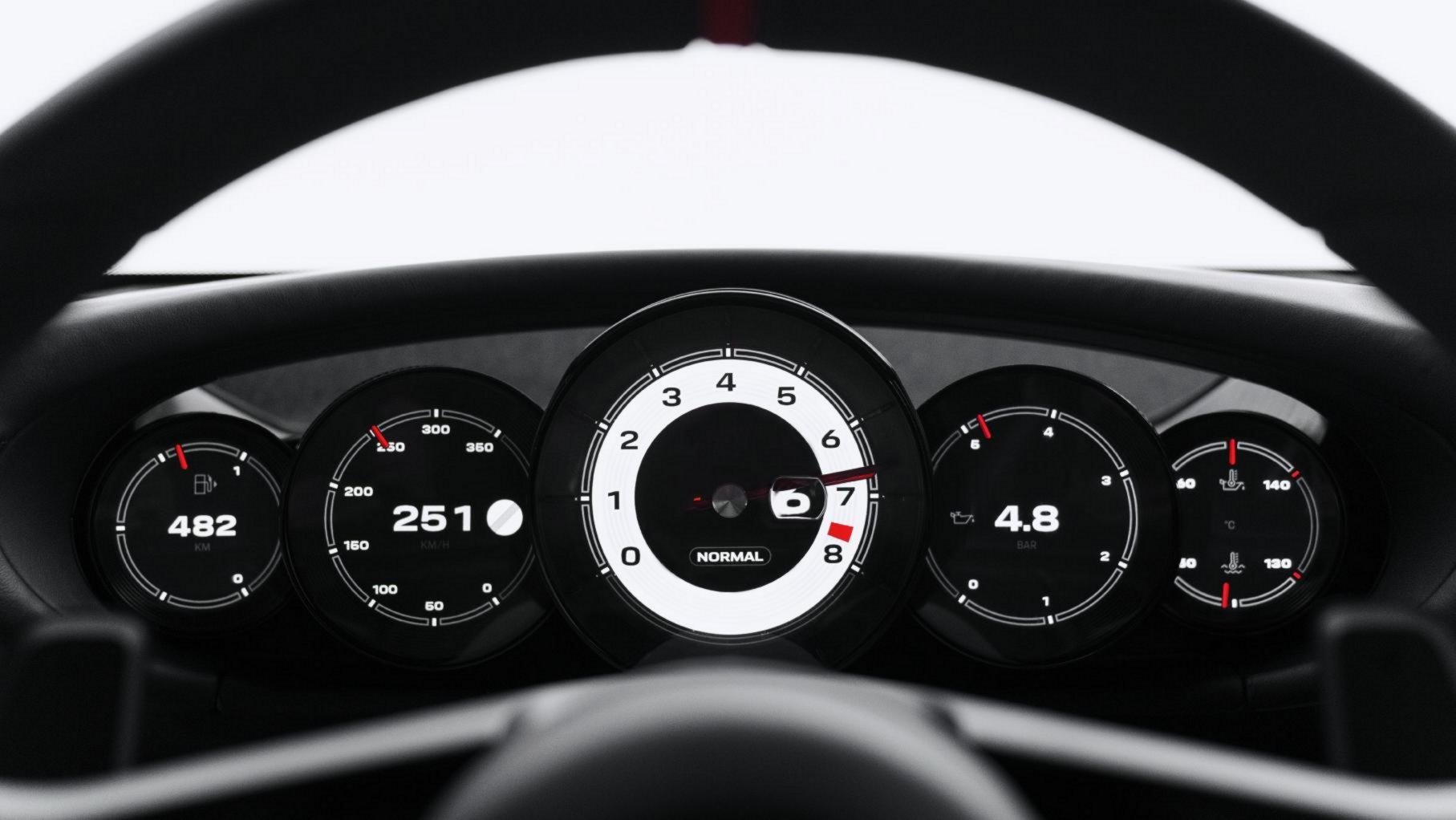
Porsche’s latest Mission S concept—foreshadowing its future leading mid-engine supercar—lacks a built-in infotainment screen. It doesn’t even feature a completely digital rev counter; instead, it incorporates a physical needle across a circular display.
If you’re in search of that kind of instrument cluster in any current Porsche models, you won’t find one. This is entirely novel, aligning with a trend initiated by the lavish Bugatti Tourbillon, characterized by its timepiece-inspired dials, as well as the debated Ferrari Luce.
Regardless of your opinions on the Luce’s exterior, its interior combines technology and tradition thoughtfully in a manner few vehicles achieve, mirroring Porsche’s vision with the Mission S. The brand discusses the “symbiosis of analogue and digital controls,” with the five distinct circular gauges epitomizing this concept.
The central gauge—a tachometer—features that analog needle, but a small section of the glass over it is enlarged to amplify the gear readout, adding a cleverly retro touch. Depending on the driving mode, the tach will extend toward the driver, distinguishing itself from the surrounding gauges.
Creating hybrid gauges like this is more complex than it appears. The quality of the screen is vital; the display should be OLED for optimal black without light bleed. (Porsche hasn’t specified the panel technology they’ve employed, but it’s reasonable to assume it’s OLED.) This topic arose during my conversation with Jean, the owner of Usual Suspects Garage, which specializes in German performance cars. He is working on a plug-and-play digital gauge kit for E28 5 Series and E30 3 Series sedans, and he emphasized that display selection has been crucial to that venture.
Is this a trend that could filter down to more accessible models? Possibly. Instrument clusters transitioned partially digital before becoming fully digital initially. As screens became less expensive than physical hardware, the business rationale shifted.
This is precisely why Mate Rimac argues that the supercar sector has entered its “Swiss watch phase,” where analog craftsmanship, rather than cutting-edge software and digital user experience, has become the prevailing philosophy. This sentiment is echoed in the concept sport sedan recently unveiled by Alfa Romeo, which includes a central screen that disappears beneath a stylish, mirrored, angled center console when idle.
The Mission S even lacks that feature. Personally, I believe it may be a bit much to expect purchasers of what is likely to be a minimum half-million-dollar vehicle to place their smartphones on the dashboard each time they enter the car; surely a sensibly sized, compact screen for critical information would be practical. Yet, Porsche is making a bold statement here, one that enthusiasts have been eager to hear.
Have a tip? Contact [email protected]
**The Porsche Mission S: A Fusion of Luxury and Analog Innovation with a Tachometer**
Amidst a landscape filled with digital displays and interfaces, the Porsche Mission S distinguishes itself by featuring a distinct characteristic: an analog tachometer. This choice not only elevates the car’s aesthetic allure but also resonates with a mounting trend towards a digital detox in premium automotive experiences.
**A Harmonious Blend of Heritage and Modernity**
The Porsche Mission S, an all-electric sports model, symbolizes the brand’s commitment to innovation while respecting its rich legacy. By incorporating an analog tachometer, Porsche honors traditional automotive aesthetics, appealing to aficionados who value the tactile and visual feedback from classic instrumentation. This feature acts as a reminder of the fundamental driving experience, emphasizing the bond between the driver and the vehicle.
**The Analog Tachometer: An Icon of Opulence**
In luxury automobiles, the selection of materials and design features significantly shapes the overall experience. The analog tachometer in the Mission S is meticulously crafted, utilizing premium materials that embody Porsche’s commitment to quality. This tactile component stands in stark contrast to the digital interfaces seen in numerous contemporary vehicles, providing a nostalgic and genuine feel that captivates discerning motorists.
**Encouraging Mindfulness in Driving**
The digital detox concept is gaining popularity as individuals seek to extricate themselves from the incessant stream of notifications and screens. The analog tachometer in the Mission S promotes a more immersive driving experience. By reducing dependence on digital displays, Porsche encourages a more mindful approach to driving, enabling enthusiasts to concentrate on the road and the exhilaration of speed and performance.
**Elevated Driving Enjoyment**
The analog tachometer serves not only as a design feature but also enhances the driving experience itself. It offers immediate, intuitive feedback regarding engine performance, allowing drivers to monitor their speed and revs without the distractions typically linked to digital interfaces. This immediacy can heighten the excitement of driving, transforming it into a more engaged experience.
**Luxury and Sustainability**
As an electric vehicle, the Porsche Mission S exemplifies sustainability while maintaining luxury. The addition of an analog tachometer complements the vehicle’s eco-friendly design by minimizing reliance on intricate digital systems, which often consume extra energy. This thoughtful approach aligns with the values of eco-conscious consumers who seek opulence with a reduced environmental footprint.
**Final Thoughts**
The Porsche Mission S, featuring its analog tachometer, signifies a seamless blend of tradition and contemporary innovation. By embracing the idea of digital detox, Porsche not only enhances the luxury driving experience but also reinforces its dedication to craftsmanship and sustainability. In a technology-driven world, the Mission S encourages drivers to reconnect with the pure pleasure of driving, making it an outstanding choice for those desiring both performance and a deliberate automotive experience.
 admin