
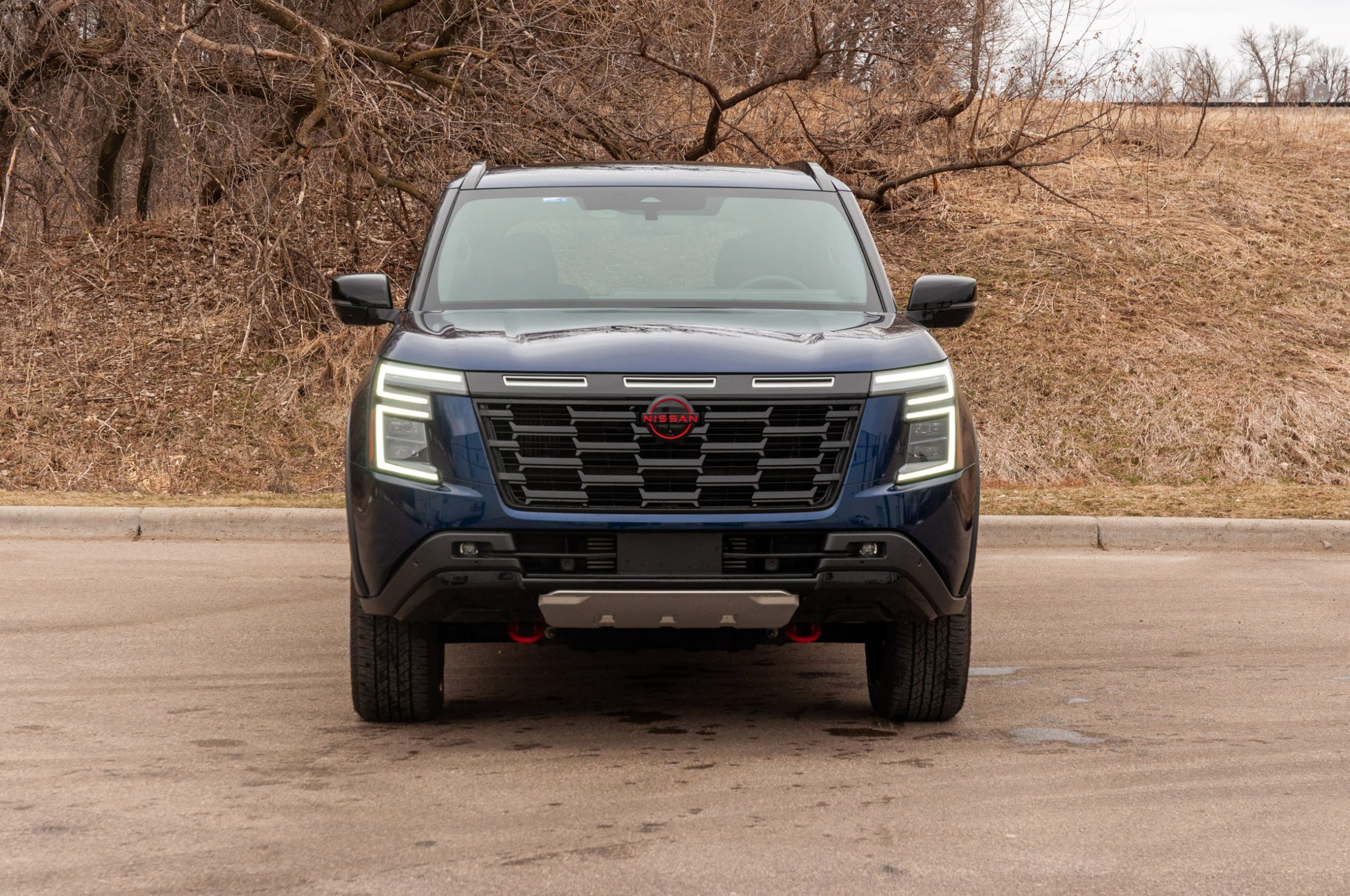
- Nissan Armada rises to the occasion. The 2026 Armada Pro-4X fills the void left by the Toyota Land Cruiser with remarkable off-road prowess.
- Impressive power and aesthetics. Comes equipped with a twin-turbo V6, upgraded interior, and off-road styling features.
- Family-oriented yet compact in its class. Provides improved access to the third row but offers less space than larger rivals.
- Attractive pricing. Priced at $81,675, it is more affordable than the departing Land Cruiser.
Summary: The 2026 Nissan Armada Pro-4X presents an appealing off-road choice for enthusiasts, bridging the gap left by the authentic Land Cruiser with style and performance.
AI assisted, editor verified
Nissan has introduced a model that takes the place of the Toyota Land Cruiser. Did you foresee that? I’ll confess: I didn’t.
The 2026 Nissan Armada Pro-4X is a full-sized, three-row, body-on-frame SUV fitted with a twin-turbo V-6 engine and an off-road package that offers the majority of off-road capabilities you’ll ever require. It’s underrated and, frankly, being overlooked.
After spending a week with the Pro-4X, I was surprised that Nissan’s succeeded where Toyota faltered. Strip that away, and the true winners here are off-road aficionados. However, families might find better options elsewhere.
The Fundamentals
The 2026 Armada makes its long-awaited return, now with a new performance-focused Nismo version as well. It is said to draw inspiration from the GT-R. The Armada kicked off its third generation for 2025, transitioning from a naturally aspirated V8 engine to a twin-turbo V6, alongside a more modern interior. Aside from the Nismo variant, it debuted for 2026 with little fanfare for its second year.
The exterior of the Armada stands apart from all competitors. It has a notably shorter stature than a Chevy Tahoe or Ford Expedition. The upright square shape features tall windows, short overhangs, and an appearance that clearly suggests it was made for off-road use. The fog lights are even placed higher to avoid potential damage. The front end isn’t excessively tall or aggressive, and it doesn’t seem like it’s compensating for anything. It simply looks like an SUV. I appreciate the nostalgic triple-slot design that references the original hardbody-based Pathfinder. The orange accents, such as the tow hooks, stripe on the D-pillar, and badging, add a touch of flair without shouting “notice me, I’m the off-road version!”
On the inside, the low dashboard allows for excellent forward visibility, with the tall glass in the cabin enhancing that sensation throughout. It features two 14.3-inch displays: one acts as the digital gauge cluster while the other serves as the touchscreen infotainment system, covered by a single glass panel. These displays are complemented by real buttons, knobs, and toggles. I enjoy a good toggle, and the climate control system has three of them. The pushbutton gear selector worked well for me here, as each button operates similarly, unlike the last GMC Yukon with its complicated push-and-pull setup.
All three rows of seating are upholstered in leather, with the first two featuring quilted orange stitching and orange stripes. All four doors boast soft-touch materials and stitching. The padding on the front center console is thin along the edges, and my elbow sank through to hard plastic in areas along the front edge. The second-row captain’s chairs offer the same tilt-and-slide capability as the Pathfinder, allowing car seats installed with LATCH to remain in place for third-row access. A feature the Tahoe lacks, by the way. However, the Armada’s third row is notably smaller than those in larger Tahoe, Expedition, and Jeep Grand Wagoneer models. Cargo space in the back is also limited regardless of the third-row position. To make matters worse, the design of the independent rear suspension means the fold-flat third row isn’t perfectly flat. When down, the floor angles towards the rear of the Armada, which can be amusing when soccer balls roll out from the back.
I appreciated the small cubby of underfloor storage in the cargo area, which is just right for towing equipment.
Experience the 2026 Nissan Armada Pro-4X
Each Armada comes equipped with a 3.5-liter twin-turbocharged V6 producing 425 horsepower and 516 lb-ft of torque, except in the Nismo, which boosts output to 460 hp. A nine-speed automatic transmission distributes power to the rear wheels, while four-wheel drive with a two-speed transfer case is standard on the Pro-4X. Included are a locking rear differential, air suspension system, and a triple skid plate configuration to protect the fuel tank, oil pan, and engine. The substantial vehicle rides on 20-inch wheels shod with Yokohama Geolander All-Terrain tires.
Both in the city and on highways, the Armada offers ample power, and the turbo-six doesn’t whine like the turbocharged V6 in the Lexus LX. There’s a solid character to this V6 engine that gives it a truck-like feel, though it won’t fool anyone into thinking it has the deep rumble of a V8. Those days have come to an end.
The nine-speed automatic transmission performs admirably and has little to critique, but I prefer the quicker, sharper shifts of Toyota’s 10-speed automatic found in the Sequoia.
The suspension feels soft and easily absorbs the rough Midwest pavement. There’s noticeable body roll when cornering on the all-terrain tires and air suspension.
The two-speed transfer case engages quickly and showcases a pleasantly nostalgic Nissan 4Lo icon in the digital gauge cluster. A total throwback I thoroughly enjoy. The rear electronic locking differential icon brings similar satisfaction.
The black running boards standard on the off-road Pro-4X trim seem amusingly out of place. It’s hard to envision they wouldn’t sustain damage during adventures, but they are family-friendly.
In urban environments, the Armada’s more compact size compared to the Tahoe, Expedition, and Grand Wagoneer shines through. Especially in grocery store parking lots. It’s easier to navigate, easier to park, and requires far fewer three-point turns.
It’s noteworthy that EPA fuel economy ratings for the turbocharged V6 are 15 mpg city, 18 highway, and 16 combined. Over 375 miles of varied suburban driving, the Armada averaged 15.9 mpg. These EPA figures are accurate, not exceptional, but significantly better than the previous V8. It’s also roughly on par with what the competition offers, whether equipped with a turbocharged V6 or a V8.
Rapid Conclusion
At $61,030, inclusive of a sizeable $2,190 destination fee, the 2026 Nissan Armada distinguishes itself from its lengthier and more spacious competitors while maintaining all the technology and amenities consumers desire. It also provides more family-friendly access to the third row than its competitors. However, most importantly for buyers, the off-road Pro-4X model affords genuine capability that its rivals lack once the pavement ends.
At $81,675 as tested, it isn’t cheap, but that’s marginally less than the previous Land Cruiser 200 Series, and the U.S. market won’t see the 300 Series except under the Lexus brand.
Nissan has given us what feels like, or is as close to, a genuine Toyota Land Cruiser—not merely a Prado with a different badge—and enthusiasts may just be overlooking an excellent off-road vehicle.
Nissan provided The Drive with a week-long loan of this vehicle to facilitate this review.
2026 Nissan Armada Pro-4X Specifications
| Base Price (Pro-4X) | $61,030 ($81,675) |
| Powertrain | 3.5-liter twin-turbo V6 | nine-speed automatic | four-wheel drive |
| Horsepower | 425 @ 5,600 rpm |
| Torque | 516 lb-ft @ 3,600 rpm |
| Seating Capacity | 7 or 8 |
| Curb Weight | 6,093 pounds |
| Towing Capacity | 8,500 pounds |
| Cargo Volume | 20.4 cubic feet behind third row | 56.3 cubic feet behind second row | 97.1 cubic feet behind first row |
| Ground Clearance | 9.6 to 11.6 inches |
| Off-Road Angles | 30-33° approach | 21.5-24.5° breakover | 22-22.5° departure |
| EPA Fuel Economy | 15 mpg city | 18 highway | 16 combined |
| Score | 8.5/10 |
Brief Overview
The 2026 Nissan Armada Pro-4X may not suit everyone seeking a full-size, three-row SUV, but for off-road enthusiasts, it fills the gap Toyota vacated.