
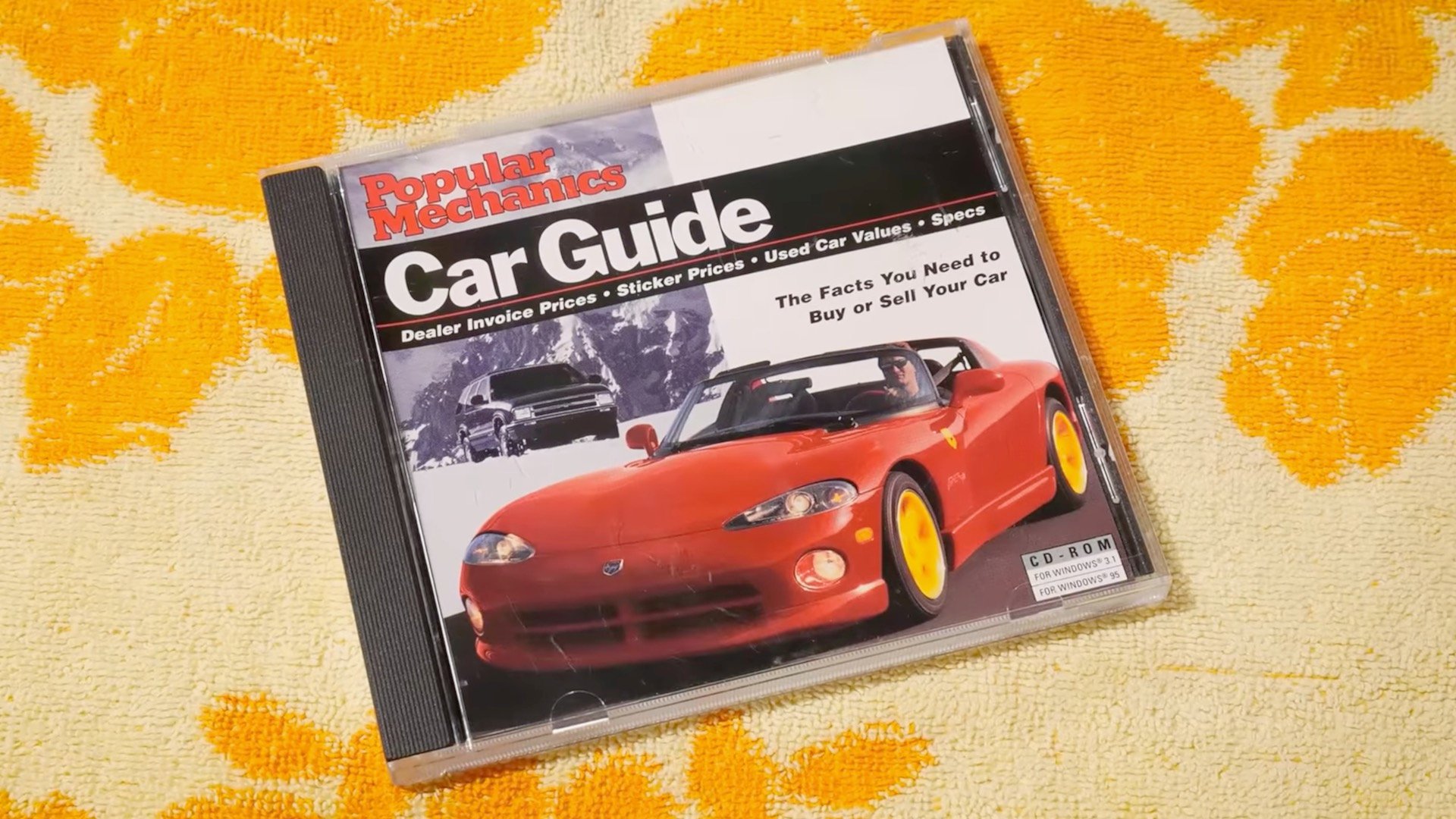
One of the numerous areas where the internet has not fulfilled its potential is in online car shopping. True, you can skip the dealership visits or mail away for physical pamphlets, but online car purchasing guides often prioritize attracting clicks to advertisements rather than providing genuine information. The same can be said for automaker configurators, where specifications may be concealed (or completely absent) and the visuals don’t quite showcase the latest technologies. There is a superior alternative, and one publication discovered this solution 30 years ago.
In 1996, Popular Mechanics launched a “Car Guide” on CD-ROM that allowed individuals to browse all new cars for sale without needing the internet. As detailed in a recent YouTube video by LGR Blerbs, it highlights how much progress has been reversed. Its cover features a Viper with yellow wheels.
After you navigate past the primary menu with its clever startup animation, a dropdown menu appears, listing not only each model but all its trim levels. Each trim level comes with its own landing page featuring key details such as pricing (including destination fees), powertrain information, fuel economy stats, and the availability of specific features like cruise control and airbags for the driver and front passenger. The requirement for dual front airbags on light trucks (which encompassed most SUVs and pickups at that time) wasn’t enforced until the 1998 model year, and central locking and air conditioning were not standard features then.
You could additionally browse and price the entire list of options and view a vehicle in its offered paint colors—and even some not available. I’m fairly certain that the 1996 Pontiac Sunfire didn’t come factory-equipped with a full-body woodgrain wrap, but you can find it here. On a more practical note, you could compare specs and features among various models and calculate fuel expenses by entering anticipated weekly mileage and gas prices. The default of $1.25 per gallon is quite upsetting.
1996 Popular Mechanics Car Guide CD-ROM for Windows 3.1
There is also a section for used cars, albeit with fewer models and less information available for those listed. However, it still provides value estimates based on mileage, similar to today’s used car platforms. Whether a dealer would agree with those estimates is another story.
This car-buying CD might seem amusingly outdated, but despite slow loading times and simple graphics, it surpasses many contemporary online buying guides and configurators. All the data is sensibly arranged, without interruptions urging you to reach out to a dealer or complete a survey. The current internet has not surpassed this early attempt since, as it turns out, easy information access does not equate to a viable business model.
**1996 ‘Car Guide’ CD: A Resource for Constructing and Pricing Cars Offline**
In the mid-1990s, the automotive sector was experiencing major shifts, with technology starting to assume a more significant role in the car purchasing and construction process. A standout innovation from this period was the introduction of the 1996 ‘Car Guide’ CD, a thorough offline resource aimed at aiding consumers in building and pricing vehicles.
**Summary of the 1996 ‘Car Guide’ CD**
The 1996 ‘Car Guide’ CD was an innovative tool that supplied users with in-depth information regarding assorted car models available that year. It featured specifications, characteristics, and pricing data for a diverse array of vehicles from various manufacturers. The CD format allowed users to retrieve this information without needing an internet connection, making it especially beneficial at a time when online resources were scarce.
**Attributes of the Car Guide**
1. **Car Specifications**: The CD included comprehensive data on engine types, horsepower, fuel efficiency, dimensions, and other technical specifications for every model. This information assisted consumers in making informed choices based on their individual needs and preferences.
2. **Cost Information**: Users could access the MSRP (Manufacturer’s Suggested Retail Price) for each vehicle, alongside optional features and packages that could affect the final price. This aspect was particularly valuable for budgeting and comprehending the cost implications of various configurations.
3. **Comparison Features**: The guide allowed users to view different models side by side, emphasizing distinctions in features, performance, and pricing. This feature was vital for consumers seeking to assess multiple options prior to committing to a purchase.
4. **User-Friendly Design**: Crafted with user access in mind, the CD sported a straightforward interface that facilitated easy navigation through the assorted sections. This was essential for users who may not have been technologically inclined.
5. **Offline Usability**: A primary benefit of the CD format was that it could be utilized without internet access. This was particularly advantageous for users residing in areas with limited internet services or for those who preferred to explore information at their convenience without the interruptions of browsing online.
**Influence on Car Purchases**
The 1996 ‘Car Guide’ CD marked a pivotal advancement in the car buying experience. By offering detailed information in an easily navigable format, it empowered consumers to take control of their car buying decisions. The capacity to build and price automobiles offline enabled users to thoroughly investigate their options before visiting dealerships, ultimately resulting in more informed and confident purchase choices.
**Heritage and Development**
Although the 1996 ‘Car Guide’ CD was a groundbreaking resource for its era, technological advancements have since reshaped how consumers research and acquire vehicles. The growth of the internet and mobile applications has facilitated more dynamic and interactive car-buying tools, comprising online configurators and real-time pricing insights. Nonetheless, the foundational principles established by the ‘Car Guide’ CD still influence contemporary automotive resources.
In conclusion, the 1996 ‘Car Guide’ CD was an innovative instrument that significantly impacted the automotive scene of the 1990s. By providing extensive information on vehicle specifications and pricing, it empowered consumers and paved the way for the digital evolution of the car buying experience.