
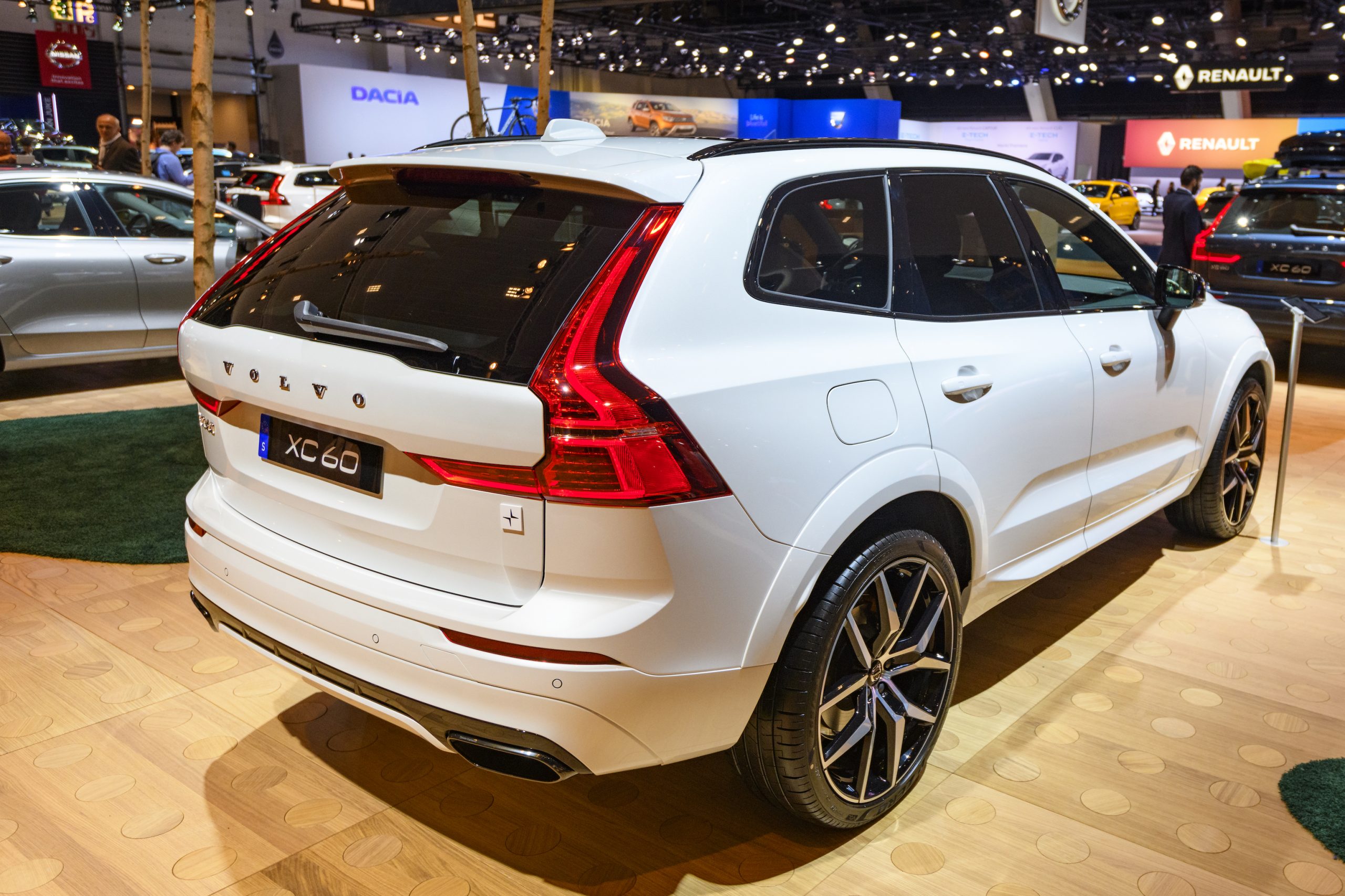
The Bowers & Wilkins Premium Sound system found in the 2026 Volvo V60 Cross Country Ultra is the finest original equipment manufacturer (OEM) car audio I’ve encountered. It fills the cabin with a sound that is both booming and crystal clear—even when limited by a Bluetooth streaming connection. Volvo’s B&W systems are renowned for their ability to replicate the acoustics of specific music venues, and naturally, you can adjust the equalizer settings yourself if you wish. Additionally, the system features adjustable “envelopment” and “intensity,” elements you typically don’t find in sound settings menus. The Volvo team took the time to clarify what those terms mean and how they function within the context of car audio.
By opting for a V60 CC Plus ($54,000 base price), you can elevate your ride with a 14-speaker, 600-watt Harman Kardon Premium Sound System for an extra $800. If you decide on a V60 CC Ultra (which starts at $5,300 more), you gain that H/K system along with a four-zone climate control and an elegant Orrefors crystal shift knob. From there, you can invest an additional $3,200 in the 15-speaker 1,410-watt Bowers & Wilkins Premium Sound option that we had the chance to test.
As a casual music enthusiast, I genuinely believe the high-end B&W system is a worthwhile investment. Especially since adding three grand to a $60,000 vehicle has minimal impact on your monthly payment. As Volvo’s presentation states: “To achieve extremely low and undistorted bass frequencies, an air-ventilated subwoofer employs cutting-edge technology that enables it to move large volumes of air—without intruding on cargo space.”
I’ve been fortunate enough to experience numerous OEM car audio systems. This Volvo’s B&W setup impresses me primarily due to its ability to deliver music at high volumes without sacrificing richness or clarity—everything from the adrenaline-pumping vocals of “No More Tears” to the comically quirky computer-generated Viking ballads that I’ve been jamming to all winter—sounded clearer and more powerful to me than in any other vehicle.
True audiophiles often regard car stereos as a lost cause, due to the unavoidable environmental sounds of wind and tire noise. However, to me, a car is one of the most enjoyable settings to immerse oneself in music, whether it’s classic Ozzy Osbourne or guilty-pleasure parody tracks. It’s simply fun to crank up the volume and lose some brain cells in the comfort of your car’s cabin on the way to your destination. In reality, the term “stereo” is commonly used—much more occurs than just two speakers.
Two words I believe capture the essence of the Volvo B&W’s sound remarkably well are “intense” and “enveloping.” I’m sure you grasp their meanings, but in relation to this B&W audio system, some specific science informs their precise definition.
Aside from bass, treble, midrange, and other modifications you can make to Volvo’s B&W system, within the Surround mode menu specifically, there are sliders for Intensity and Envelopment. As I experimented with these while enjoying various music genres, I discovered they were aptly named. Adding Envelopment indeed seemed to create a deeper sensation of being immersed in a track.
This led me to wonder, how is such a thing quantified within the audio system’s brain? How does the car empirically adjust to enhance or reduce the somewhat abstract concepts of intensity and envelopment without physically moving the speakers?
I posed that question to a contact at Volvo, who forwarded it to George Fryer, Automotive Engineering Manager, Bowers & Wilkins, and Jonatan Ewald, Attribute Leader, Audio Performance, Volvo Cars. These gentlemen graciously shared their insights, which I will relay to you here (slightly modified for punctuation and formatting):
Explaining the Volvo Bowers & Wilkins Surround Mode
George Fryer, B&W: “This mode utilizes QuantumLogic Surround, a technology that transforms stereo input into a multi-channel experience. Through proprietary processing, the system discerns and isolates spatial cues within the recording, which are then redistributed across the vehicle’s speaker array. This reconstruction is complemented by vehicle-specific tuning to provide an immersive listening experience tailored by the user.”
Jonatan Ewald, Volvo: “This mode employs QuantumLogic Surround. This processing analyzes correlated content (parts of the recording primarily in sync, or with a consistent phase relationship) versus decorrelated content (stochastic or more random phase characteristics). In a concert recording, the direct sound from vocals and instruments is largely correlated; it reaches the listener with fixed phase and amplitude relationships.
Contrarily, the ambiance or reverberation of the room is bouncing around, creating a mix of early and late reflections that establish a sound field that is more chaotic and noise-like in nature.
Our surround processing distinguishes the stochastic part of the signal from the correlated aspect, effectively separating direct sound from the instruments and the room ambiance in the recording.
In the correlated sound portion, we can pinpoint the location of each source (instrument) in the stereo field by comparing the phase, amplitude, frequency, and timing relationships in the two stereo channels, thus creating spatial “slices” of the stereo landscape.
After performing that processing, we can individually manipulate the ambiance and spatial location of sources and position them anywhere in space by integrating them into our 7.1 surround sound framework of the V60.”
How Volvo’s Bowers & Wilkins Stereo Modulates “Intensity” and “Envelopment”
George Fryer, B&W: “The system offers a variety of calibrated surround presentation states by extracting spatial components from a stereo input and allocating them across the vehicle’s speaker system. Adjustments to the envelopment control modify the balance and spatial arrangement of these derived signals, transforming the audio landscape from a more concentrated, forward-centric presentation to an expansive and immersive listening experience. In the V60, these adjustments are realized through predefined, vehicle-tailored surround states that are smoothly interpolated in response to user input.
Intensity adjusts the anticipated scale and spatial presence of sound reproduction without altering the overall volume level. This control operates on a similar principle, adjusting the contribution of ambient and spatial elements relative to direct sound. By modulating these relationships within calibrated boundaries, the system allows the listener to customize the sense of impact and spaciousness while maintaining tonal balance and overall system cohesiveness.”
Jonatan Ewald, Volvo: “As mentioned previously, we receive a signal that is 2 channels in stereo which we then upmix to surround playback with seven horizontal channels.
We then apply advanced processing for bass management and further upmix these 7 channels to our individual speakers within the vehicle.
As for how we adjust the stereo content to fully utilize our 7.1 surround sound architecture, we accomplish the following: By separating the ambiance from the direct instrument sound, we can individually manipulate the ambient level in the recording separately from the direct audio.
If you lower the intensity fader, you can decrease the ambiance and reverberation, which may provide interesting results and enhance clarity for elements that were previously obscured by the ambiance. Alternatively, you can raise the ambiance to create a greater feeling of space and a sense of immersion in the acoustic characteristics of the recording environment.
The ambiance is also upmixed for Surround to deliver a more authentic representation of the space where the recording occurred.
The envelopment slider allows you to condense the recording to mono in the center or unfold the entire orchestra surrounding you. This is accomplished by first analyzing the position of each instrument within the stereo field, which you can visualize as creating pizza slices or the individual blades of a Japanese hand fan.
If the fan is opened to 30 degrees, the entire stereo field of the recording is represented within those 30 degrees before you. If you open the fan wider, each blade starts to separate, and the instruments that were on that blade will move accordingly as you fully extend the fan to envelop the instruments around you. Conversely, you can bring the fan together to condense the instruments into a smaller space than the original stereo field.”
I found all of this to be quite intriguing. If you share the same enthusiasm in this area, I hope you find it equally engaging. Lastly, as I anticipated some inquiries in the comments, we also received insights on the best audio file types for optimal sound quality:
George Fryer, B&W: “We often utilize various sources when tuning, but WAV and FLAC have been determined to provide the highest fidelity.”
Jonatan Ewald, Volvo: “We support full quality lossless audio via Tidal (ensure you select this in your settings) as well as lossless audio over Apple CarPlay, enabling you to store lossless files on your phone or utilize your favorite CarPlay-compatible applications.
We always recommend listening to lossless encoded audio formats like FLAC, raw WAV files, or utilizing streaming services that support lossless audio playback. For the best possible experience, avoid Bluetooth as it introduces codecs that can compromise the signal. Use CarPlay or the in-car apps to guarantee that lossless audio from your phone and streaming services plays back in full quality in the vehicle.”
Have a tip? Send us a note at [email protected].
**Volvo’s $3,200 Sound Package Offers Distinct Features Elevating Audio Experience**
Volvo has long been acknowledged for its dedication to safety, innovation, and luxury, and its latest sound package epitomizes this commitment to excellence. At $3,200, the premium audio setup aims to transform the in-car listening environment, presenting a host of distinct features that augment audio fidelity and personalization.
**1. Superior Components**
At the core of Volvo’s audio package are premium components that assure outstanding sound reproduction. The setup typically comprises a blend of robust amplifiers, high-end speakers, and advanced digital signal processing technology. This culminates in a lucid, balanced sound across all frequencies, crafting an immersive listening experience.
**2. Tailorable Sound Profiles**
Among the key highlights of Volvo’s audio package is its adjustable sound profiles. Drivers can fine-tune settings to align with their preferences or the type of music being played. This encompasses options for bass, treble, and midrange adjustments, empowering users to curate a bespoke audio experience that resonates with their taste.
**3. Cutting-Edge Surround Sound Technology**
The audio system employs state-of-the-art surround sound technology, which cultivates a three-dimensional audio landscape. This feature enhances the spatial nature of music, giving the impression that sound emanates from multiple directions. This immersive effect is especially advantageous for movie playback and live concert recordings.
**4. Compatibility with Smart Devices**
Volvo’s audio package flawlessly integrates with smart devices, permitting users to stream music directly from their smartphones or tablets. This connectivity is enabled through Bluetooth and USB connections, ensuring that users can effortlessly enjoy their favorite playlists and podcasts. Additionally, voice control capabilities allow for hands-free operation, promoting safety while driving.
**5. Acoustic Optimization**
To further refine audio quality, Volvo’s audio package incorporates acoustic optimization features. These settings examine the vehicle’s interior acoustics and modify the sound output accordingly. This guarantees that, regardless of the car’s design or materials, the audio experience remains consistent and of high quality.
**6. Premium Sound Experience Across Models**
Although the $3,200 audio package is a premium choice, Volvo has made it accessible across various models, allowing more drivers to relish high-end audio without the necessity of upgrading to the highest trim. This approach reflects Volvo’s commitment to offering luxury features to a wider audience.
**7. User-Friendly Interface**
The audio system’s design emphasizes user-friendliness. The interface is intuitive, facilitating drivers to seamlessly navigate through settings and options without distraction. This ensures that users can concentrate on the road while enjoying their music.
**Conclusion**
Volvo’s $3,200 audio package transcends mere audio enhancement; it signifies a commitment to enhancing the driving experience holistically. Featuring high-quality components, customizable settings, and advanced technology, this audio package offers a unique listening adventure that meets the preferences of every driver. Whether for daily commutes or extended road trips, Volvo’s premium audio system guarantees that every journey is accompanied by unparalleled sound quality.
 admin
admin