
Typically, Volkswagen’s press releases and social media are filled with dull crossovers and EVs not available in the United States, but that took a turn last week when VW started sharing images and videos of its most exciting concept cars. This is part of the celebrations for the 50th anniversary of the Golf GTI, and also serves as a reminder of the brand’s decline.
With apparently no significant news to share, VW published an album titled simply “GTI Concept Vehicles” on its global media site on Wednesday. This collection showcases three distinct concepts: the GTI Roadster, Design Vision GTI, and the GTI W12-650. These vehicles have also been appearing on the automaker’s social media for the past several days.
Revealed in 2013, the Design Vision GTI is derived from the then-new Mk VII GTI. VW enhanced it with an intricate wide body and a twin-turbocharged 3.0-liter VR6, generating 503 horsepower and 413 lb-ft of torque, delivered to all wheels via a seven-speed dual-clutch transmission. At its unveiling, VW claimed the Design Vision GTI could accelerate from 0 to 62 mph in 3.9 seconds and achieve a top speed of 186 mph.
The Design Vision GTI’s mechanical setup was mostly carried over to the GTI Roadster, unveiled approximately a year later, but with an additional 78 lb-ft of torque. The roofless GTI wasn’t meant to replace the Golf Cabrio or Eos, but was actually part of the Vision Gran Turismo series of concepts designed for the Gran Turismo video game series.
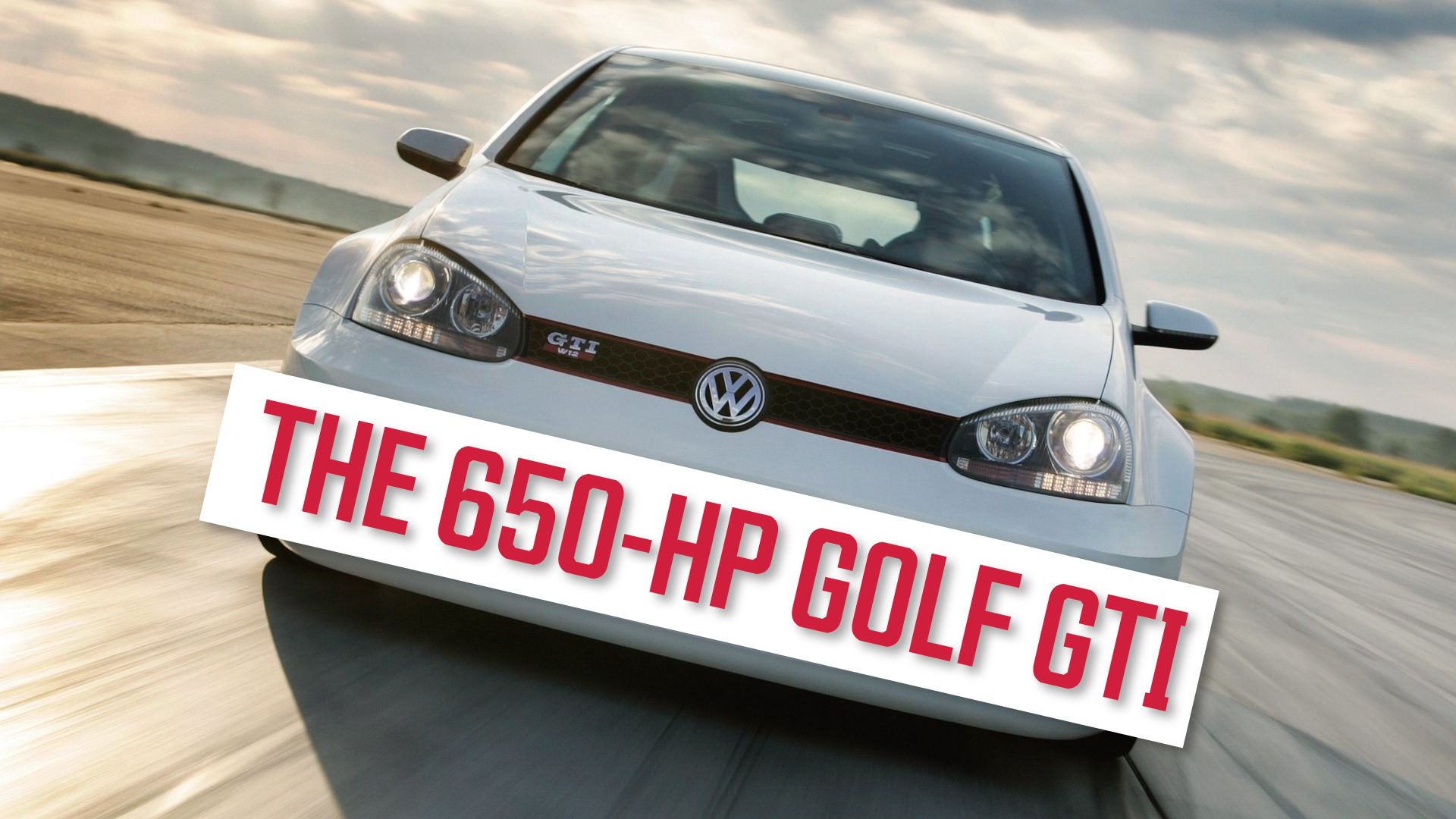
More extreme than the GTI Roadster is the W12-650, which has been turning heads since 2007 (when it was showcased in white). As indicated by its name, it features a Mk V GTI with a mid-mounted 6.0-liter W12 from a Bentley Continental GT. The enormous engine outputs 641 hp and 531 lb-ft of torque, propelling the GTI W12 from 0 to 62 mph in 3.7 seconds on its way to a top speed of 202 mph.
The current GTI remains an impressive vehicle, and enthusiasts should appreciate its existence as vehicles that are both enjoyable and practical become increasingly rare. VW is launching an even better Edition 50 that is quicker around the Nürburgring than a Golf R, and is contemplating how to transition the GTI legacy into the EV era. Yet, today’s VW lacks the excitement and whimsy of the company that produced a 12-cylinder hot hatch simply because it could.
By displaying historical concepts, VW undoubtedly wants consumers to recall how remarkable it once was. The automaker might need a reminder of that itself.
All images credit: Volkswagen
**Volkswagen Revives Legendary Concepts, Including the W12 GTI, Showcasing Its Historical Achievements**
Volkswagen has been acknowledged for its inventive spirit and dedication to engineering excellence. Among its numerous contributions to the automotive industry, the revival of legendary concepts like the W12 GTI highlights the brand’s capability to merge nostalgia with advanced technology. This article explores the history of the W12 GTI, its revolutionary innovations, and what its revival signifies for Volkswagen’s future.
**The W12 GTI: A Concise Overview**
First introduced as a concept in 2001, the Volkswagen W12 GTI marked a significant shift from the conventional GTI design. Fueled by a 6.0-liter W12 engine, this concept aimed to stretch the limits of performance while preserving the practicality and enjoyment synonymous with the GTI line. Boasting an output of approximately 600 horsepower, the W12 GTI could sprint from 0 to 60 mph in slightly over three seconds, an extraordinary accomplishment for a hatchback.
The W12 GTI’s design was equally impressive, featuring a sleek and aerodynamic body indicative of its performance potential. This concept boasted all-wheel drive and an advanced suspension system, ensuring it could manage the power produced by its formidable engine. Though it never reached production, the W12 GTI continues to represent Volkswagen’s engineering excellence and bold ambitions.
**Innovative Milestones**
The W12 GTI was not merely a display of brute strength; it also integrated several pioneering technologies that were ahead of its era. One of its standout features was its lightweight construction, utilizing advanced materials to decrease weight and enhance performance. This emphasis on weight reduction has become a crucial element of contemporary automotive design, influencing numerous vehicles since.
Furthermore, the W12 GTI showcased a distinct engine arrangement that combined the smoothness of a V12 engine with the compactness of a W architecture. This design allowed for a condensed engine bay while also improving weight distribution, thereby enhancing the vehicle’s handling traits.
**Resurrection of the W12 GTI**
In recent times, Volkswagen has rekindled its focus on its iconic concepts, with the W12 GTI taking center stage in this revival. The brand’s dedication to sustainability and electric mobility has sparked discussions about re-envisioning the W12 GTI for a new audience. While the original concept was rooted in traditional internal combustion techniques, future iterations could incorporate hybrid or fully electric powertrains, preserving performance while minimizing environmental footprint.
The return of the W12 GTI aligns with Volkswagen’s broader vision of embracing innovation while respecting its rich history. By revamping iconic models, the brand intends to captivate not only loyal fans but also a new generation eager for high-performance vehicles that are environmentally aware.
**In Closing**
The Volkswagen W12 GTI remains a testament to the brand’s inventive spirit and engineering excellence. Its revival not only emphasizes the historical importance of the concept but also indicates a progressive approach to automotive design. As Volkswagen continues to navigate the intersection of performance and sustainability, the legacy of the W12 GTI is bound to inspire future vehicle generations that honor the past while looking toward the future.
 admin
admin