
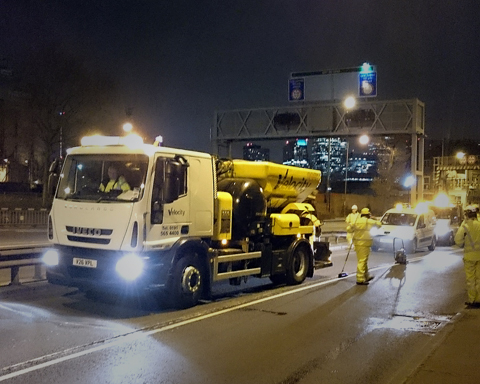
We Americans have a passion for cars, and consequently, potholes are an unavoidable aspect of our infrastructure. They are inevitable. However, many municipalities struggle to keep up with them, deploying maintenance crews only after someone gets a flat tire or damages a bumper and lodges a complaint. It requires human resources, and depending on the location of the pothole, it can be quite hazardous for the crews. A specialized maintenance truck equipped with a robotic spraying arm could be very useful in this context.
Enter the Cimline P5. This innovative pothole-patching machine designed for one operator emerged a few years ago and is currently being integrated into government fleets. Most recently, Akron, Ohio, added two of these machines to their operations, and they are already in action.
Using the P5 with DuraPatcher technology—quite a title—is straightforward. Operators remain in the cab at all times, maneuvering the sprayer arm with joysticks. Cimline highlights on its site a “three-section boom and nozzle,” which likely ensures precise spraying. Additionally, it boasts a pressurized 300-gallon tank featuring an overnight electric heating blanket, enabling work to commence promptly, even in five-degree weather. The tank can accommodate 10 tons of patching material at once.
A 74-horsepower engine compliant with Tier 4 Final emissions standards aids in spraying 450 cubic feet of material per minute. According to the Akron Beacon Journal, this machine is helping the city repair potholes in as little as two minutes. These repairs are also more durable than standard patch jobs, which often last only a season or so.
Cimline P5 One-Person Patcher with DuraPatcher Technology™
Although Cimline does not provide any price estimates on its website, the Akron Beacon Journal states that these trucks cost about $300,000 each. With this purchase, you receive the one-man DuraPatcher system mounted on an Isuzu chassis with an Allison 2500 six-speed transmission. (The demo shown features a cabover Kenworth, but nonetheless.) Cimline claims they have a 12,000-pound front I-beam paired with a 21,000-pound rear axle, along with a 5.57 axle ratio. The official gross vehicle weight (GVW) is 33,000 pounds.
I can easily envision such a device being beneficial nearly everywhere. Naturally, not every local government has the funds to acquire one, but for those that do, it significantly boosts productivity and safety. As roadways begin to thaw in the northern states and certain parts of the Midwest, I’m sure many road crews will spot this equipment and wish they had access to it.
Honestly, I somewhat desire one, even without a specific need for it.
Have a tip or question for the author? Reach out to them directly: [email protected]
**Truck Capable of Repairing Potholes in Only Two Minutes**
In recent times, local governments and road maintenance departments have encountered growing difficulties in preserving road infrastructures, especially in cities where potholes can develop quickly due to adverse weather and heavy traffic. An innovative solution has emerged in the shape of a specialized truck engineered to fill potholes within two minutes, significantly enhancing the speed of road repairs.
### The Technology Behind the Truck
This cutting-edge truck is outfitted with sophisticated technology that automates the process of pothole repair. It includes a heated asphalt system that facilitates the prompt application of hot mix asphalt, which is crucial for effective pothole restoration. Additionally, the vehicle is armed with a robotic arm that can accurately deliver asphalt into the pothole, ensuring an ideal fit and reducing waste.
### Key Features
1. **Fast Deployment**: The truck can evaluate and fill a pothole in less than two minutes, drastically minimizing the time allocated to road repairs. This swift deployment aids in reducing traffic disturbances and bolstering road safety.
2. **Automated Operation**: The truck employs sensors and cameras to detect potholes and gauge their size. This information is processed in real-time, enabling the truck to accurately determine the necessary amount of material for each repair.
3. **Eco-Conscious Materials**: Many of these trucks are engineered to utilize recycled materials, making the pothole filling process more sustainable. By using reclaimed asphalt pavement (RAP), the trucks contribute to environmental protection initiatives.
4. **Intuitive Control System**: Operators can conveniently manage the truck via an intuitive interface that allows for quick modifications and monitoring of the filling procedure.
### Advantages for Communities
The implementation of pothole-filling trucks presents numerous advantages for communities:
– **Economical Repairs**: By curtailing the time and labor needed for pothole repairs, municipalities can conserve funds and optimize resource allocation.
– **Heightened Road Safety**: Promptly repairing potholes helps avert accidents caused by damaged road surfaces, enhancing overall safety for motorists and pedestrians.
– **Increased Public Contentment**: Residents are likely to appreciate the rapid response to road maintenance issues, leading to greater satisfaction with local government services.
– **Diminished Traffic Interruptions**: Swift repairs translate to less time spent on road closures and detours, which can pose significant inconvenience to commuters.
### Real-World Implementations
Various cities across the United States have started to incorporate these trucks into their road maintenance strategies. Initial pilot programs have demonstrated promising outcomes, including substantial decreases in reported potholes and improved repair response times. As more localities recognize the advantages, the adoption of this technology is anticipated to expand.
### Conclusion
The introduction of trucks capable of filling potholes in only two minutes marks a noteworthy progress in road maintenance technology. By merging efficiency, speed, and sustainability, these trucks not only enhance the quality of road infrastructure but also improve the overall driving experience for the public. As urban areas continue to confront the challenges posed by aging roadways, such innovations will be vital in sustaining safe and dependable transportation networks.
 admin
admin