
Histamine is a naturally occurring compound in the body that is involved in immunity, digestion and the central nervous system. It is both found in foods, as well as made in our own body.
The low histamine diet is an elimination protocol designed to reduce symptoms of histamine intolerance. It does this by temporarily restricting foods high in histamine or those that trigger its release. Once symptoms improve, foods are systematically reintroduced to identify individual tolerance levels and to regain dietary flexibility.
What the Diet Is
As a broad overview, the diet involves restricting intake of two categories of foods:
- Foods that are high in histamine.
- Foods that are “histamine liberators.â€
The first category is simple to understand. There will also be a comprehensive list added later.
The second category is because theoretically there are certain foods that might not be high in histamines but can trigger the body to release its internal stores of histamine.
This diet is not meant to be a long-term restrictive diet. It is split up into three phases:
- The initial phase of restricting these foods.
- A systematic reintroduction phase to figure out what foods are tolerated well.
- An ongoing personalisation phase, where ideally symptoms are well-managed, while having as much flexibility with food as is feasible.
Who Might It Be Beneficial For?
There are three main categories of people that a low histamine diet might be worth trialling.
Histamine Intolerance (HIT)
Histamine intolerance happens when your body accumulates more histamine than it can break down.
A commonly used analogy is to think of your body as having a “histamine bucket.” Histamine comes from both the foods you eat and your immune system. Normally, enzymes in your gut act like a drain at the bottom of the bucket to break it down.
If those enzymes aren’t working well enough or you eat too many high-histamine foods, the bucket overflows, which triggers symptoms like bloating, headaches, hives, flushing, or congestion.
Mast Cell Activation Syndrome (MCAS)
Mast Cell Activation Syndrome happens when the immune cells responsible for storing histamine become hypersensitive and trigger excessive allergic signals unnecessarily.
While histamine intolerance is usually a problem with breaking down histamine from food, MCAS is an issue where your body needlessly floods your system with histamine and other chemicals to cause symptoms like hives, flushing, digestive distress, and fatigue.
Many factors contribute to this beyond just food, but the low histamine diet is still an option that can potentially help in certain cases.
Histamine Producing Microbes
Certain gut bacteria naturally produce histamine as they ferment food in your digestive tract. If these species overgrow, they constantly add to your “histamine bucket.”
Reducing high-histamine foods helps lower the overall burden. Other factors can play a role in addressing the overall gut balance, but the low histamine diet has can still play a role immediately.
Symptoms to Look Out For
There are common symptoms that can be signs that a low histamine diet might be worth considering. A complicated thing is that there are multiple causes of all these symptoms. But if somebody is presenting with multiple of these symptoms, and there is a link with many of the foods restricted on the low histamine diet, it increases the odds of this being relevant.
- Bloating
- Blocked or runny nose
- Diarrhea
- Fast or irregular heart rate
- Headaches
- Itchiness
- Low blood pressure
- Nausea
- Rashes or hives
- Shortness of breath
- Swelling of the lips, tongue or throat
- Vomiting
Evidence
While the low histamine diet is not one of the most well researched diets out there, we do have some amount of evidence worth looking at.
One review found 10 relevant studies looking at the diet and highlighted a few key points:
- Most studies found good success for the diet improving symptoms.
- There are limitations in many of the studies around things like sample size and the duration of the diet.
- The histamine liberating concept is lacking evidence. The idea of certain foods triggering histamine to be released by the body is plausible. Anecdotally there are positive experiences based on it. But right now research has not really identified if it is or isn’t effective. For the sake of this post, it will still be discussed. But it is worth noting that it seems less evidence based than the rest at this stage.
- There is also just a general lack of consensus around what foods should be excluded in a low histamine diet in general too.
List of avoided foods in studies on low-histamine diets
Foods to Avoid
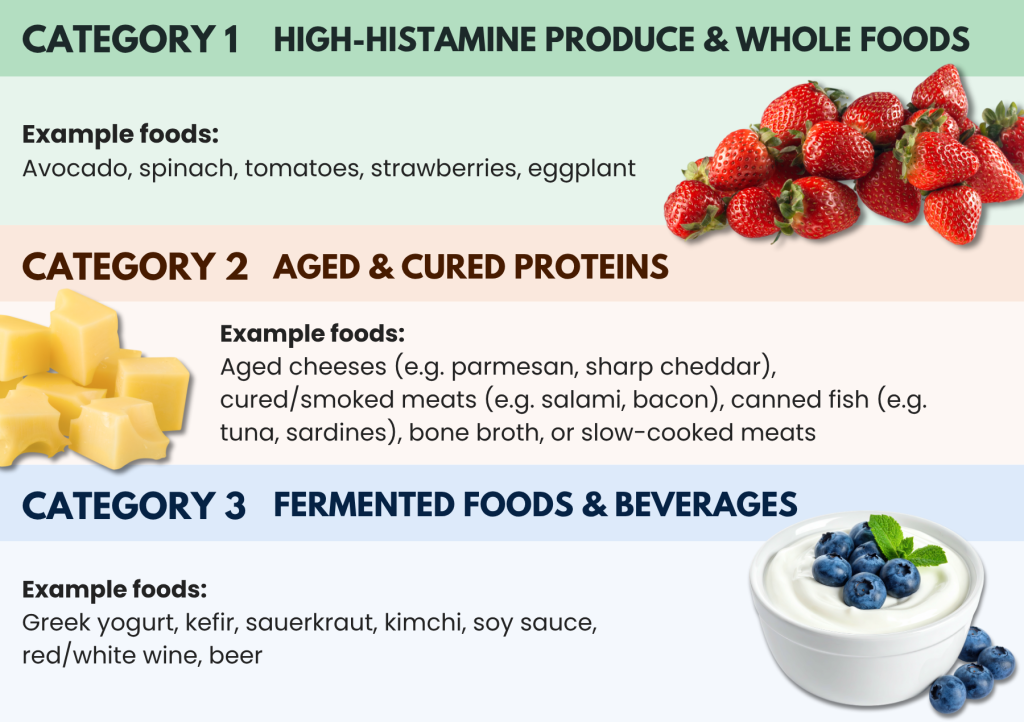
While on the elimination phase of the low histamine diet, here is a list of foods to avoid.
Note that it is slightly more complicated than this. Because even within the same food product, there can be differences. For example, cheese can have a significantly different histamine content depending on how long it has been aged, stored and also if it has additives.
As a typical rule, fresh, unprocessed foods have the lowest levels. Any wheat-based products containing gluten should also be avoided.
Foods That Can Be Included
How To Implement the Diet
The diet should be split up into the below 3 phases. The first phase should not be done indefinitely, for a variety of reasons.
Phase 1 – Elimination
This phase simply involves avoiding the foods mentioned in the relevant section above. It is typically done for 2-4 weeks.
During this phase it is important to be relatively strict to see if symptoms significantly improve.
Continuing the analogy, the goal is to “empty†the histamine bucket as much as possible.
Different people will have varying levels of how strict they need to be. But in many cases it makes sense to fully commit to this phase.
If symptoms do not noticeably improve, it is good and bad news. The good news is that you no longer need to do this diet, as it likely is not a factor in your symptoms. The bad news is obviously just that this is not the solution you were looking for.
If symptoms do improve, then after 2-4 weeks it makes sense to move onto the next phase.
Most people see improvements within 2 weeks if this is relevant for them, so the 4-week mark is more of a conservative cut-off to ensure a definitive answer.
Phase 2 – Reintroduction
For the re-introduction phase, the goal is to test an individual food at a time. While it’s possible to do this by yourself, it’s highly recommended to work with a dietitian.
Ideally for this phase, you do not want any major life changes or stress either, just in case they trigger symptoms that you unintentionally link to food.
The 6-Day Test Protocol
Day 1: Small Portion
Eat a very small portion of one of the foods you previously were avoiding. Consume this alongside a low-histamine meal.
Example: 1 teaspoon of yogurt or 1 slice of avocado
Monitor for symptoms for 24 hours. If you get symptoms, discontinue this test.
Day 2: Moderate Portion
If no symptoms occur on Day 1, eat a standard portion with lunch or dinner. Monitor for reactions.
Example: 1/2 an avocado or 1/2 cup of yogurt.
Day 3: Large Portion
If Day 2 is clear, include a larger portion in two separate meals during the day. Ideally this is more than you’d normally consume in day-to-day life.
Days 4-6: Washout
Return to a strictly low-histamine diet for 3 days without introducing any new test foods. This allows your histamine bucket to clear and ensures it doesn’t influence your next test.
Symptom Tracking
It is well worth writing things down using a tool like a food and symptom diary to keep a record of symptoms. That way when you get to the end of this process, you can easily identify any trends.
Total Testing Protocol
There are many ways to do this testing, but it’s recommended to test 2 representatives from each of the following categories over time. This process takes around 5 weeks, pending the outcomes of each test.
Phase 3 – Personalisation
After the reintroductions, you should have a good idea of what foods you can and can’t eat while keeping symptoms minimal.
From here, it is an ongoing process of personalising the diet.
Even with a good idea from the prior phase, there are still some relevant challenges:
- The foods were previously challenged in isolation. If you combine multiple things that were fine, they might now stack together in a way that causes issues.
- Your tolerance might change over time.
- Other factors such as environmental or life stressors can influence things.
This might sound complex, but as time goes on, it tends to get easier to identify what will and won’t work well for you.
Downsides & Risks
While there are potential benefits to this diet, there are also downsides worth being aware of.
One clear one is that it is intensive to do. It involves significantly changing the way you eat for a period. This presents a lot of challenges, particularly around things like:
- Quickly gaining knowledge around things like what foods you can/can’t buy when shopping, as well as what recipes you can make that are suitable.
- Social gatherings involving foods that might not suit this diet could be difficult. It’s also not as easy of a diet to explain as other options.
And much more.
There are nutritional risks associated with things like malnutrition, micronutrient deficiencies and also gut microbiome changes. These can be offset with a well-executed plan. But they are also common issues that are seen when people implement the diet without that.
And finally, if somebody has a history of disordered eating, it is typically recommended to not go down the route of a diet like this. In many cases, the risk can outweigh the benefits for scenarios such as that.
The above reasons are also why it is encouraged to not extend the diet any longer than is necessary to achieve the desired outcome too.
DAO Enzyme
Diamine oxidase (DAO) is the primary digestive enzyme responsible for breaking down dietary histamine in the gastrointestinal tract.
DAO function relies on specific nutrient cofactors, including vitamin B6, vitamin C, copper, and zinc. This is another reason why monitoring micronutrient intake and levels is relevant too.
It is possible for DAO activity to be lower for the following reasons:
- Gastrointestinal damage
- Medications
- Genetic factors
This can contribute to a histamine intolerance, because histamine levels build up more easily.
Supplementation
DAO supplements can be a useful tool for many people where the low histamine diet is relevant.
Typically, they are taken 15-20 minutes before eating a meal. This helps break down histamine in that specific meal.
Usually, these supplements are used as temporary tools for things like social events, rather than on the day to day before all meals.
The main reason they are not used day-to-day is because they get expensive if having before all meals. But technically they could be used more regularly if desired.
One unorthodox usage is that you could actually use this enzyme to identify if a low histamine diet is likely to be relevant for you. You could have the enzyme before meals for 2 weeks and see if symptoms improve. If they do, it is likely worth looking into this idea further.
Summary
The low histamine diet is a potentially useful tool for many people who experience symptoms related to a build up of histamine. The evidence base is growing and looks promising, albeit currently lacking in certain areas.
Given the diet also comes alongside some downsides, it is worth picking and choosing when it should be used. Good candidates typically will have multiple symptoms related to histamine, some level of pre-identified linkage between foods and those symptoms, and interest in doing the diet, and ideally no history of disordered eating.
The post The Low Histamine Diet: A Comprehensive Guide first appeared on Ideal Nutrition.