
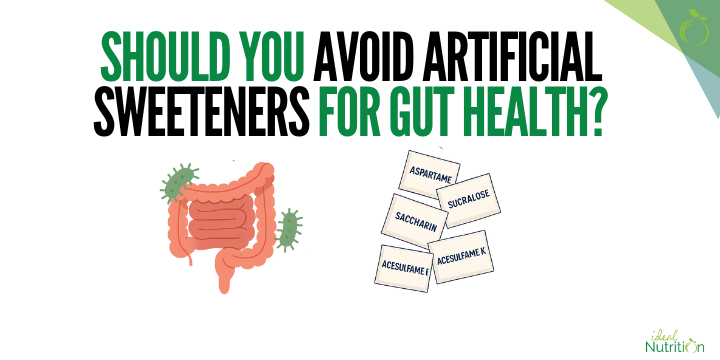
There is debate about whether artificial sweeteners have negative impacts on gut health. On one side, there are people discussing how it can negatively impact it, while on the other side, people are pointing to it having no impact.
This post will cover the evidence on the topic and what you can do practically with this information.
Specifically, this post will cover aspartame, sucralose, saccharin and acesulfame potassium (ace K). These are the four most common sweeteners.
Sugar alcohols are often discussed alongside artificial sweeteners, but since they are technically not artificial sweeteners, they have been excluded from this article for simplicity.
Defining Gut Health
Gut health can have two components that are worth discussing.
The first aspect is the ratio, amount and diversity of bacteria.
Some bacteria are more commonly referred to as “good” bacteria and are more commonly linked with positive health outcomes. Other bacteria can be thought of as “bad bacteria.”
Of course, it is not that simple. But good gut health can involve having a great balance of these.
Alternatively, the other aspect is related to symptoms such as gas, bloating, diarrhea or constipation.
The absence of consistent symptoms could also be considered “good gut health” as well.
This article will touch on both of those.
Microbiome Changes
Since different sweeteners have different mechanisms for how they could interact with the bacteria in the gut, it makes sense to go through them individually.
All of these sweeteners have quite a bit of animal research, but the main focus is going to be on human research, since that is arguably more relevant.
Aspartame
There has been human research that has had mixed results.
One study that gave participants various forms of artificial sweeteners found a link between aspartame and microbial changes. But even that study was quite unclear on the changes and whether they actually matter.
Another study found no noticeable differences. They did link a reduced microbial diversity to people who were habitual artificial sweetener consumers, though. But this brings us back to the common question of whether artificial sweeteners directly caused these changes, or other variables did.
Mechanistically, it doesn’t even make sense that aspartame could directly influence the gut.
It breaks down into phenylalanine, aspartic acid and methanol before reaching the large intestine.
And the amounts it breaks down into are substantially lower than people naturally get through food.
If there happened to be any effects, they would have to be quite indirect.
Sucralose
Sucralose is an artificial sweetener that has been more commonly linked with changes in bacteria in the gut.
A major contributor to this was a 2022 ten-week study that found noticeable changes in gut bacteria, as well as glucose and insulin levels.
It contained 40 participants. Half of them consumed water, and the other half had 48mg of sucralose per day. For context, that is the equivalent to ~2/3 of a can of diet soft drink.
This study is worth noting since it is quite well-designed. But it’s still just an individual study and by itself is not definitive.
Another study had a very different finding.
This study involved people having 780mg of sucralose per day. It was only for 7 days, but that is the equivalent of ~11 cans of diet soft drink. They found no changes in blood glucose, insulin resistance or the intestinal microbiome.
Those two studies are the main ones we have at this stage and are quite conflicting.
From a mechanistic perspective, it gets more interesting though. Sucralose actually is not metabolised by the microbiota. So, it is another one that theoretically should not directly impact the bacteria.
Saccharin
One study gave 7 people roughly the acceptable daily intake of saccharin for 6 days. Of those people, 4 of them developed glucose intolerance and had changes in their microbiome. The other 3 had no changes.
That sounds quite drastic and concerning. Hypothetically, if that were occurring on a larger scale, it seems like it would get identified quite quickly. Realistically, we would see a lot of people developing glucose intolerance linked to saccharin.
Another study did a similar dosage for 2 weeks. They found no change in microbial diversity or glucose tolerance.
Once again, it is quite odd for both of these studies to co-exist. It makes it easy to see why there are a lot of mixed messages out there. But it is another scenario where more research would be beneficial.
Ace K
Ace K appears to be the least studied out of these four, for this specific aspect.
Like the others, there are plenty of animal studies, but not much human.
The main one was a cross-sectional study that found no link between Ace K and changes in gut bacteria.
Based on animal studies, there is potential that it can play a role.
It is another one that technically is not metabolizable by bacteria in the gut. Any interaction could only be feasible if it was related to chemical interactions, rather than bacteria feeding on it.
Broad Overview of Artificial Sweeteners and Microbiome Changes
When looking more broadly at artificial sweeteners and the microbiome, findings are largely inconsistent. A great review from 2025 covered all the relevant research and basically summarised:
- Findings are mixed
- Animal studies make it look like there is a link
- Human studies generally find milder or no significant changes
- It could be worth having some level of caution around artificial sweeteners.
Gut symptoms

Anecdotally, there are a lot of people who say artificial sweeteners trigger gut symptoms.
This is a tricky area to interpret for a few reasons.
One is that in the real world, there are a lot of things going on.
Using one of many examples, diet soft drinks have carbonation. If bloating occurred, was it the artificial sweetener or the carbonation?
Another example is that sugar alcohols are often triggers for symptoms. But they technically are not what we are referring to in this article.
If excluding sugar alcohols, the consensus is that asweeteners can cause gut symptoms in some people, but it’s uncommon at typical intake levels.
If artificial sweeteners altered the composition or activity of gut bacteria, these shifts could, in theory, influence digestion or gut comfort. But consistent links to symptoms like bloating or diarrhoea haven’t been shown.
Aspartame, sucralose, saccharin and ace-K are largely absorbed or excreted before reaching the colon in meaningful amounts. They usually don’t ferment or produce gas, so most people don’t experience bloating or diarrhoea from them.
A small number of people report gut discomfort or looser stools after very high intakes, typically from large amounts of diet drinks or multiple products containing these sweeteners, but this is not the norm.
Overall, that basically summarises it where it seems like quite a rare trigger. But it is possible that individual people are more sensitive to them as well, particularly in larger amounts.
Practical Recommendations
Human research has consistently found smaller differences (if at all) than what has been observed in animal studies. But there is still enough there were caution would be warranted.
And then of course, there is potential for individual variation too.
At this stage, I think artificial sweeteners, in normal amounts, are likely fine. And in many cases, they are far less of a potential issue than many other behaviours people have.
But I could also understand caution. If avoiding or limiting artificial sweeteners is your preference, that makes sense too.
 admin
admin