
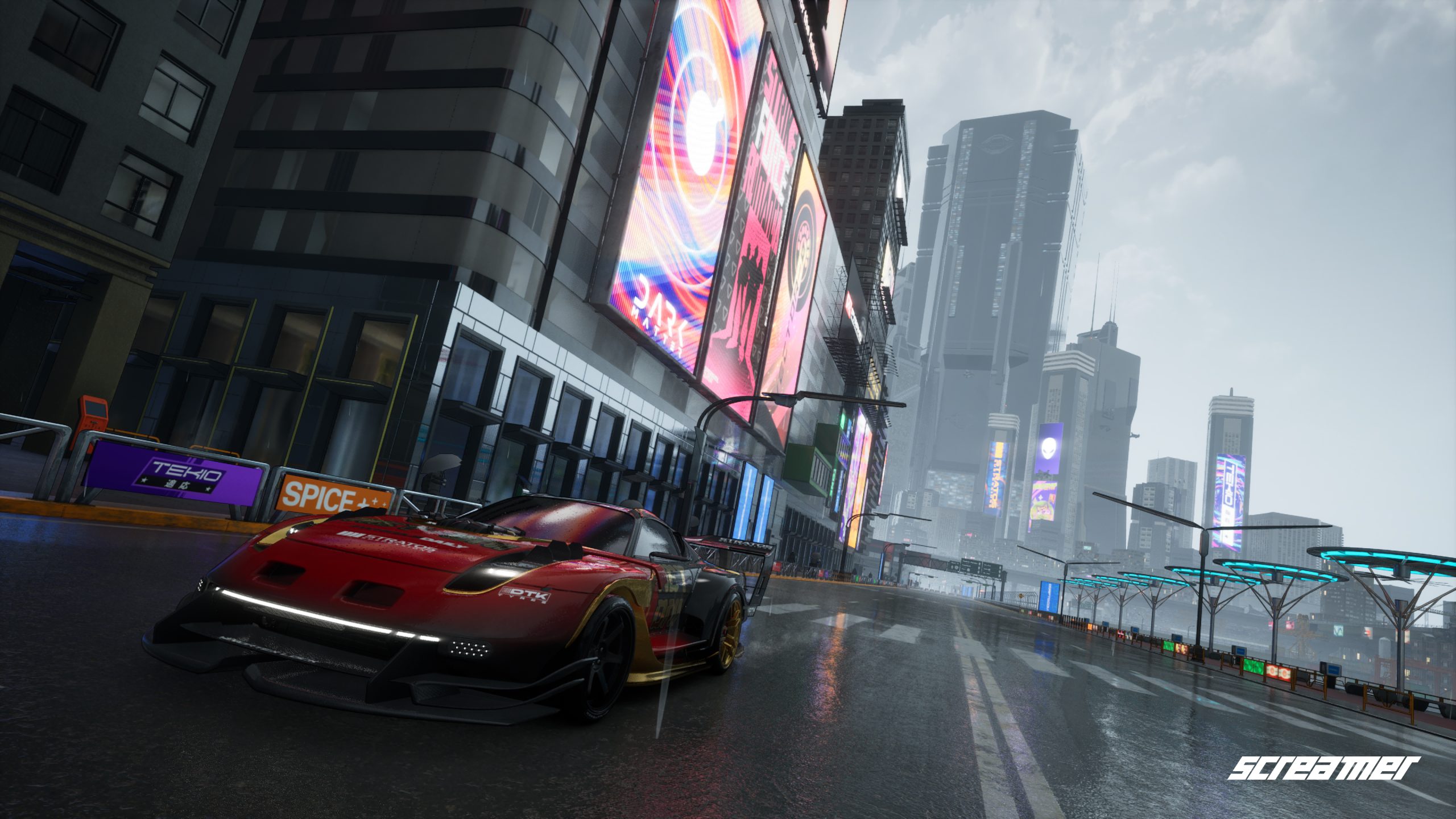
Games like Screamer are a rarity these days. This narrative-driven, cyberpunk-themed, anime-inspired arcade racer features a completely wild control scheme without an open world, developed by the team famous for Hot Wheels Unleashed and numerous motorcycle simulations. It’s ideally suited for competitive gameplay yet offers an extensive single-player campaign; its cars are remarkable characters on their own, though they aren’t officially licensed. Did I mention the soundtrack is fantastic? Screamer isn’t merely good—it’s a huge unexpected delight in racing games that we haven’t seen in ages, and I’m thrilled it exists.
Screamer’s robust artistic direction, combat elements, and rich lore, which I anticipate will inspire an entire community of fanfiction, might make it seem more intricate than it is; at its heart, it remains an arcade racer. True fans remember the original Screamer from the mid-’90s: A PC-exclusive, 3D polygonal racing experience that effectively offered those without a PlayStation a way to cope with missing out on Ridge Racer. This game was created by the same team behind this installment—previously named Graffiti, now known as Milestone, based in Milan. And that marks the end of any similarities between the two.
The new Screamer’s most striking distinguishing feature lies in its control scheme: Driving involves both left and right analog sticks, along with gas and brake triggers, where you’d naturally expect them. The left stick steers conventionally, while the right one initiates a drift, independent of throttle position. We’ll explore how that feels later.
In this video game landscape of 2026, however, straight driving alone may not captivate everyone, so there are two meters to monitor during races: Sync and Entropy. Sync represents the Screamer universe’s version of boost, accumulated not by drifting but by shifting at optimal times and maintaining high speeds. Entropy, which is introduced in the story mode a bit later, adds a combat element to the racing. Spending your Sync for a boost grants Entropy, which can be used to transform your car into an indestructible battering ram for a brief period, allowing you to knock out opponents (who respawn). Successfully knocking opponents out replenishes some Sync, providing a gratifying gameplay loop when everything clicks into place.
Entropy can also be used to create a temporary shield against attacks—termed Strikes—and you are notified of incoming offensive maneuvers through the HUD. However, Strikes can also be canceled right before activation, as they are triggered by holding down a button. A cunning trailing driver might prepare a Strike to trick their rival into deploying their shield, retract the attack, and then attack when the shield dissipates and they become vulnerable again.
With all these systems—plus the unique ways specific characters and their vehicles interact with them—it’s straightforward to see how Screamer transforms into a game of strategy alongside traditional racing skills. The slight downside is that navigating all of this requires managing gas, brakes, two sticks, and two shoulder buttons which perform different functions based on whether you press or hold them. I grew up on Sega Rally. I believe that simply driving can be rewarding, and Nintendo’s recent adjustments to make Mario Kart more vertical seem as ineffective to me as the first time I attempted to build a shack during a firefight in Fortnite.
Yet even I, a nostalgic player, find enjoyment in this. Yes, it’s overwhelming, and especially in my initial play sessions, I mixed up my inputs more times than I could tally. Screamer never lets you rest; AI opponents bounce back with Burnout-like determination, and if you fail to execute those shifts well, Sync generation slows to a crawl, leaving you vulnerable to be overtaken. However, managing everything while gliding from corner to corner feels rhythmic.
This brings us back to the physics. Initially, I found Screamer’s handling frustrating. Steering with the left stick feels heavy and awkward—imagine Criterion’s Need for Speed Hot Pursuit with cinderblock tires. This compels you to rely more on the right stick for drifting in most scenarios. Nonetheless, the left stick has its uses, aiding in fine-tuning drift angles. Once you master the coordination of both sticks together, and grasp how braking and easing off the throttle create substantial differences for sharper cornering, it all starts to fall into place. But I wasn’t completely grasping it yet.
Then I discovered the view change button. I realized I cannot play Screamer from the default behind-the-car perspective; it’s entirely behind the car, which doesn’t suit me in racing games. Even with all the tail sliding, I found the physics to be much more intuitive and enjoyable from the hood or bumper viewpoints. I would love to try it with an effective chase camera, though, as the cars look stunning, so maybe Milestone could consider adding camera customization options in a future patch.
It’s impossible to discuss Screamer’s vehicles without touching on its artistic style, characters, storyline, and everything else contributing to its uniqueness—the elements that racing games often overlook today. I haven’t seen fictional cars that look this impressive since Ridge Racer. There are nearly 15 of them, and I’m not complaining; this level of detail is rare for unlicensed cars in games.
While you could draw comparisons between some vehicles in the roster and real-life models, the artists have been incredibly creative in modifying certain bodywork segments while enhancing others, resulting in designs that feel neither derivative nor satirical. They simply look outstanding. This applies equally to the liveries, particularly how the cars for specific teams—like Strike Force Romanda—use lighting in inventive ways.
Another aspect of Screamer’s art direction is its remarkable coherence, allowing each car to embody the character who drives it, with vastly different behaviors. The first crew you encounter in the tournament, the Green Reapers, are linked to a private military firm. Their vehicles exhibit a rugged and classic cyberpunk aesthetics, in contrast to the highly JDM-influenced, sponsor-laden setups of the aforementioned Strike Force Romanda team, a group of pop celebrities. Alternatively, the austere, black, Art Deco-inspired vehicles of Anaconda Corp., a towering megacorporation. If you hold any nostalgia for Square’s “high-speed driving RPG” Racing Lagoon, you’ll be pleased to find that the narrative resonates with similar themes.
Themes of love and loss, trauma and revenge, unfold in the setting of shady characters and corporations engaging in dubious high-tech dealings that are only briefly introduced and allowed to be inferred going forward. I wouldn’t describe Screamer’s narrative as gripping or even good; it employs every dramatic anime cliche with a blunt object. (Prepare for many “…” gasps.) Nevertheless, considering its context, it fits well. Additionally, the effectiveness is heightened by breathtaking cutscenes scattered throughout the narrative, courtesy of Japanese animation studio Polygon Pictures.
I often found myself craving more cutscenes, as the majority of the story progresses through text interactions among characters. Nonetheless, every single line of dialogue is voiced, which is commendable given the sheer volume. Each line is articulated in the character/actor’s own language, because in Screamer’s future, everyone understands each other regardless of their spoken language. A nice touch.
It genuinely feels as though Milestone considered every aspect, which is a rarity in modern games that often release with critical bugs or lack entire gameplay modes. The menus are elegant and highly polished. The overall graphical presentation and performance excel as well; this Unreal Engine 5 title operates smoothly without any stuttering (!), appears to be well-optimized for mid-range PC hardware, and can look incredibly striking at times. There’s a specific track early in the game, situated in the Neo-Ray city, where players race down highways circling a stadium during daylight. Witnessing the sunlight reflecting off the tops of all the buildings below is simply breathtaking.
It would also be a significant oversight not to acknowledge the soundtrack, which is a blend of licensed and original tracks. It’s a well-known fact that music enhances the best racing games, and I think the moment I realized how much I was enjoying Screamer was when I first heard one of the tracks featured during the Strike Force Romanda segments of the story. I’ve been humming it for days.
There are still a few frustrations here and there. The win criteria in campaign events can paradoxically be irritating, such as needing to knock out a specific number of opponents while also clinching first place—two objectives that never seem to mesh well in a single race. To succeed solely on speed, you must dart past the pack as quickly as possible, making it challenging to knock anyone out under those circumstances. At times, I feel that grappling with all of Screamer’s mechanics and their associated timed button presses turns me into a clumsier driver, and all I really long to do is familiarize myself with a vehicle.
However, I find it easy to overlook these flaws because this is the most surprisingly revitalizing racing game in at least one, possibly two console generations. Look, you know Forza Horizon 6 is set to be excellent. You’re aware of what Gran Turismo entails and offers. They are both superb games, but they lack surprise, and that was never their intention. Screamer reminds us that this genre can be a medium for artistry, inventive gameplay, and expansive narrative worlds, just like any other.
Milestone provided The Drive with software prior to release for the purpose of crafting this review.
Quick Take
Milestone has created a treasure—a highly polished, entertaining, and inventive arcade racer unlike any other that seeks to push beyond the boundaries of the genre.
| Screamer Specs | |
|---|---|
| Price | $59.99 ($69.99 for Digital Deluxe Edition) |
| Release Date | March 26, 2026 (Digital Deluxe Edition available March 23) |
| Platforms | PlayStation 5 | Xbox Series X and S | PC via Steam and Epic Games Store |
| Cars | 15, customizable |
| Tracks | 32 across four environments |
| Multiplayer | Up to 16 players online cross-platform | Up to four players split-screen |
| Score | 9/10 |
Email the author at [email protected]
**Screamer Review: Establishing a New Benchmark in Racing Game Visuals**
The racing game genre has consistently been a foundational element in the gaming world, enthralling players with high-speed excitement and heart-pounding competitions. With the launch of “Screamer,” developers have elevated the expectations for visual quality in racing titles, delivering an experience that not only tests players’ skills but also immerses them in incredibly lifelike environments.
**Visual Quality and Graphics Engine**
“Screamer” employs a state-of-the-art graphics engine that utilizes advanced rendering techniques, such as ray tracing and dynamic weather systems. The outcome is an astonishing visual experience that highlights intricate details in both vehicles and surroundings. From the sparkle of sunlight bouncing off a shiny car hood to the genuine textures of asphalt and dirt, every element is carefully designed to enhance immersion.
The game showcases a variety of intricately crafted tracks set in diverse locations, from energetic urban settings to tranquil rural vistas. Each environment is vibrant with dynamic components like moving traffic, wildlife, and fluctuating weather that influence gameplay. The day-night cycle further enriches the visual appeal, granting players a fresh perspective on familiar courses as they race under different lighting circumstances.
**Vehicle Performance and Customization**
In “Screamer,” vehicle design reaches new heights. The game features a vast collection of cars, each precisely modeled to represent real-world equivalents. Players can anticipate a selection of vehicles, from elegant sports cars to robust off-road machines, all exhibiting detailed interiors and customizable features. The customization system allows players to modify both performance and aesthetics, ensuring that every car reflects the player’s individuality.
The attention to detail extends to the driving experience as well. Each vehicle behaves differently, with physics that mimic real-world driving dynamics. This realism not only enriches the visual experience but also adds depth to gameplay, as players must adjust their driving techniques according to various vehicles and track conditions.
**Audio Design and Immersion**
Alongside the captivating visuals is an outstanding sound design that submerges players in the racing environment. The roar of engines, the squeal of tires, and the ambient noises of the surroundings create a rich soundscape. The game features a dynamic soundtrack that adjusts to the race’s intensity, further increasing the adrenaline rush as players navigate tight turns and fast straights.
**Multiplayer and Community Interaction**
“Screamer” also places emphasis on community interaction through its multiplayer features. Players can challenge friends or join global leaderboards, fostering a competitive atmosphere that revitalizes gameplay. The game includes regular updates and events, introducing new courses, vehicles, and challenges, motivating players to return and hone their skills.
**Final Thoughts**
With “Screamer,” developers have established a new benchmark in racing game visuals, merging cutting-edge technology with immersive gameplay. The striking graphics, realistic vehicle mechanics, and engaging sound design create an unrivaled racing experience that caters to both casual players and dedicated racing buffs. As the gaming landscape evolves, “Screamer” distinguishes itself as a standard for upcoming racing titles, demonstrating that visual excellence and gameplay can coexist beautifully.