
Alternators are driven by an engine to produce electricity for powering everything from lights to seat warmers, but this increases the load on the engine, restricting power output and impacting fuel efficiency. Some manufacturers have sought to remedy this with 48-volt electrical systems that utilize a larger battery for electric power, but this adds weight, and recharging is still necessary. The innovative minds at Garage 54 have proposed a different approach.
These are the same video-making mechanics who transformed a Subaru boxer engine into an inline-four and created a V16 using chainsaw motors, so they don’t follow conventional logic. They devised an alternator alternative driven by exhaust gases like a turbocharger rather than a belt, similar to a standard alternator. The rotation is still utilized to produce electricity, making this device akin to a small-scale version of turbines used in power stations. To ensure it produced adequate electricity, the Garage 54 team assessed the rpm of a traditional alternator, establishing specifications to work from.
The turbine alternator features a circular casing and a fan-like wheel constructed from flat steel blades, spun by the engine’s exhaust gases. The exhaust enters and exits through precisely placed ports to allow the gases to effectively rotate the wheel. If the ports were positioned directly across from one another, for instance, the gases wouldn’t have sufficient travel distance. The gap between the wheel and casing needed to be minimized to extract maximum energy from the exhaust gases, and the inlet port and overall chamber volume—determined by the diameter of the housing and the quantity and arrangement of the blades—were kept to a minimum to sustain pressure. This necessitated some experimentation.
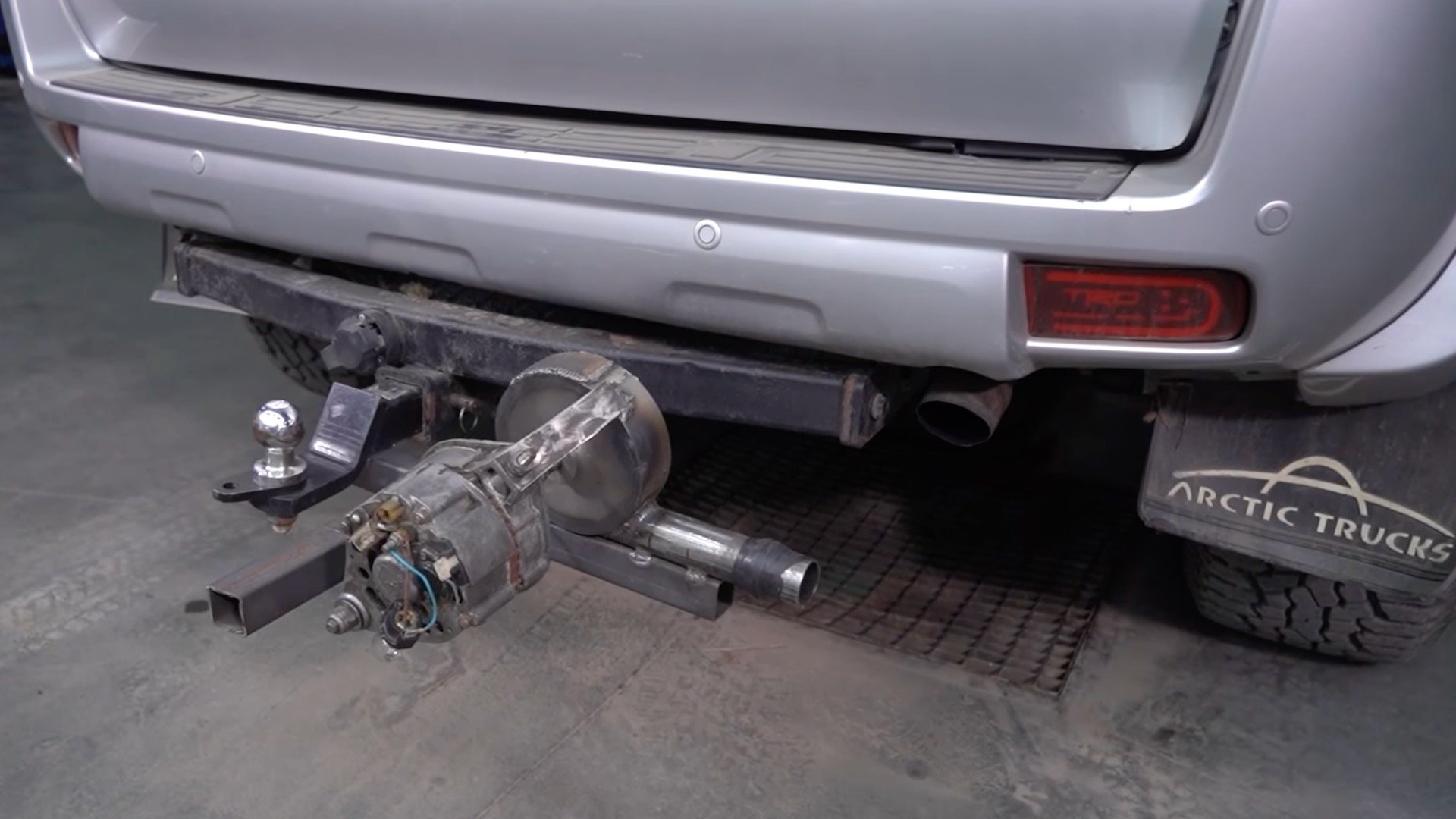
The end product is relatively compact, but the installation cannot be described as OEM-approved. The turbine drives a conventional alternator via a small driveshaft and is connected directly to the tailpipe. Therefore, instead of being located under the hood, the entire setup hangs off the rear bumper on a modified trailer hitch. This is merely an experimental prototype, after all.
Exhaust-powered turbo-generator for a vehicle – will it function?
But was this experiment successful? In a way. The expectations were set quite low; rather than powering an entire car’s electrical system, the aim was simply to keep three light bulbs lit. The turbo-alternator achieved that at around 2,500 rpm from the engine, producing quite a disruptive noise in the process. The hosts worried that excessive throttle could cause it to disintegrate, while reducing throttle dimmed the bulbs.
That’s the challenge with turbines. They require a steady, generally high speed to perform effectively. Anyone slightly knowledgeable about cars knows about turbo lag, and while modern turbos and engine management systems have mostly overcome this, applying the same concept to electricity generation is more complex. This is why Jaguar had to abandon a turbine range extender for its C-X75 supercar (before ultimately giving up on the car itself). A belt simply provides a more efficient means to harness an engine’s rotation, which is why belt-driven alternators operate at much lower engine speeds. Nonetheless, the team at Garage 54 should be commended for their efforts.
**Russian Engineers Create Turbo-Inspired Alternator Driven by Exhaust Gases**
In a notable advancement in energy efficiency and automotive innovation, a group of engineers from Russia has created a turbo-inspired alternator that utilizes exhaust gases to generate electricity. This cutting-edge system aims to enhance the efficiency of internal combustion engines, diminish fuel consumption, and reduce emissions.
### Overview of the Innovation
The new turbo-inspired alternator functions by harnessing energy from exhaust gases that would typically be lost in standard vehicles. By capturing this energy, the alternator generates electricity, which can then be used to power various electrical systems in the vehicle, such as lighting, entertainment systems, and even assist in recharging the vehicle’s battery.
### Operational Mechanism
The essence of the technology lies in its construction, which merges a turbocharger with an alternator. As exhaust gases travel through the turbocharger, they rotate a turbine linked to the alternator. This rotational movement generates electricity through electromagnetic induction, a concept that has been utilized in standard alternators but is now augmented by the extra energy source from the exhaust gases.
### Advantages of the Turbo-Inspired Alternator
1. **Enhanced Efficiency**: By transforming waste heat from exhaust gases into usable electrical energy, the turbo-inspired alternator can significantly boost the overall efficiency of an engine, resulting in improved fuel economy and lower operational costs for vehicle owners.
2. **Lower Emissions**: With increased efficiency, vehicles equipped with this technology can emit fewer pollutants. This is especially crucial given global efforts to address climate change and reduce air pollution.
3. **Improved Performance**: The additional power generated can support more electrical systems without placing additional load on the engine, leading to better performance and responsiveness in vehicles.
4. **Potential for Hybrid Use**: The technology may also be adaptable for hybrid vehicles, where the produced electricity could complement the power supplied by electric motors, further improving efficiency.
### Challenges and Future Developments
While the turbo-inspired alternator offers several benefits, there are hurdles to its widespread implementation. Engineers must ensure the system is robust and can endure the high temperatures and pressures linked to exhaust gases. Furthermore, integrating this technology into existing vehicle designs may necessitate considerable modifications.
The Russian engineering team is presently conducting additional research and development to tackle these challenges. They are also investigating potential applications beyond the automotive sector, such as in industrial machinery and power generation systems.
### Conclusion
The creation of a turbo-inspired alternator powered by exhaust gases marks a promising advancement in the pursuit of more efficient and environmentally friendly energy solutions. As the automotive industry continues to progress, innovations like this could significantly influence the future of transportation, making vehicles more sustainable and minimizing their environmental impact.