
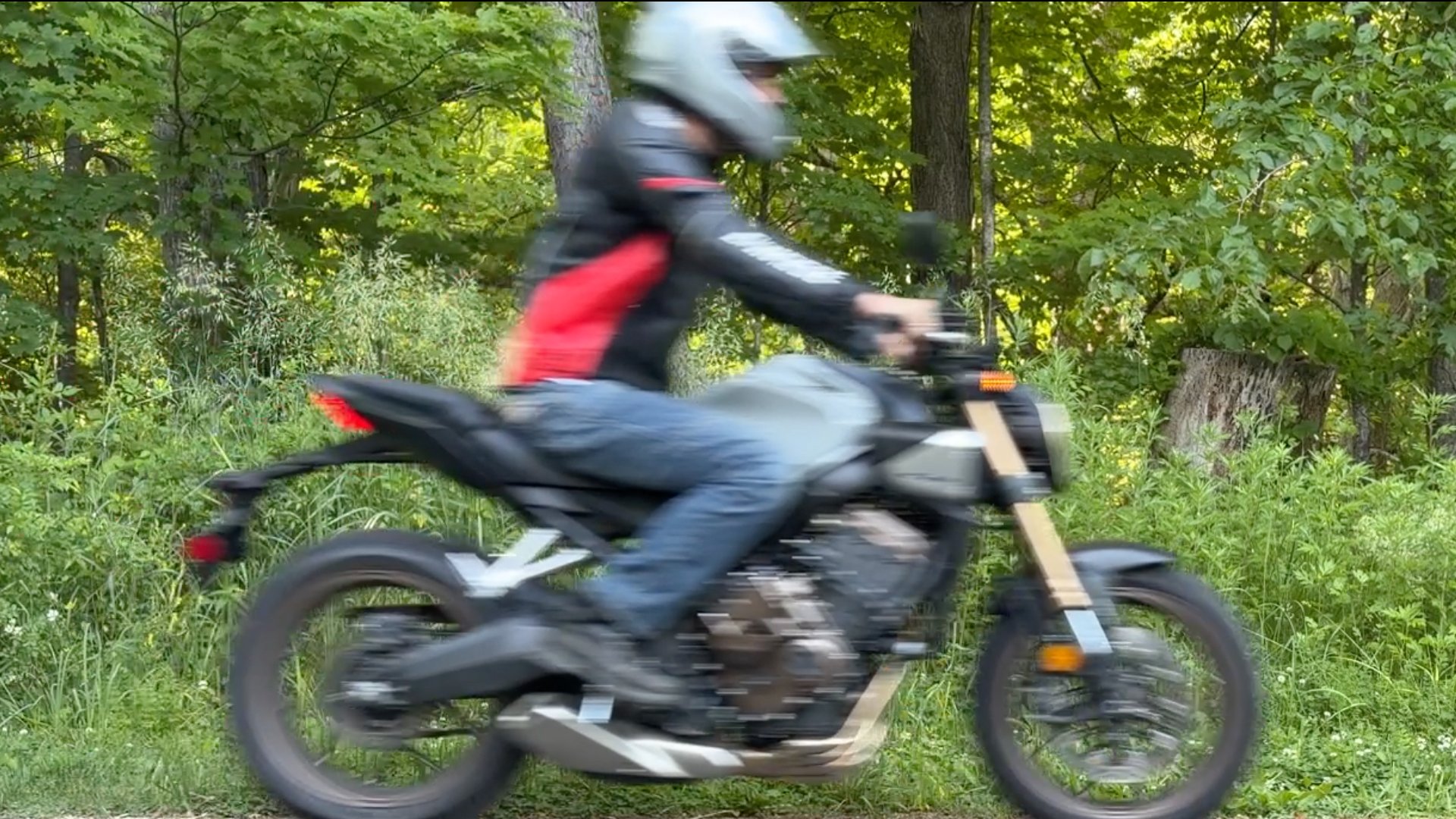
The Honda CB650R E-Clutch is an impressive machine with a stunning blend of features. It’s welcoming and contemporary yet maintains a sense of character. Energetic, but not daunting. The clutch can be set to automatic, but you’ll still need to shift gears manually. This bike is ideal for beginners or seasoned riders seeking modern technology that enhances the experience rather than merely simplifies it. For me, riding a Honda E-Clutch bike was genuinely transformative.
We don’t often release motorcycle reviews here, but this piece is aimed at anyone with a casual interest in bikes. If you’ve never been on a motorbike, here’s the only bit of technical background you need:
- Most motorcycles utilize a sequential manual transmission configured consistently
- The clutch is operated via the left handlebar lever
- The shifter is a lever you operate up (upshift) or down (downshift) with your left foot
- Braking is handled on the right side
- The right handlebar lever engages the front brake
- The right foot pedal engages the rear brake
Here’s a visual:
Motorcycling With an Impaired Hand
I’m uniquely positioned to appreciate an auto-clutch motorcycle due to my left hand being impaired. It’s a long and unfortunate tale. The brief version is that I rolled a UTV in remote wilderness, and during the tumble, my hand got pinned between the ground and the vehicle’s roll cage. Can you believe I was supposed to be getting married just hours later? In fact, I still went through with it—my wife and I were officially wed in a hospital corridor just minutes before I was taken in for surgery.
In the year following that accident, the only thing I was riding was a never-ending cycle of medical appointments. I held off selling my motorcycle at that time, a Yamaha WR250R with entirely custom suspension, believing it might motivate me to regain the use of my hand. However, as time passed and medical bills piled up, the prospect of pulling a clutch grew more distant. The Yamaha was sold, and motorcycles were reluctantly removed from my list of passions.
That accident occurred eight years ago now. Today, few seem to notice that my left hand is somewhat deformed and lacks a pinky. Unfortunately, I still suffer from significantly limited dexterity and strength. There’s also a constant hum of pain I can never entirely ignore.
But I promised this would be the “short version,” so let’s return to bikes. I hadn’t ridden a true motorcycle since 2018—I believe my last loaner was a Honda Rebel 500. Therefore, swinging a leg over this CB650R and speeding down my driveway was quite an emotional experience. The astonishing part is, by the time I rode from my garage to my mailbox, I felt at home on a steel horse once again. And I was immediately convinced that Honda’s E-Clutch is fantastic.
What is Honda’s E-Clutch?
Practically speaking, the Honda E-Clutch allows you to have a full-fledged manual-transmission motorcycle, but without needing to engage the clutch. You still shift and fully manage the throttle, but using the clutch is optional. Indeed—optional, not eliminated. If you choose to use the clutch, it remains fully manual, and you can disable the E-Clutch in the CB650R’s settings menu. It can be a bit tricky to locate, but as we’ll cover in this discussion, I doubt that many owners will want to deactivate it frequently. E-Clutch functionality is set to “auto” by default.
A no-touch-clutch motorcycle isn’t a novel concept. There are aftermarket auto-clutches (like Rekluse), and there are even some dual-clutch automatic motorcycles now (Honda’s prominent in that area, too). Honda’s E-Clutch debuted in 2024 on the CB650R and the sportier CBR650R—all this to say, it has been on the road for years, but it remains new enough that many are still unfamiliar with it.
How Does E-Clutch Function?
While the programming and engineering behind E-Clutch are intricate, the concept is quite straightforward: The clutch has two input mechanisms. It can be operated by a hand lever or a computerized lever. With the E-Clutch off, the rider directly manages clutch engagement with the lever, just like on any other motorcycle. With E-Clutch activated, the rider indirectly controls when the clutch engages based on their standard riding behavior—the bike’s ECU determines when to engage the clutch based on a wealth of data it gathers from various sensors.
Honda E-Clutch structure and control overview
In actual use, having E-Clutch means you never have to pull the lever, even if you’re at a stop. You can idle in first gear without engaging the clutch. Just keep in mind that you’re in gear before you rev the bike—you might unintentionally lurch forward if you forget you’re not in neutral! Fortunately, there’s a large gear indicator on the display.
E-Clutch Reference Material
If you want to delve deeply into E-Clutch technology and its development, Honda has released some interesting cutaway diagrams, a technical briefing, and a fantastic interview with the engineers who created it.
Pricing, Value, and Competitors
Motorcycles offer an incredible price-to-performance ratio compared to cars. A brand-new CB650R E-Clutch has a listed price of $9,299, including destination fees, positioning it neatly between larger and smaller models within Honda’s lineup. E-Clutch isn’t an extra you select at the dealer; it comes integrated into some Honda models. In the middleweight standard motorcycle category, there are several options that I haven’t ridden, but we can compare their specifications.
The Kawasaki Z650 S is significantly less expensive at around $7,700. Other competitors include the Triumph Trident 660, Suzuki GSX-8S, and Yamaha MT-07, which many regard as the benchmark within this mid-weight, no-fairing category. Honda’s selling point is that it boasts a four-cylinder engine (smoother than rivals powered by a twin) and, naturally, the E-Clutch, which isn’t available in competitors of this size.
If you’re looking to get into E-Clutch at the lowest possible price, the CB750 Hornet E-Clutch is a parallel-twin priced at about $8,600 with destination fees.
Honda CB650R E-Clutch Ride Evaluation
If I had to pinpoint the ultimate “car enthusiast cliché,” and I admit to being guilty of this, it’s discussing “pure” driving experiences in terms of engagement over sheer speed. It’s genuine—when it comes to an enjoyable drive, I’d choose a 90-horsepower Caterham 7 over a Tesla Plaid any day. This is why the Miata remains a favorite among automotive writers, and why those who never off-road buy a Jeep—it simply feels great to drive something that feels alive. It creates a sensation, and here comes the classic phrase: “one with the machine.”
After about a minute on the CB650R, it hit me: wow, motorcycling feels more exhilarating than driving a McLaren (which is a comparison I can genuinely make, as I recently reviewed one). Now, hold on. No biker on earth would label this middleweight standard motorcycle as “badass.” Its style and character lean more towards khakis and a blazer over a t-shirt; a mix of sharp lines with a hint of youthful rebelliousness.
However, when it comes to feeling connected to your machine, there’s simply no competition between a car and a motorcycle. Forget searching for steering feel while nestled in a cushy leather seat. On a bike, you’re out in the same wind as your engine. A car is a vehicle; a motorcycle is more akin to an extension of oneself.
I’m stressing this to highlight the significance of rider engagement and why motorcyclists are right to be skeptical about ease-enhancing aids like E-Clutch. But also to stress that I genuinely didn’t feel like I was missing any joy while riding in clutchless mode. That was my major realization: This enhances the riding experience, not just makes it easier. I still felt completely connected to the motorcycle as I shifted gears effortlessly without needing my left hand—and to me, that’s the best endorsement one could give this innovation.
I switched between E-Clutch on and off frequently during the weeks I had this CB650R for testing. Though I was pleasantly surprised to find I could operate the clutch lever more easily than expected, I hardly utilized it. The E-Clutch made my riding experience much more enjoyable, period.
Regarding the bike’s other attributes—the CB650R can best be described as “balanced.” It handles in a predictable and consistent manner, feeling reasonably responsive, but it’s definitely not a sport bike. It’s quick enough to provide excitement, but the suspension isn’t harshly stiff, and there’s no risk of unexpected wheelies.
The motorcycle is very approachable for new riders, with an upright and comfortable riding posture, but also welcomes experienced riders who may not feel an overwhelming urge for speed. The CB650R felt thrilling and engaging to me without encouraging reckless behavior, which I believe is an excellent space for powersports equipment to inhabit. It isn’t excessively loud either, which I appreciated.
My only true letdown is the gauge cluster. It’s functional and adequate, offering some flexibility (there are various display modes), but a large rectangular display isn’t particularly exciting. An analog tachometer would significantly enhance the visual appeal of this setup.
Nonetheless, I thoroughly enjoyed riding it, and I’m entirely convinced by Honda’s E-Clutch concept. It should be a fantastic catalyst for encouraging more people to take up riding. And as engaging cars become increasingly rare, more driving enthusiasts should genuinely start considering motorcycles as the next frontier of enjoyable machinery.
Want to discuss bikes? Reach out to me at [email protected].
**Recovering from a Major Injury: How Honda’s E-Clutch Aided My Return to Motorcycling**
Motorcycling is a passion that many enthusiasts hold dear, but it carries substantial risks. After suffering a major injury that took me out of riding, I confronted the intimidating task of returning to the sport I adored. My path back to motorcycling was greatly facilitated by Honda’s cutting-edge E-Clutch technology, which offered a new level of accessibility and control.
### Comprehending the Injury
My injury stemmed from a serious accident resulting in a broken leg and several months of rehabilitation. The physical and psychological obstacles were significant. As I moved through physical therapy, I began to think about my return to motorcycling. However, I was acutely aware of the challenges I would face, especially related to the manual clutch operation, which could be challenging due to my condition.
### The Significance of Honda’s E-Clutch
Honda’s E-Clutch, or electronic clutch system, is crafted to simplify the riding experience by automating the clutch engagement and disengagement process. This technology enables riders to shift gears without utilizing a traditional clutch lever, making it especially advantageous for individuals with physical constraints or those recovering from injuries.
#### Primary Advantages of the E-Clutch:
1. **User-Friendly**: The E-Clutch system removes the necessity for manual clutch operation, allowing riders to concentrate more on balance and control rather than on clutch management. This was vital for me as I regained my confidence and coordination.
2. **Seamless Gear Changes**: The electronic mechanism offers smooth gear transitions, significantly decreasing the chances of stalling or abrupt movements. This smoothness was reassuring as I navigated my way back to riding.
3. **Customizable Settings**: Honda’s E-Clutch often includes adjustable settings, enabling riders to modify the sensitivity and engagement points to suit their preferences. This capability allowed me to adapt the system to my specific requirements during my recovery journey.
4. **Increased Safety**: With the E-Clutch, I could focus on the road and my environment rather than fretting about clutch control, dramatically enhancing my overall safety while riding.
### The Path Back to Riding
Equipped with the E-Clutch on my Honda motorcycle, I began my journey back to the open road. My initial rides were cautious, concentrating on getting accustomed to the bike’s handling and the new clutch system. The initial anxiety of returning to riding was palpable, but the E-Clutch provided a reassurance that I could handle.
As my confidence gradually grew, I began to venture on longer rides and tackle more demanding terrains. The E-Clutch enabled me to navigate through traffic and complex maneuvers without the fear of stalling or losing control, which had been a major concern during my recovery.
### Conclusion
Recovering from a significant injury is a demanding process, particularly for a motorcyclist. However, Honda’s E-Clutch technology played a crucial role in facilitating my return to riding. It not only eased the transition back into motorcycling but also helped restore my confidence and love for the sport. For anyone grappling with similar hurdles, exploring advancements in motorcycle technology can provide pathways to recovery and reintegration into the riding community.