
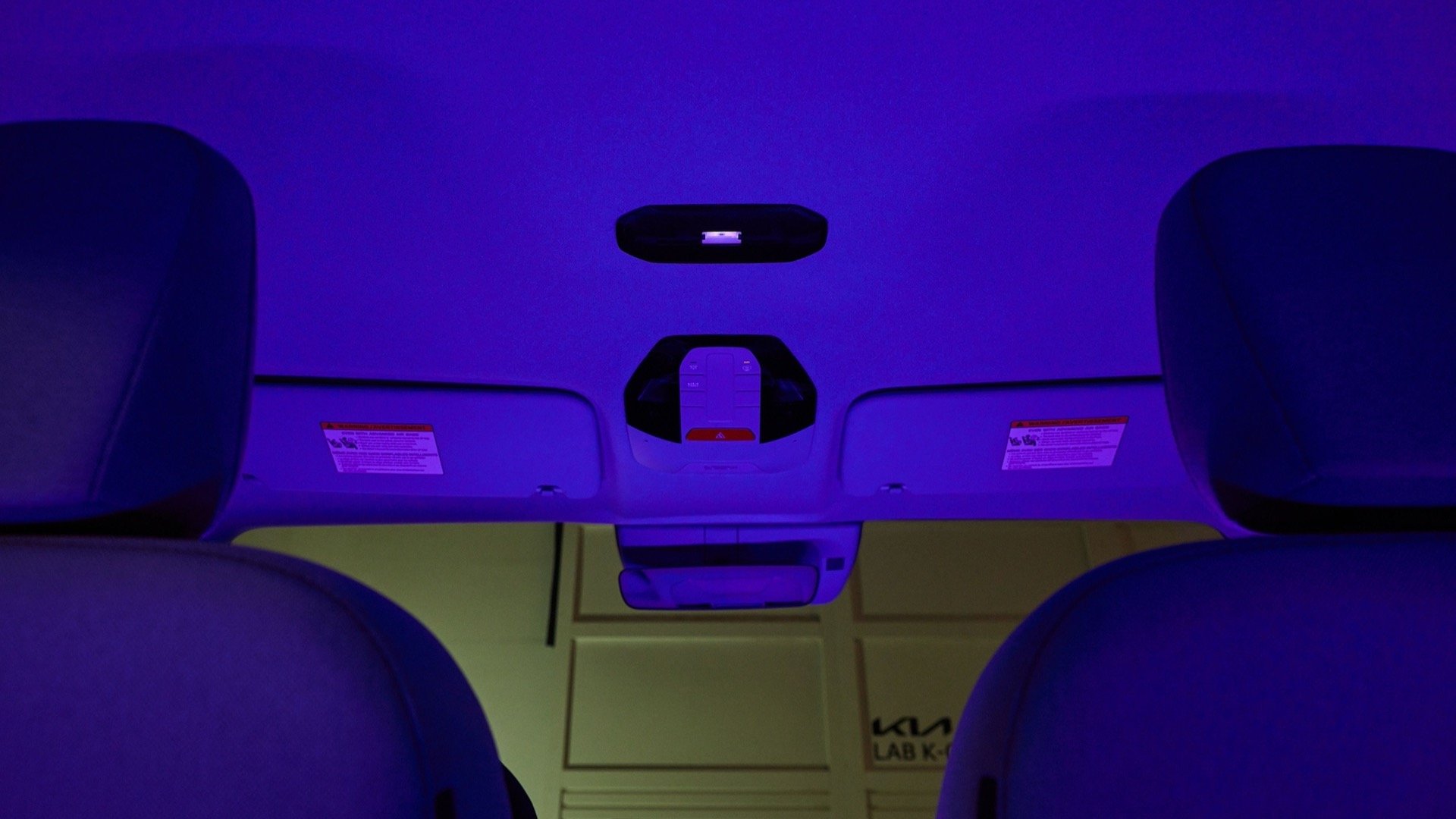
You may have moved on from ultraviolet light sanitizers along with other unpleasant memories of the coronavirus pandemic, but Hyundai and Kia have not. The two manufacturers have created technology that can sanitize entire car interiors—with individuals present.
The concept is termed Plasma Care UVC, and in a statement Hyundai and Kia assert it’s the first of its kind. It employs far-ultraviolet C (far UVC) light within the 200-230 nanometer wavelength spectrum. That specific wavelength has sufficient energy to eliminate bacteria and viruses while not penetrating past the protective outer keratin layer of human skin, according to the manufacturers, rendering it safe for utilization in occupied vehicles. It is positioned at the lower end of wavelengths used by traditional UV sterilizers but is less potent than UV emitters utilized for treating skin conditions or industrial uses.
Far-UVC technology has already been proposed for implementation in hospitals and educational institutions, the statement adds, but some adaptations were required for automotive use. The more confined environment, the closer proximity of occupants to UV emitters, and the array of electronics within a vehicle’s interior all posed challenges, as stated by the manufacturers. Components were miniaturized to fit and underwent the same durability assessments as any other elements integrated into a car interior. A plasma lamp was selected for use since it is more efficient at reaching the 200-230 nanometer wavelength than the commonly-used LEDs, and a filter was added to ensure an extra safety measure.
Engineers evaluated the technology in an approximately 282-cubic-foot chamber intended to replicate a car interior, claiming a 96.8% decline in airborne viruses within 30 minutes. In a more traditional laboratory setting, the same technology removed 99.9% of pneumonia-causing bacteria after 30 seconds and entirely eradicated the bacteria after 60 seconds. In a third evaluation involving a Kia PV5, the UV treatment eliminated 99.9% of E.coli in the electric vehicle’s interior after 40 minutes of operation.
However, this UV sanitizer isn’t yet available for production vehicles. Hyundai and Kia aim to conduct further tests, noting that, like any other emerging automotive technology, future adoption in production cars is contingent upon regulatory clearance. The two manufacturers have a history of publicizing research initiatives that never reach commercial viability, so don’t anticipate seeing UV lights in the upcoming Hyundai Elantra.
Is this even a prospect worth hoping for? Besides disinfecting surfaces, Hyundai and Kia assert that a UV bath can aid in odor reduction. That combination would be ideal for ride-share vehicles. Yet while it may not transform you into a superhero or damage your car’s electronics, what remains unmentioned are the potential long-term impacts on the sanitized interior surfaces. If you want your interior to stay visually appealing, it’s generally wise to limit UV light exposure, not shine it all around.
Have a tip on future technology? Reach out to us at [email protected]
**Hyundai and Kia Launch UV Light Technology for Cleaning Car Interiors**
Responding to increasing health concerns and the demand for better cleanliness in vehicles, Hyundai and Kia have unveiled a groundbreaking solution: UV light technology specifically designed for sanitizing car interiors. This innovation indicates a notable advancement in the automotive sector’s mission to create safer environments for both drivers and passengers.
**Comprehending UV Light Technology**
Ultraviolet (UV) light has long been known for its ability to kill germs. It functions by disrupting the DNA of bacteria, viruses, and other harmful microorganisms, rendering them inactive and unable to multiply. The addition of UV light technology in vehicles seeks to utilize these characteristics to effectively sanitize surfaces inside the car, including seats, dashboards, and other frequently-touched areas.
**Integration in Vehicles**
Hyundai and Kia have incorporated this technology into their newest models, focusing on improving the overall user experience. The UV sanitizing system is generally activated once the vehicle is parked and can be operated through the car’s infotainment system or a dedicated application. The procedure includes the use of UV-C light, which is deemed safe for controlled environments and is designed to function without human presence to ensure safety.
**Advantages of UV Light Sanitization**
1. **Improved Hygiene**: The main benefit of UV light technology is its capacity to drastically minimize the presence of harmful microorganisms within the vehicle, promoting a healthier atmosphere for occupants.
2. **Convenience**: The automated nature of the UV sanitization process enables users to uphold cleanliness without manual cleaning, making it a convenient solution for hectic schedules.
3. **Eco-Friendly**: In contrast to traditional cleaning agents that may contain harmful chemicals, UV light sanitization is a chemical-free method, making it an environmentally friendly alternative.
4. **Consumer Confidence**: As public awareness of hygiene continues to increase, the integration of UV technology can bolster consumer assurance regarding the safety of their vehicles, potentially affecting purchasing choices.
**Challenges and Considerations**
Despite the notable benefits of UV light technology, there are obstacles to address. The efficiency of UV sanitization can depend on variables such as exposure duration and the distance of the light from surfaces. Moreover, manufacturers must ensure that the system is constructed to operate safely without posing risks to passengers or pets left inside the vehicle.
**Future Prospects**
The launch of UV light technology by Hyundai and Kia represents an encouraging advancement in the automotive industry. As the demand for cleaner and safer vehicles continues to rise, it is probable that more manufacturers will investigate similar technologies. Future developments may feature improved integration with smart vehicle systems, enabling more efficient and effective sanitization processes.
In summary, Hyundai and Kia’s adoption of UV light technology signifies a proactive approach to tackling hygiene issues within the automotive sector. By prioritizing the well-being and safety of their customers, these manufacturers are establishing a new benchmark for vehicle cleanliness and paving the way for future innovations in car sanitation.