
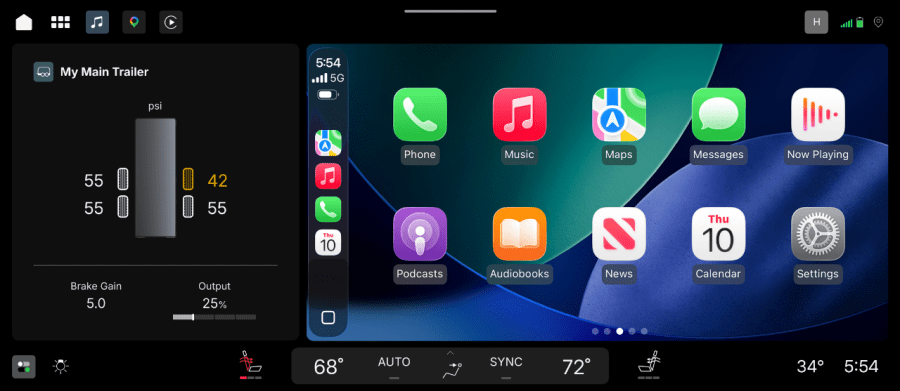
General Motors revealed a new infotainment user experience that will debut in trucks before “expanding across the broader portfolio,” according to the company. The updated UX includes Apple CarPlay and Android Auto in a fresh, picture-in-picture design, and since the messaging characterized this system as “a single scalable foundation that can extend across electric, gas, and diesel-powered vehicles,” many—myself included—understood it to suggest that GM was finally backing down in its battle against phone projection in EVs. Unfortunately, it appears that nothing has truly changed today.
To provide a brief overview, every new GM EV launched since 2024 has sacrificed seamless, comprehensive connectivity with Apple and Google’s smartphones—except, oddly, the Cadillac Lyriq. Traditional gas vehicles have not been affected, even though CEO Mary Barra previously hinted at removing it from those models as well.
On Monday, noted technology journalist Joanna Stern shared on X that, “GM has confirmed it is NOT rolling phone projection to GM EVs. Instead, this announcement is specific to JUST their new gas-powered light-duty pickups, which have always supported Apple CarPlay and Android Auto.” This scenario represents the worst outcome: GM appears intent on continuing its course to deny phone projection, a feature that the vast majority of car buyers express a desire for, from their EVs for reasons that are challenging to justify. We’ve discussed those reasons before, so we won’t go over them again here.
This claim was quite explicit, so I reached out to GM directly and inquired: Will phone projection be available in future EVs? A representative replied with a markedly less definitive statement that, honestly, leads me to believe that GM is sticking to its current stance on the issue:
“We don’t have any news about EVs. The team’s focus is on the 2027 light-duty pickups given their importance to the business. GM’s mention about ‘broader portfolio’ and the UI being a ‘scalable foundation’ is intended to convey flexibility of the new UI framework and not meant to signal future plans regarding projection.”
So, there it is: While certain higher-ups at the company have promoted this new picture-in-picture strategy in trucks as a fusion of the projection and native environments—”a single experience rather than moving from room to room inside a house,” according to Software Defined Vehicle Engineering Executive Director Mike Wahlstrom—it seems gas vehicles will still have access to CarPlay and Android Auto, while electric ones will not.
At this stage, the ambiguous nature of GM’s position and the arbitrary distinction between the haves and have-nots (why the Lyriq?) have arguably generated enough confusion that they aren’t providing any real value to the business. Dismantling this confusion will be challenging if GM eventually decides to change its approach. All I can assert is that the new infotainment system looks appealing, and GM should implement it, just as it is in the Silverado and Sierra, across as many of its products as feasible. Wouldn’t that be straightforward and efficient?
Have a new tip? Reach out to us at [email protected]
**GM’s Conflicted Position on CarPlay: An Overview of Current Developments**
General Motors (GM), a leading automotive manufacturer worldwide, has recently found itself in a complicated and somewhat contradictory position regarding Apple’s CarPlay. As the automotive landscape evolves with the adoption of technology, GM’s approach to this widely used infotainment system mirrors broader trends and challenges within the industry.
**Background on CarPlay**
CarPlay, developed by Apple, enables iPhone users to link their devices to their vehicles, granting access to apps, navigation, music, and messaging through the car’s dashboard interface. It has become a standard feature in numerous new vehicles, improving the driving experience by facilitating seamless integration of mobile technology.
**GM’s Initial Embrace of CarPlay**
At first, GM welcomed CarPlay, offering it in numerous models across brands like Chevrolet, GMC, and Cadillac. This approach was part of a broader strategy to modernize its vehicles and attract tech-oriented consumers. The incorporation of CarPlay was seen as a means to enhance user experience, providing drivers with familiar interfaces and functionalities.
**Shift in Strategy**
However, recent developments suggest a change in GM’s strategy. In 2022, GM declared that it would start to limit the availability of CarPlay in some of its newer models, especially within the electric vehicle (EV) segment. This decision has raised eyebrows and ignited discussions about the company’s long-term vision for in-car technology.
**Reasons for the Shift**
1. **Focus on Proprietary Systems**: GM is increasingly concentrating on creating its in-car technology and infotainment systems. By restricting CarPlay, GM aims to promote its proprietary software, believing it can provide a more integrated and customized experience for users.
2. **Electric Vehicle Strategy**: As GM shifts toward electric vehicles, the company aims to establish a unique ecosystem that aligns with its vision for sustainable transportation. This includes the development of advanced features that may not work with CarPlay.
3. **Data and Connectivity**: By decreasing reliance on third-party systems like CarPlay, GM can enhance its control over data collection and connectivity features, which are gaining significance in the age of connected vehicles.
**Consumer Reactions**
Consumer feedback has been mixed. Many users value the convenience of CarPlay and express concerns over GM’s choice to limit its availability. Critics argue that this move could alienate tech-savvy customers who prefer the familiarity and functionality of Apple’s ecosystem. Conversely, some consumers are open to exploring GM’s proprietary systems, provided they deliver comparable or superior features.
**Industry Implications**
GM’s conflicted stance on CarPlay underscores a wider trend in the automotive industry. As manufacturers seek to set themselves apart in a competitive market, the balance between integrating popular third-party technologies and creating proprietary systems is becoming increasingly intricate. This situation prompts inquiries about the future of in-car technology and consumer preferences.
**Conclusion**
As GM navigates its conflicted position on CarPlay, the company must thoughtfully consider the repercussions of its decisions on consumer satisfaction and market competitiveness. Ongoing developments in this realm will be closely monitored by industry analysts, consumers, and competitors alike, as they may establish precedents for how automotive manufacturers approach technology integration in the coming years.
 admin
admin