
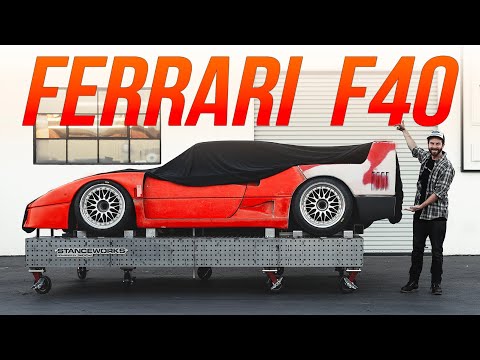
It has been some time since Ferrari took legal action against someone for altering one of its vehicles, but it’s not long enough for anyone to dismiss the chance. That’s why many enthusiasts are closely following Mike Burroughs’ latest endeavor at Stanceworks, where he’s modifying a legendary F40, just anticipating the forthcoming cease and desist. Sure enough, last week he posted a letter from Ferrari’s attorneys on Instagram that appeared to indicate the Italian carmaker was acting again. But as it turns out, that’s not the case, and the situation is more complex.
Burroughs’ project is dubbed the “F40 Evolution,” and it’s significant to note that he intentionally avoids calling it a Ferrari. The build includes a custom-designed tube chassis and an F140 V12 engine capable of reaching 9,000 rpm, which should make it quite thrilling once it’s operational. Currently, however, it’s not—Burroughs has been working on the vehicle since October 2024, proceeding with caution as he constructs pushrod suspension, incorporates centerlock hubs, and engages in various race car activities.
A Genuine F40: The most insane project you’ve ever witnessed is now starting.
All of this is public knowledge. Burroughs has chronicled the entire process on Stanceworks’ YouTube channel with 424,000 subscribers and Instagram account boasting 523,000 followers. In February, he shared a video entitled “Is Ferrari Going to Sue Me for Building My Own F40?” addressing the question that keeps coming up. He mentioned that Stanceworks had previously modified a Honda K24-swapped Ferrari 308, and Ferrari never pursued action over that, despite his public critique of the car during the process.
“I’m more mindful about what I say regarding the F40 because of my deeper respect for it,” Burroughs noted. “I also avoid provoking them. However, they aren’t concerned with what I’m doing here. They have no issues with you modifying their vehicles. That’s perhaps the most common misconception…. If I were expecting to hear from them, I believe I would have by now. We’ve moved well beyond that.”
Then, just last week, Burroughs shared an image of a letter he received from a law firm representing Ferrari alongside a vague caption that suggested he may have spoken too soon. Without additional context, an outcry ensued; supporters vocalized their backing for Stanceworks and criticized Ferrari for allegedly attempting to stifle an exciting project and being overly protective of its brand. Why shouldn’t a car owner be allowed to customize their vehicle as they prefer? It appeared to be another classic David vs. Goliath scenario and a fresh trigger for outrage.
However, that’s not precisely how it unfolded. After his post went live, we contacted both Burroughs and Ferrari for more information. Ferrari chose not to comment, and while Burroughs initially engaged with us, he lost contact before responding to our inquiries. Nevertheless, in a private video posted on Stanceworks’ Patreon, Burroughs provided additional insights that illuminated the communication in a much different way, stating, “Honestly, between us, we’re going to amplify this a little. But it’s not that severe.”
In the video, Burroughs confirms that the letter is indeed a cease and desist—but not regarding the F40. Instead, it pertains to posters and desk mats that Stanceworks was marketing featuring the two cars with visible Ferrari logos, and he admits that was an error on his part, acknowledging Ferrari’s rights to control the use of its trademark.
Meanwhile, both the 308 and F40 projects are referenced in the letter, but he notes that Ferrari’s legal team conceded that they cannot prevent him from altering them. Rather, they are requesting that he publicly recognize to his audience “that there are technical and operational risks associated with using custom or modified components,” and that utilizing “non-Ferrari components… does affect the monetary value and authenticity” of the vehicles.
“They simply want me to acknowledge that. They don’t stipulate that we have to do anything,” he clarifies. “They don’t even insist that we must remove the logos from the 308, which I somewhat anticipated.”
Essentially, Ferrari is perhaps being a bit overly cautious in attempting to protect itself from liabilities should anything go awry with the project, but the automaker is certainly not suing Stanceworks for having fun with one of its most legendary vehicles.
“Let this put to rest the notion that you can’t modify your car,” he concludes. “There you have it, myth debunked.”
A skeptic might argue that it was somewhat misleading of Burroughs to share the letter in that manner, fully aware it would incite public sentiment and fit the ongoing narrative of the formidable Ferrari, only revealing the full context behind a paid subscription that ultimately renders it a non-issue. However, as content creation is indeed a business, similar to car manufacturing, he seized the chance to draw more attention to his work.
This situation echoes a previous notorious instance where DJ and music producer Deadmau5 received a cease and desist regarding a Nyan Cat-themed wrap on his Ferrari 458, which ignited significant public outrage. But that too involved intellectual property issues since he had also modified Ferrari’s logo to represent a prancing cat instead of a horse.
Other narratives about Ferrari taking legal action against owners over modifications have been significantly inflated. We debunked a myth in 2020 regarding a rotary-swapped 456 that Ferrari allegedly issued a cease and desist over (spoiler: it didn’t happen). Besides, the closest approach we’ve seen to Ferrari displaying discontent was when it announced it would reject tasteless modifications to “protect the values” of the brand.
Have a tip or question for the author? Reach out directly: [email protected]
**Ferrari Confirms No Legal Action Against Stanceworks for F40 Modifications**
Recently, the automotive community has been abuzz with speculation regarding modifications made to the legendary Ferrari F40 by the esteemed automotive brand Stanceworks. Concerns emerged about potential legal consequences from Ferrari, the illustrious Italian sports car company, regarding these changes. However, Ferrari has formally clarified its stance, affirming that no legal action will be directed at Stanceworks.
The Ferrari F40, debuted in 1987 to commemorate the brand’s 40th anniversary, is celebrated as one of the most iconic supercars in automotive history. With its lightweight build, turbocharged V8 engine, and streamlined design, the F40 has developed a dedicated following among car enthusiasts and collectors alike. Consequently, any alterations to such a revered model tend to capture considerable attention and scrutiny.
Stanceworks, known for its work in the automotive modification industry, has developed a reputation for enhancing vehicles while preserving their original character. Their recent venture involving the F40 featured a series of modifications aimed at heightening performance and aesthetics, which ignited discussions about the limits of customization and manufacturer rights.
In light of the growing rumors, Ferrari released a statement reinforcing its dedication to maintaining the integrity of its vehicles while also recognizing the zeal of car enthusiasts. The statement articulated that while Ferrari encourages vehicle enjoyment, it does not condone modifications that may jeopardize safety or the original design philosophy. Nevertheless, the company confirmed that it has no intention of initiating legal proceedings against Stanceworks concerning their modifications to the F40.
This clarification has been embraced by the automotive community, as it underscores Ferrari’s recognition of the evolving nature of car culture, where customization and personalization are increasingly welcomed. The absence of legal action paves the way for a more open dialogue between manufacturers and enthusiasts, nurturing a spirit of creativity and innovation within the automotive realm.
The scenario also prompts critical inquiries about the dynamics between car manufacturers and aftermarket modification companies. As the automotive sector continues to transform, with electric vehicles and advanced technology altering the landscape, the necessity for collaboration and mutual respect between manufacturers and the aftermarket community becomes ever more significant.
In summary, Ferrari’s choice not to pursue legal action against Stanceworks for their F40 modifications exemplifies a forward-thinking approach to car culture. It highlights the importance of creativity and personalization in the automotive landscape while upholding a commitment to safety and design integrity. As enthusiasts persist in testing the limits of customization, the interaction between manufacturers and the aftermarket community will likely be crucial in shaping the future of automotive innovation.
 admin
admin