
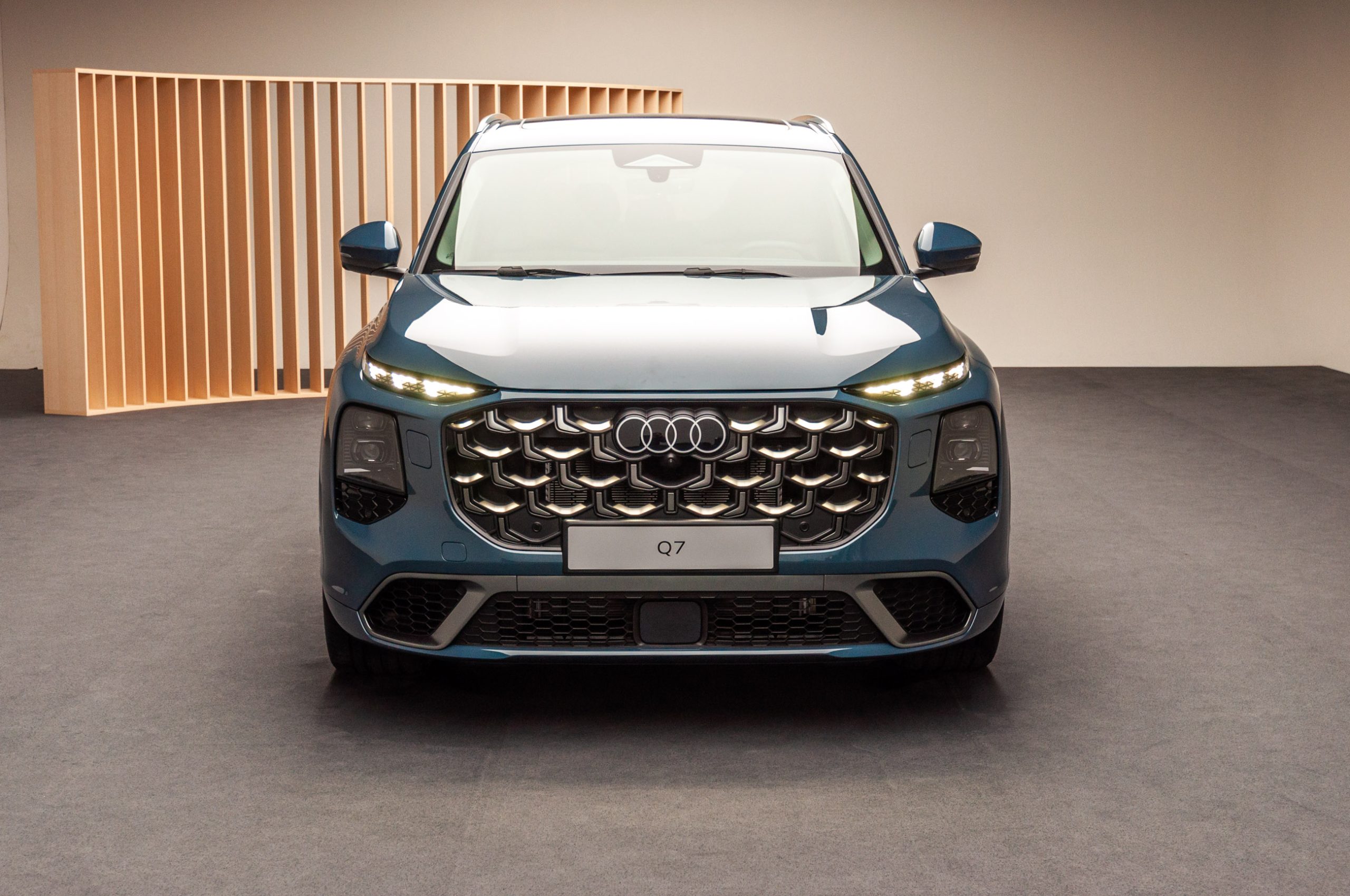
- Striking new style with technological enhancements. The 2027 Audi Q7 showcases a refreshed design inspired by the Q3 and anticipated Q9, featuring cutting-edge Matrix LED headlights and digital OLED taillights.
- Opulent interior upgrades. The Q7 flaunts a Q9-inspired cabin with matte finishes, authentic wood, and an array of screens beneath curved glass.
- Enhanced performance capabilities. A standard twin-turbocharged 2.9-liter V6 provides 429 hp, whereas the SQ7’s V8 generates 591 hp, boosting speed and towing power.
- Expanded space and adaptability. The Q7 features increased cargo capacity and power-operated seating for up to seven, with better access to the third row.
In summary: Audi’s 2027 Q7 brings together innovative design, augmented luxury, and powerful performance, likely establishing a new standard in its category.
AI assisted, editor reviewed
The third-generation Audi Q7 has just been unveiled, using the smaller Q3 as a model to outline the German automaker’s forthcoming direction.
On Tuesday, the 2027 Audi Q7 was launched with a fresh design language, cutting-edge technology, increased space, enhanced power, and while pricing details remain unavailable, it’s difficult to envision it being cheaper than the current model.
Examine the new Q7 closely. It feels familiar yet innovative. This is due to its design taking cues from the smaller Q3’s handbook but refining it further. The greenhouse is more vertical than the current Q7, particularly at the back end with a flatter roof and upright D-pillars. The front separates the horizontal LED daytime running lights from the headlights, with the latter expected to feature the automaker’s latest Matrix LED technology. The lighting components flank a significant egg crate grille. The rear abandons the signature clamshell hatch from the previous two generations, which visually makes the Q7 appear slightly narrower than before due to cutlines. It’s an optical trick. The rear includes digital OLED taillights with three-dimensional effects and customizable lighting signatures. They resemble a boomerang shape with the turn signals forming the lower section. The cost of replacements for these features is uncertain, but the answer is likely “not inexpensive.” Audi proudly highlighted that the towing receiver and the seven-pin connector for trailers are now concealed under a removable panel for a neat appearance.
Inside, the dashboard will seem familiar to anyone who has been in a recent Audi or glimpsed the forthcoming Q9’s cabin. Spoiler: This is essentially the interior of the Q9 scaled down by about a third. Similar to its larger counterpart, there’s virtually no shiny piano black plastic (thankfully!), real wood (likely optional based on specifications), and most plastics are matte rather than glossy. An LED light strip runs along the base of the windshield, indicating to the driver when a turn signal is in use by flashing the appropriate side green or glowing red during emergency braking. Yes, it can sync to the rhythm of the music.
A series of screens merges a digital gauge cluster and touchscreen, angling them towards the driver under a single sheet of curved glass. An additional screen in front of the passenger keeps them entertained. Audi includes a physical volume knob on the center console, but many vehicle controls beyond that are integrated into the touchscreen, including electronically adjusted air vent controls. The exquisitely engineered one-piece stalk design remains intact.
Cooled wireless smartphone chargers output 25 watts each, while USB-C ports available across all three rows provide between 45 and 100 watts, depending on the outlet.
The panoramic sunroof has a function reminiscent of electrochromatic technology using Polymer Dispersed Liquid Crystal (PDLC) that can control the entire piece of glass or specific sections upon selection. This glass roof can also be equipped with 78 LEDs for ambient lighting.
Audi has introduced second-row captain’s chairs, allowing the Q7 to be configured as either a six or seven-seater. All three rows of seats are now powered as standard. The second row can slide and tilt to provide access to the third row, enabling a child’s car seat to stay secured while reaching the third row. The second and third rows have slightly more space than the current Q7, but the third row remains unsuitable for adult travel during long journeys. Buyers will likely prefer the Q9 for additional space. However, the Q7’s cargo area has also expanded, offering 15.1 cubic feet behind the third row, up to 43.9 cubic feet behind the second row, and 78.1 cubic feet behind the first row of seats.
Perhaps the most notable development for folks like my daughter is that the cup holders are no longer miniature-sized. They can accommodate a Stanley. My 12-year old will be thrilled.
The base Q7, at least at the launch stage, will be significantly more powerful than the current 2.0-liter turbo four-cylinder model or even the 2.9-liter turbocharged V6 engine, which produce 261 horsepower and 273 lb-ft of torque and 335 hp and 369 lb-ft of torque respectively. A standard twin-turbocharged 2.9-liter V6 will deliver 429 hp and 442 lb-ft of torque, with an eight-speed automatic transmission transferring power to all four wheels. Audi claims this setup will accomplish a 0-60 mph time of 4.8 seconds and allow for towing up to 7,700 pounds. The SQ7 reappears with a revised twin-turbocharged 4.0-liter V8 rated at 591 hp and 590 lb-ft of torque, trimming the 0-60 mph sprint to 3.7 seconds. The more powerful SQ7 retains the same 7,700-pound towing capacity. While the standard configuration features a steel suspension system, an optional air suspension system along with adaptive dampers are available.
The 2027 Audi Q7 is set to arrive in the U.S. later this year.
Got a tip about an upcoming product? Contact us at [email protected]