
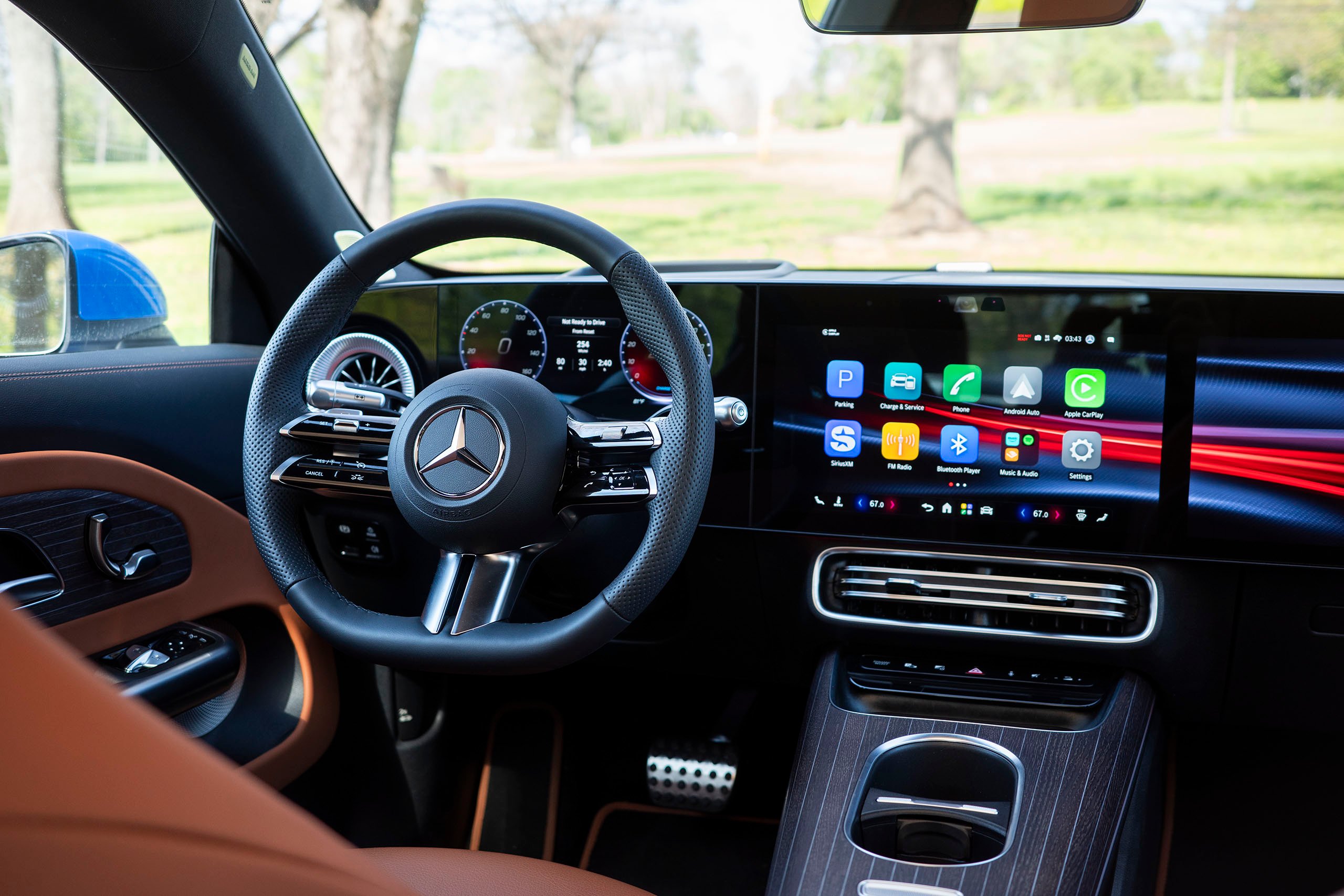
Benjamin Franklin stated that the two certainties in life are death and taxes, but when discussing contemporary car interiors, you can add touchscreens to that list. Regardless of your opinion, touchscreens have dominated dashboards, a trend that contradicts safety issues. In a recent examination, Swedish car magazine Vi Bilägare discovered that touchscreens in modern vehicles are, in fact, more distracting than several years ago.
The magazine evaluated 10 new vehicles along with a 2016 Volvo V60. Drivers were tested on routine tasks—like adjusting climate settings, changing radio stations, and modifying screen brightness—while driving at highway speeds on a closed airfield. The distance traveled and the time taken during these tasks were assessed and compared to results from a 2022 test conducted using the same approach.
The average distance covered while using the touchscreen—and consequently splitting focus between the screen and the road—rose from 756 meters (2,480 feet) in the 2022 assessment to 813 meters (2,667 feet) in the current evaluation. This translates to an additional two seconds required to finalize a task with the 2026 infotainment systems compared to the 2022 models. Be aware that at 60 mph, you’re advancing at 88 feet per second.
The increase in distance traveled while engaged with touchscreens also suggests that efforts by automakers to enhance these interfaces over the last four years have not yielded positive outcomes. As Vi Bilägare notes, screens have become larger and are often better situated than they were four years ago. Many manufacturers have also rolled out new hardware and software behind the screens featuring sharper visuals and layouts meant to be easier to interpret. However, this assessment indicates that this is not truly the case.
A clear illustration of this is the Mercedes-Benz CLA-Class, equipped with the automaker’s latest operating system. Drivers spent an average of 35 seconds interacting with the screen to complete tasks—15 seconds longer than a GLB-Class tested in 2022—and the screen took an additional 19 seconds after unlocking to respond to touch. The CLA recorded an average distance of 1,116 meters (3,661 feet), making it the second longest range in this test, just behind the Mazda CX-60’s 1,137 meters (3,730 feet), a finding that echoes our experiences. The Volvo XC60 emerged as the top performer in the 2026 assessment, yet its average of 485 meters (1,591 feet) per task still exceeded the 68 meters (223 feet) traveled by the Volvo C40 Recharge in the 2022 test.
Not all results were regressions, however. A Tesla Model Y performed better than a Model 3 in the 2022 evaluation. Although it’s simple to credit the absence of buttons and knobs in newer models, the 2026 XC60 outperformed the 2016 V60, which possesses a greater number of those traditional controls. A 2005 Volvo V70 (evaluated in 2022) also surpassed the performance of the 2016 wagon.
### A Neutral Evaluation of the Distraction Levels Caused by Car Touchscreens
#### Introduction
The incorporation of technology in vehicles has transformed the driving experience, providing both convenience and advanced capabilities. Among these developments, car touchscreens have established themselves as a fixture in contemporary automobiles. Nevertheless, the effects of these touchscreens on driver distraction have sparked considerable concern. This article seeks to objectively evaluate the distraction levels induced by car touchscreens, analyzing the cognitive burden they impose on drivers and the repercussions for road safety.
#### Understanding Driver Distraction
Driver distraction is recognized as any activity that diverts attention from driving. This encompasses visual, manual, and cognitive distractions. Touchscreens, which necessitate visual and manual engagement, can considerably add to cognitive load, hindering a driver’s capacity to process information and respond to road stimuli.
#### The Role of Touchscreens in Vehicles
Car touchscreens fulfill various roles, encompassing navigation, entertainment, and communication. They grant drivers access to GPS systems, music playlists, and hands-free calling. Although these features can enhance the driving experience, they can also elevate distraction levels.
#### Research Findings
Numerous investigations have been conducted to assess the levels of distraction associated with car touchscreens. Key conclusions include:
1. **Elevated Cognitive Load**: Research indicates that interacting with touchscreens can heighten cognitive load, resulting in slower reaction times. A study published in the journal *Traffic Injury Prevention* found that drivers engaging with touchscreens took more time to respond to critical driving tasks compared to those using conventional controls.
2. **Visual Distraction**: Touchscreens necessitate that drivers avert their eyes from the road. A study by the AAA Foundation for Traffic Safety discovered that drivers who interacted with touchscreens spent, on average, 40 seconds with their eyes off the road while completing tasks like entering navigation information.
3. **Task Complexity**: The intricacy of tasks executed on touchscreens can intensify distraction levels. Simple tasks, like adjusting volume, may present a lower distraction level than more complex tasks, such as programming a navigation system. The National Highway Traffic Safety Administration (NHTSA) has categorized touchscreen tasks by their complexity, indicating that more complex interactions substantially increase distraction.
4. **Comparison with Other Interfaces**: Studies have compared touchscreens to alternative interfaces, such as voice commands and physical buttons. While voice commands can diminish visual distraction, they may still necessitate cognitive engagement that distracts drivers. Research suggests that physical buttons might provide a more intuitive and less distracting option.
#### Mitigation Strategies
To alleviate the distraction levels caused by car touchscreens, several strategies can be implemented:
1. **Design Enhancements**: Manufacturers should concentrate on crafting user-friendly interfaces that minimize the necessity for intricate interactions. Larger icons, simplified menus, and voice-activated controls can assist in reducing cognitive load.
2. **Driver Awareness**: Educating drivers regarding the potential distractions linked with touchscreens can encourage safer driving practices. Awareness campaigns can urge drivers to limit touchscreen interaction while operating their vehicles.
3. **Regulatory Framework**: Governments and regulatory entities can establish guidelines for touchscreen functionalities in vehicles, promoting designs that prioritize driver safety.
#### Conclusion
While car touchscreens provide numerous advantages, their ability to distract drivers must not be underestimated. Objective evaluations of distraction levels indicate that these devices can have a meaningful impact on driver focus and reaction times. By grasping the ramifications of touchscreen use and employing effective mitigation strategies, the automotive sector can enhance road safety while still delivering the technological comforts that contemporary drivers anticipate.
 admin
admin