
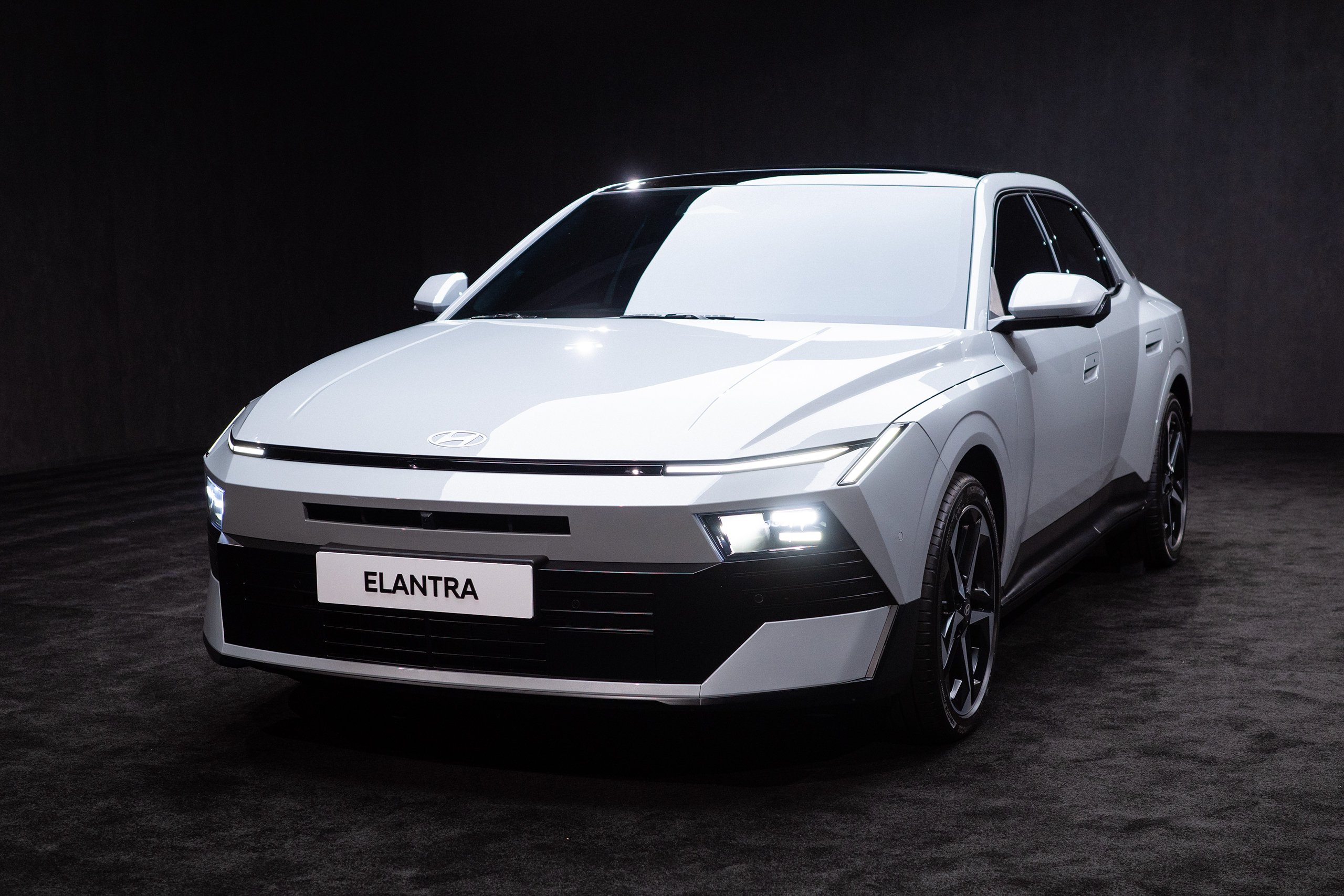
Hyundai’s design is the most fluid in the business, and the wave that hit the Tucson a few weeks back is now crashing on the brand’s compact sedan. The 2027 Elantra marks the four-door’s eighth generation, and certainly its boldest fashion statement yet.
An “everyday muscle car” is how the company defined it in a presentation to media, and while its performance figures might not exactly support that claim, the bulging fenders, three-box silhouette, and retro-forward lines allow you to follow the logic.
The new Elantra is wider than ever before at 73 inches, and 3.4 inches longer than the outgoing car, with 1.2 inches of that between the wheels. That length was added for second-row passengers, as Hyundai tells it, who will also benefit from an extra 0.7 inches of headroom.
Dimensionally, the Elantra is ticking closer to the midsize Sonata, yet Hyundai promises a curb weight below 3,000 pounds. The new Elantra will land in the U.S. first in gas-only guise, with a 147-horsepower, 138 lb-ft SmartStream 2.0 four-cylinder targeting 35 mpg. A conventional hybrid will come slightly later, as a 2028 model, and it’s clearly positioned more for fuel economy than additional power, as it only packs 8 extra hp but is estimated to average 53 mpg.
One small but important note: a multi-link independent rear suspension is exclusive to the hybrid. The regular Elantra makes do with a torsion beam.
Arguably more controversial than the Elantra’s exterior is its interior, with a massive 12.9-inch center infotainment screen as standard, supplemented by a slim 9.9-inch readout for the instrument cluster. That strip won’t serve all the information that would normally appear in the cluster, however; some of that lives on the left edge of the infotainment panel, like in a Tesla. The new touchscreen runs Hyundai’s new Pleos operating system revealed earlier for the Tucson, and it is, in a word, quite busy.
On one hand, I do find Pleos to be aesthetically sharp and straightforward, but it seems to present an absolute deluge of information, particularly if you, say, toggle the climate window open, which doesn’t replace the stuff that’s already on the screen so much as it hovers over everything (seen below). I am worried this UI is just going to be too overwhelming for road duty, but we won’t know for sure until we have proper seat time. Surely, Hyundai’s new conversational Gleo AI assistant is designed to lessen the need to tap.
At least there are plenty of buttons and switches, both on the steering wheel and for heating and A/C, under that big screen. Hyundai said the retention of real, physical inputs was a direct response to customer feedback; in fact, Olabisi Boyle, Senior Vice President of Product & Mobility, went so far as to say that the industry “got that wrong.”
The hard edges outside the cabin give way to curved surfaces with textures that appear soft, even if they’re just basic plastic. Hyundai calls this look “Furnished Space,” and I liked it on first impression—particularly with the ambient light playing against the dash’s empty space—but, as always with Hyundai Group’s design, I wonder how it’ll age.
A few neat features worth calling out. There are two USB-C ports up front, and, between them, they provide up to 100 watts of power. That’s very impressive; you could charge a laptop through one of those. Also, a Stay Mode, exclusive to the hybrid model, allows all of the car’s electrics to continue running without the engine, as if it were an EV.
Hyundai isn’t talking about price or availability yet, but we do know that production for both gas and hybrid sedans will start in the first quarter of next year.
Got a news tip? Reach out to [email protected]
The post The 2027 Hyundai Elantra Has the Wildest Fenders I’ve Ever Seen on a Basic Sedan appeared first on The Drive.