
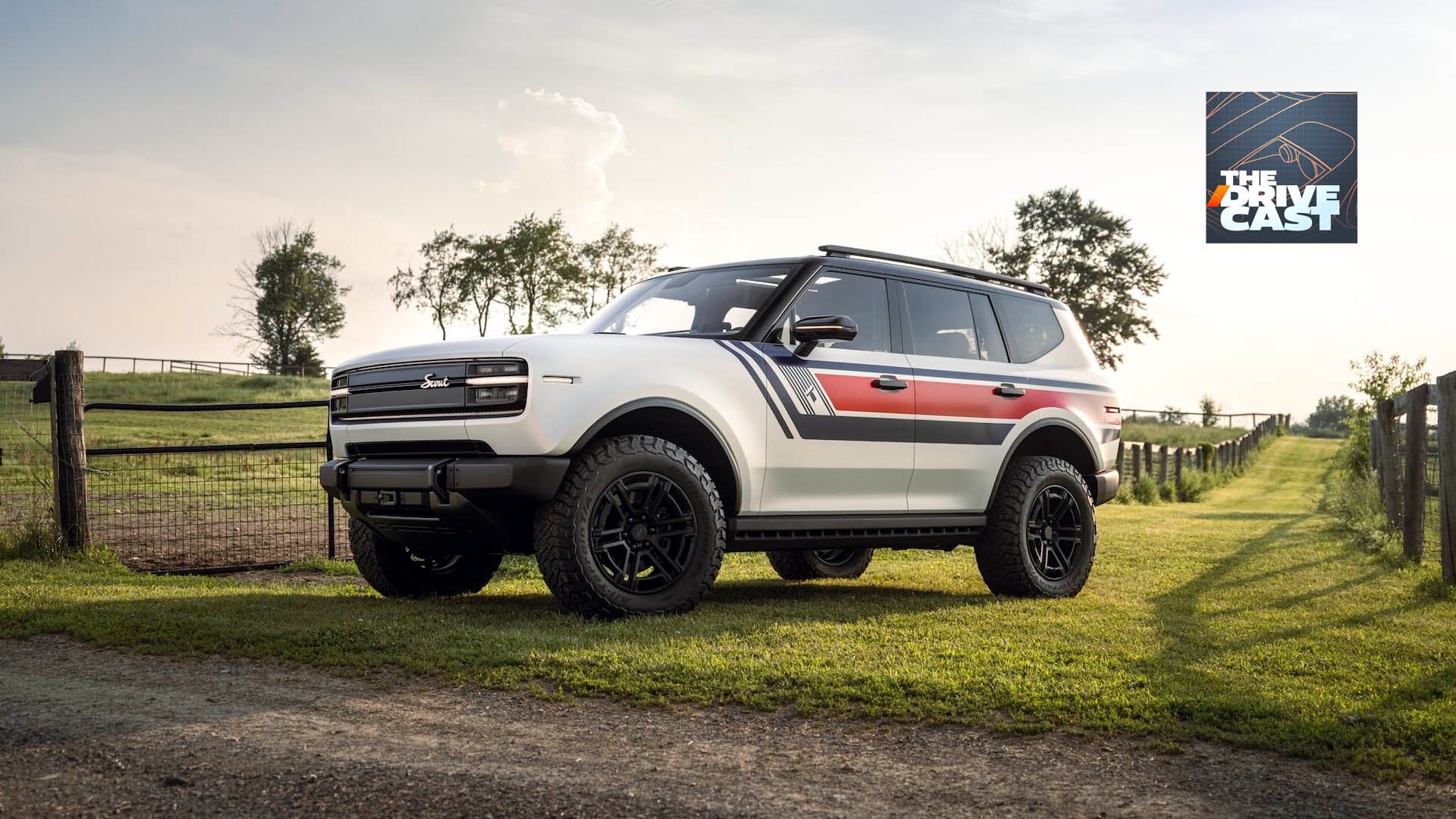
Two years ago Volkswagen Group revived Scout from the grave, showed off some pretty rad concept cars with some pretty tantalizing specs, and a pretty enticing price. A lot’s changed in the world, and healthy skepticism is only natural when it comes to reviving an iconic automaker.
Now validation units are moving off the assembly line in a 90% completed factory. On the latest episode of The Drivecast, Scout Motors President and CEO Scott Keogh sat down exclusively with The Drive to sort fact from fiction, talk pricing, timing, the competition, and reality.
Keogh’s mission is no easy feat, bringing an American icon back from the graveyard as an EV, making it relevant to generations of people who weren’t even born yet when the last Scout was built in 1980, and developing a complex battery electric platform with a gas engine range extender.
Not to mention, doing all of that under the Volkswagen Group, which got the rights to Scout with its acquisition of heavy-duty truck manufacturer Navistar in 2021. It’s got plenty of other problems right now as sales in China are flatlining and its other EV efforts are struggling, but the reason it’s poured billions into resurrecting Scout is because the Germans know America doesn’t run on Dunkin. It runs on trucks. VW Group doesn’t have any body-on-frame pickups or SUVs for sale in this country, which means it’s missing out on a huge profit center. It sees Scout as critical for getting its finances back on track. Scout revealed its first pickup in SUV concepts in 2024, which somehow was two years ago, and they looked amazing. Too good to be true, maybe? Beautiful retro design, real off-road capabilities, tantalizing pricing, and of course, that range extender engine.
Still, there are a lot of questions. Will these things arrive as promised for the price they promised, with the specs they promised? Can they get around those dealer lawsuits? Can a German company make electric trucks work in America when so many others have failed? Today, it’s the resurrection of Scout, what’s going on behind the scenes and sorting out hype from reality with Keogh.
First time? The Drivecast is The Drive‘s weekly podcast that takes you behind-the-scenes on the largest controversies, stories, and characters shaping the automotive industry along with the way our roads look today. Powered by The Drive‘s inside access, original reporting, exclusives, and insights, The Drivecast aims to make everyone an insider.
Listen to The Drivecast via Spotify, Apple Podcasts, or Amazon Music. Love it? Like it? Want to help? Leave a five-star review on your platform of choice to help get The Drivecast
Full Transcript
Joel: Scott, thank you for taking the time. We’re here in Blythewood at the new factory where you guys have actually got vehicles pr- pre, pre, pre-production. They are not even, and people aren’t gonna know this term, it’s an industry term, Ivers. They’re not even Ivers. These are validation units. These are proof of concept. We can move metal. We can, you know, we can figure out the issues. But there’s so many questions about Scout that people have that we want to run through here, and I know we’re limited on time, so we’ll blow through a bunch of these. The overarching thing that we wanna ask is, you know, we’ve seen the Simpsons, we’ve seen the monorail episode, we’ve seen how long it took to get a Cybertruck. , But I think the thing that people… There was skepticism when they debuted, of course. Healthy skepticism.
I think now we’re two years later. Are they real? Are they coming? Like what… People are like, “These things are gonna happen?”
Scott: Big time, they’re gonna happen. And in about half an hour, you’re gonna go to the factory and see exactly what’s happening. Look, let’s be straightforward. We’ve hit basically every milestone and have fulfilled every sort of commitment and promise. So you’re right, two years ago we showed the concept vehicles and we laid out the specs, we laid out the pricing, we laid out the vision, and we laid out the design at that time. And if you look at it, what have we achieved since then? Basically, the design has manifest itself into a production car, early validation. We’ll talk about that. You’ll see it. The cars are actually being tested as we speak and mules are out there. Software is being integrated. And then if you look at the factory, we broke ground, which means shovel in dirt, you know, just over two years ago.
And you’re gonna see a factory that’s 90% complete. And I think the magical thing we’ve done, most people outsource the prototype or early validation cars. They don’t have a running factory, or if they do, what they have is an existing car there, so they never integrate it. So for us to prove and validate that we can make the body, paint shops working, of course, it’s gonna take a little bit to get assembly fully going, but it is big time happening. And honestly, we fulfill commitments and, we’re super excited.
Joel: I gotta tell you, it’s funny. It’s almost like you know what I want. Like, you know what the Internet wants to hear because you ran through so many things just now – … That I wanna hit through. So let’s go through it.
Scott: You have to remember, we have a couple of hundred thousand, as you know, customers out there waiting for the car, so I hear it a lot as well.
Joel: Okay. Are we gonna switch sides here because my next question is, I wanna – All right,
Scott: I’m gonna stop.
Joel: Yeah, yea yeah. I wanna… man, you are on it. So let’s just run through a couple high level things, just so we have update numbers as we go into this.
Scott: Perfect.
Joel: Today, how many reservations are we at now?
Scott: We have 212,000 reservations as of a day or two ago.
Joel: And what’s the expected conversion… ‘Cause Reservations, you’re executive from other companies as well from this, from your past. You know reservations are different than orders and people buying trucks and SUVs. What’s the expected conversion or what’s the goal? What’s the, what’s the target?
Scott: Look, here’s what I’d like to get to. I think without a doubt, we can easily get to 400,000 reservations by the time we launched the vehicle. The thing that makes me happy is if you look at when we revealed the car, reservations has been consistent. Each and every week, we’re getting, hundreds and thousands of reservations, which is awesome. What would I like to do? I would love to have about 12 to 18 months of sales fully sold out, dialed in. So how the process work, right now you’ve put down $100 to have a reservation. At some point, we’re gonna fully open up the configurator, that configurator will give you full transparency pricing and options, and then that will convert into an actual sale. So if we can get, let’s say a year to 18 months of sales fully sold out, fully booked on a thing, that’s the goal.
And you’re right, I’m not naive that there’s gonna be a 100% conversion for every reservation holder. That’s crazy. Absolutely crazy. But I’d like to see a high number. I think we will see a high number. I’d be crazy to commit to it because then you’re gonna hold me to it for the next couple years. So, but I think it’s gonna be… The reason I think it’s gonna be high is this isn’t being treated like just the next generation of another car. There’s some people that have literally been waiting this for decades. When we hear the stories, I think it’s 50% about an awesome product. The other 50% is why I believe in the brand, why I believe in bringing back American manufacturing, what we’re doing here in Blythwood. So they’re committed much more than just a product with features. They’re committed to the idea and that’s, that’s awesome.
Joel: Well, it is a unique brand because a lot of people can say, “My grandfather drove.” Like you can’t… And you can’t say, you can say that about a lot of historical brands that are on sale today or they’re dead, but you can’t say that about a lot of… No one’s saying that about Tesla, Lucid, Rivian. Like you can’t, right?
Scott: Exactly.
Joel: Like these are clean sheet companies.
Scott: Exactly.
Joel: So, on the conversion thing, and, and you mentioned production capacity, as we’re running through a couple more numbers and then we’ll move on from numbers, what is the initial and then long-term goals? ‘Cause You guys have built this so you can expand this plant as well. So what’s the initial, we can build up to this volume per year, and then as you guys continue to expand the factory and/or you need to increase volume, what are your caps?
Scott: Yeah. So look, what that factory can get to, I think the best number to use is approximately 200,000 units. The factory that you’ll see is, can go up to 200,000 units. Now, of course, you can work shifting –
Joel: Per year, annually?
Scott: Annually. Per year. Exactly. So what’s our goal? How quickly can we get to 200,000 units?
Joel: Sure.
Scott: Now, you’d be crazy to say we’re gonna get there in 12 months.
Joel: You’re gonna get that ramp up.
Scott: Exactly. So we wanna deliver great high quality car, but of course we wanna ramp as quickly as possible. The number in my head, honestly, when I look at a ramp up, it’s how quickly can you get to 100k? Get to that number because that at least gets you covering the fixed cost. It gets you on the absorption. You can start to breathe and then go. But 200,000. Now, what we can also do at some point, there is enough land to basically mirror the factory, then you can double it, and that can get you into a zone of 400,000. If we wanted to do more than that, you’d have to press really hard with the scheduling. Work on Sundays, triple shift, all that kind of stuff. I’m not sure we’d go there just yet.
So 200,000 units, good number.
Joel: But not unheard of in the industry. We’ve seen truck plants.
Scott: Not unheard of.
Joel: No triple shifts, et cetera.
Scott: Yeah. And so we’re capable of doing it, is my, , is my, is my point. Exactly.
Joel: Okay. And then actual timelines now, because things have shifted and over time, let’s just as we’re locking in where we are today.
Scott: Yeah.
Joel: What’s the particular for the timeline for the Traveler EREV, Terra EREV, and the BEVs, and will the BEVs actual happen? ‘Cause I do… We’ll get to this in a second, but we know that reservations have been a little slighted.
Scott: Big time. 87%. But we’ll get to that. Look, we are making validation cars right now. We’re gonna continue to make better and better validation cars to simplify it. We call them VFF1s, that’ll go to VFF2, it’ll go to PVS, it’ll go to zero, and then it’ll go to customer production. We’re gonna be doing that all the way through 2027, each time making more cars, validating, boom. Cars in the hands of customers, 2028. What we originally committed is sometime around ’27 in the customers. So if I look at it in light of everything, a commitment made in 2024 to where we are now, I think we’re still –
Joel: Lots happening in two years.
Scott: Super, super on target with that thing. So that’s where we are in terms of that. In terms of vehicles, we are gonna launch 100% traveler first. That’s the only thing we’ve communicated. We’re gonna launch EREV first. It makes sense. We’ll talk about the mix in a second. And then Terra will follow. We haven’t confirmed those timings. So Traveler, EREV first.
Joel: So if a guy or gal wants Terra, they… Because there, there are customers that have reservations on Terras.
Scott: Yes, there are.
Joel: How long are you… Are we talking years, months? Like, how long is someone gonna have to wait extras is where I’m getting?
Scott: After the Traveler.
Joel Okay. After.
Scott: Sorry to be – Sorry to be one of tho guys.
Joel: You know, I get it. And you mentioned Traveler is now 87%?
Scott: EREV is 87% of the mix.
Joel: So you have 87% of the mix.
Scott: Exactly.
Joel: Was that expected?
Scott: Maybe a little higher than what we expected, for sure. I think we were certainly expected EREV to be the predominance of the thing. That’s no debate, maybe a little higher than what we expected. But I think if you look at the specs of the EREV, it’s a pretty phenomenal offer, and I think that’s motivating a lot of people without a doubt. The specs of having something that’s 1,000 pound feet of torque, 800 horsepower, 500 miles of range is a pretty phenomenal solution. And I think that’s why people are, people are jumping there. The other thing we noticed, which I think is great, is if you look at a BEV buyer in general, what we’ve seen, there definitely is a BEV buyer that’s pure BEV, period, bar none. We’ve also seen a BEV buyer that says, “Yeah, an EREV totally works for me. I get 150 miles of pure electric range. I can get gas as a sort of insurance policy when I need it. Fantastic.” The other side is most of the people making reservations are internal combustion engine people, and they’re saying, “Yeah, this is perfect. It gives me the, let’s say, security blanket, but it has all the things I love about electric vehicles, the torque, the quiet, the power, and everything else.” So I think it’s a, an awesome mix and that’s
Joel: Stepping stone.
Scott: Big time. Big time. Big time.
Joel: So is the BEV still gonna happen at some point?
Scott: Right now, the BEV is gonna happen, but we’re definitely gonna prioritize the EREV, and it’s simple math. 87%. Sure, of course. 87’s bigger than 13.
Joel: Do you view Scout as a Rivian competitor? And who do you see as a direct competitors as a brand?
Scott: Look, I think anyone selling a truck and SUV and doing something cool is a competitor. So let’s not be naive. I think you’re crazy to sort of so finely slice the market. Do I see ’em a direct competitor, massive cross shop? No. Who do I see as the competitors? If I look at the Traveler world, I would see vehicles like the Toyota Land Cruiser, see vehicles obviously like the Bronco, even to go a little bit higher end on the Defender is the definite crossshop. If I look on the other side, definitely Ford, definitely Chevy, and a little bit of Rivian in there. But the difference between, let’s say, our truck, it’s a whole different philosophy. One, we’re basically a size up. It’s a full size vehicle. We have a full five and a half foot bed, so the Rivian does not. We have a separate cab in terms of the architecture, how we set the vehicle up, body on frame, solid rear axle. It’s a whole different vibe, if you will, than what the Rivian’s done.
No criticism of Rivian. It’s just different target group, different everything. I think the other thing is the brand profile is quite different. We’ve set Scout up to sort of be an authentic, no joke, American brand. And I think you said an interesting thing. One of the powers that we have is the brand. If you don’t have it, you have to go create a name and you have to say, okay, how do we, how do we create this name? You have to call a party. They have to create some name that theoretically sounds like adventure and outdoors and whatever. It’s like, we don’t need it. We’ve got Scout, it’s got it. And that’s a, that’s a big asset and we’re using it and people love it.
Joel: So let’s go back to pricing. , Originally, it was supposed to be less than $60,000. Will that hold the line? Is that gonna survive? Obviously, like you said, two years, a lot’s changed, but you guys have come really far in two years in terms of we started with a dirt pile and now we have a factory. Will $60,000 hold the line?
Scott: 100% holding. We always committed we’d be high 50s, we’d be low 60, and that’s exactly where the pricing is gonna be, and that’s where we are.
Joel: So the one shown in concept form that we’ve seen now a couple times, we’ve seen different colors, we’ve seen with different wheels and tire sizes and all that stuff, but let’s just say in general, what are those? Those are loaded? Those are mid-spec? Forget the accessories for a second.
Scott: Yeah, no, that’s, that’s good. You can acquire that vehicle that you’re seeing, particularly that entire, let’s say, drivetrain, right? All the specs that we’ve, I’ve just said right? The 500 miles – The harvester. 150 electric and all of that for high 50s. Now, I haven’t got into, do those vehicles have cloth or leather and all that kind of distinction. But that power, that equipment, that body style, that whole thing for high 50s, which by the way, I totally agree with you. A tariff storm, an inflation storm, inflation at the factory as well as inflation on raw materials and, and suppliers and everything else, to be able to hold that pricing speaks to the killer hard work that we’ve been doing on the bill of material and the material cost and everything else, which we can, we can get a deep dive on that as well.
So, so yes is the answer.
Joel: All right. I’m not expecting you to suddenly sell one of those with 37s and, and a winch and all that, like –
Scott: Right, exactly.
Joel: By all means, but that’s not worth –
Scott: We’ll offer that stuff, by the way, but –
Joel: Of course. So, all right, so let’s go to that for real quick. A loaded version. Let’s say somebody that has a winch and, and that’s just, let’s not go accessories because you can go crazy with accessories.
Scott: Yeah.
Joel: But leather, full on compass, the full on everything. What it, what’s… If we’re starting in the high 50s to low 60s, what’s our, what’s our range? We know where Rivian goes.
Scott: You can work your way up to the high 80s into the low 90s with a, –
Joel: We’re not touching six figures?
Scott: Are we touching six figures? No, unless you put completely, as you say, crazy time accessories on, puts it to a different place.
Joel: Okay.
Scott: But Scout, we’re not.
Joel: Okay. So, and to your point about Rivian, Rivian’s going from, let’s say, 70 to 130, right? So, like, I unders… And, and Defenders, you can… I mean, Defender one, 110 with a V8, that’s, that’s north of what I just said.
Scott: Exactly.
Joel: So those are expensive vehicles.
Scott: Okay. And I think where’s gonna be our sweet spot? I think our sweet spot is gonna be sitting in the 60s, obviously, with exactly the vehicle I told you about, you know, that platform. So that’s gonna be a phenomenal price.
Joel: So let’s talk real quick about, and, and move on, and then we’ll move on from, from options. The EREV versus… Which is the harvester, to be clear for anyone listening, the Harvester is the EREV, that’s the, the range extender –
Scott: Yeah.
Joel: With the gas engine. So if that’s gonna be, let’s call it 60, high 50…
Scott: Yeah. Let’s… call it 59.
Joel: We’ll just, we’ll just call it 59.9999 without destination.
Scott: There you go. ,
Joel: but, but what is that? If that’s the harvester –
Scott: Yep.
Joel: Is the BEV comparable? Is the Harvester an option that costs ex – like, is the BEV now gonna be, when it, when it comes, less expensive because the Harvester is an option? Or is it, well, it’s one-to-one because the battery is bigger, so the battery costs money, but now we have a gas… You see what I’m asking?
Scott: I see totally where you’re going. And look, the only pricing we’re giving is we are gonna launch with the EREV.
Joel: This is what we’re launching with, this is what it costs.
Scott: And that’s our price. Exactly. And then every step we’ll get there, I promise.
Joel: Okay. Let’s go to sales. You guys are doing a direct sales model. Same thing. Rivian’s done, Tesla’s done, Lucid has done. Each one of those, I’m gonna call it, has paved the way, if you will.
Scott: Yes.
Joel: They’ve, they’ve, they’ve been barnstormers. But they’ve all had their own challenges, and they all still have their own challenges. You can’t lease a Rivian in Minnesota right now. And initially, you couldn’t do direct sales. You still can’t do direct sales with some of those in certain states, right? Like, there are challenges. You guys just have gone through this now twice, I believe, with California. You’ve just done, I think it was on the 9th, gone around with Tennessee. Obviously, you’re not selling vehicles today, so this isn’t a huge issue today, but these are issues you have to tackle in the next –
Scott: Yeah.
Joel: 16 months.
Scott: Yeah.
Joel: What is plan B? Let’s just say you can’t sell in South Carolina. A federal judge says you can’t sell in South Carolina, and a guy’s got a reservation in South Carolina. What’s plan B?
Scott: There is only plan A, and plan A is to execute it direct to consumer. And the reason there’s no plan B in my mind is, one, it’s strategically right. Why is it strategically right? In this environment, you wanna have a relationship directly with the customer. You wanna have direct control of the data. And in the world of AI, I promise you, you wanna have to do that. When you have someone’s agent buying a car from another person’s agent, spiraled across thousands of dealerships, it’s, it’s gonna be chaos. So 100% is the right strategy. If you look at it, if you wanna look at it the other way, a monopoly is an extremely hard thing to curtail. Interstate commerce is an extremely impossible thing to curtail because that’s called the constitution. And so you’re not capable… A judge is not capable of saying to a South Carolinian, “You cannot buy a Scout.” So there is a way, and we will 100% continue to find that way.
And as you well know, we have the licenses, and with those licenses, you can execute a 50-state strategy, and we will execute a 50-state stragedy. The key debate I think we’re really getting to is how convenient is it? How easy is it? How simplistic is it? That’s what we wanna do. We wanna be maximum convenient, max and easy. It gets more challenging when you have less licenses, without a doubt. But the path, as you say, has been, let’s say, broken and, put through and trailblazed by Tesla and by others, and we’re gonna continue to follow that because it’s the right thing for our customers, it’s the right thing for America competitiveness, and it’s the right thing for us. So that’s what we’re gonna do. And I’m not a fan of having plans A, B, and C. Armies need to march, you need to get up to the mountain.
And plan A is to climb to the top of the mountain, and that is what we’re gonna do. Was it easy? No.
Joel: I like the military reference. I like the, the I’m a general, we got soldiers –
Scott: Let’s go. We’re going up the mountain. Our army is the American consumer because they’re on our side.
Joel: There you go.
Scott: ‘Cause They want… So –
Joel: They want it.
Scott: They, they, they want it. And, and, , and to that – Or at least they want the choice of it.
Joel: Well, and to that point, like, you’ve – look, you’ve worked in other… I’m gonna use air quotes here, car companies because, like, you know, the elephant in the room, Volkswagen Group is, is a conglomerate, right? They, they actually own Scout and the rights right through Navistar acquisition.
Scott: Exactly. Exactly.
Joel: But you’ve worked at Volkswagen, you’ve worked at other companies within Volkswagen and in the industry.
Scott: Yeah.
Joel: So you’ve worked with dealers, you’ve worked with dealer lobbyists. You know industry, the sector, that vertical, if you will. Obviously, they want… I mean, Volkswagen dealers it’s very obvious why they would wanna sell Scout. They want body-on-frame trucks and SUVs because America runs on, not Dunkin Donuts, trucks and SUVs, right? Like, that’s just what it is. We all know this. I get it. But also, at the same time, I have eyes. I’m at the factory. There’s no Volkswagen batch here. It’s a Scout, not Volkswagen. And your trucks and SUVs are gonna say, Scout, not Volkswagen. So the obvious argument is, well, we’re not selling Volkswagens. I get that. What do you guys envision in terms of service though, right? So obviously, Volkswagen’s got this vast network. What are you guys gonna do in terms of service? How do you lay it out? I buy a Scout directly from you, you know, a couple taps and some Apple Pay.
You guys take my 60,000, my 59,999. 99. What am I gonna do with my Scout? How am I gonna get a service?
Scott: Yeah. So look, 100%, we are gonna service a vehicle. And I think there’s a myth out there. The myth is, if we go direct to consumer, that means it’s a mobile app digitally thing, and we’re just gonna abandon you and just be a digital enterprise. No, no. We’re also gonna do serious hardware, and that hardware manifests itself as we’re gonna build a hundred Scout stores in the country, and those Scout stores are gonna have lifts, they’re gonna have technicians, and they’re gonna fix your car, and you’re gonna go to them to do test drives, and you’re gonna go to them to service your vehicle. The way we’re looking at this is quite simplistic. We engineered the vehicle. We’re certainly capable of training the technicians to repair the vehicles, and those repairs are gonna work this way back to our engineers so we can manufacture the better vehicle, have a circle, and make a perfect car.
So that’s what we’re gonna do. I think the one thing where maybe Tesla went a little bit awry, and it’s a lesson we learned, they focused heavily on malls at the beginning to get exposure to the brand and show it. They focused less on service. We are 100% focused on service from day one. We are building a service infrastructure. We think the number one problem to solve is servicing and taking care of the customer, taking care of the vehicles, as opposed to, let’s say, being in high-end shopping malls and things like that. So we’re building for service, and we know how to do that.
Joel: So that’s actually a good question because, , you know, I, was… RJ Scaringe, the founder and CEO of Rivian was on the podcast.
Scott: Yeah.
Joel: He’s was on the Drivecast. We’re big fans, obviously. And we talked about service. And they, and, you know, Te- Tesla, Tesla’s a pioneer. They laid the groundwork. They were first. And Rivian came after, and I think both of them had the opportunity to learn a lot from Tesla, just the same as you just said. But in ways, they followed Tesla in certain ways, right? They started off by having galleries, ser – whatever you wanna call it, in a mall, right? And then their service centers are separate. They are two independent… Service is dirty. Nobody likes service. It’s dirty. It’s oily. It’s wrenchy. Like, nobody wants to see that end of it. It’s not pretty. It’s not pristine. It’s not clean, right?
It’s not a good experience if you, if your customer –
Scott: I wanna debate you on a second, but keep going. Keep going. I wanna see the question.
Joel: I like the smell of oil and I like service.
Scott: I love service.
Joel: I like wrenching on my own car. I do my oil changes. But the general consumer, nobody lines up and says, they like the smell of oil and diesel fuel in the morning. Like nobody does that, right? So the question I have is, are you gonna make it so that your service centers are also where you do your test drives and you see this stuff? Like is there a showroom? It’s like a… I don’t wanna say a car dealership because that’s… We’re not making car dealerships. I get that. But is it like a dealership where you walk in up front, it’s the sales, sales test drive experience in back is the wrenching? It’s one facility?
Scott: 100%. It’s one facility. And the one thing I would debate you like crazy is to say, oh, there’s this behind the curtain, ugly little place called the Service Zone. If you go to great restaurants in America, the kitchen’s open, you’re looking in, there’s flames everywhere, there’s, there’s fryers all over the place. There’s chefs vibing out, banging back and forth. That’s what we’re gonna have. So yeah, you’re gonna be able to look in there. You gonna see the whole thing. If I look at the best way to look at it is the footprint. We’re gonna dedicate about 85% of the footprint towards service, because that’s the number one thing we’re gonna be focused on to make sure we get it right. About 15%, as I said, would be, let’s say, sales and transactions. But look, if I think about what did we learn from all of these people who, let’s say, blaze the the path, first and foremost, the digital experience can be dramatically better.
And now with AI, it can get really better. We can handle the trade-in. We can handle the financing. We can, of course, handle logistics to bring the car either directly to your driveway or bring the vehicle to a Scout center. But the one I think was missed, I think Tesla got there now a little bit later, is you have to set the service wave ahead of the curve, not behind it. So you can’t put 10,000 cars on the road and then say we’re gonna build a service network or 100,000 cars. You gotta –
And that’s what we will do.
Joel: Rivian’s CEO was pretty clear. They admitted that they –
Scott: I’ve seen it. I’ve seen it. I’ve heard it.
Joel: You know, but owning your mistakes is, 80… Like everyone makes mistakes. Owning it is, is a big deal. And, and he, he came on here and he was like, “We got over our skis, you know? It took 50 days to, to repair a car. It’s not okay.” So, you know, at least at least we own it. But yeah, no, I agree with you. It’s… You can’t put 100,000 cars out there and have two service centers, right?
Scott: And look, it’s something we’re fanatical about. I think a lot of people focus, let’s say, on the front end of the brand, let’s say the branding, the manufacturing, all the vibe kind of stuff. Being scout, I think it’s our jobs to get hardcore and let’s say the less sexy part of the brand. So that’s why we’re documenting, honestly, all of our repair types. We have all the repair types documented. We have what tools you need for that repair type, what training you need for that repair type, and of course, what parts you need. And this is the car business. So all the other stuff is, is great. The UX and UI. I love all that stuff, but this is the hardcore stuff and it’s, it’s what we’re doing. We’ve hired those people and we know how to do it.
Joel: So, before we move on, I wanna go back to this dealership thing and the interesting thing because, like, your comparison to the high-end chefs and you see in the vi – their vibe and the word vibing –
Scott: This is gonna haunt me, this comparison now.
Joel: No, I think it’s really actually interesting. The vibing, because now I’ve got my head, you know, guys with the chefs and they’re doing this, the soufflés and all that. But, but it’s interesting because let’s go with the high end. You walk into a Lexus, an Audi, a Bentley, and you walk into any luxury premium dealership, and it is all white, it is all wood, it is… Or steel or whatever, and then you’ve got… Back behind sales, you’ve got the service advisor’s desk. And then behind walls that are not glass, you’ve got the guys that are wrenching on this stuff. And it started pristine on day one, but it ain’t pristine back there anymore. It’s just not, right? It’s all hidden. Even if you go to a Ford or a Nissan, now we’re going mainstream. Even if you go to one of these dealerships or you go and you’re driving a Bronco Raptor, a Raptor, or you’re driving a, a Jeep Wrangler, you’re driving something, that’s…
Now this is an enthusiast thing. These guys probably wrench and they put their own Rigid lights on these things. Those are more old school. Now you go to these dealerships and it’s like the dim lighting and all that stuff. But like even when they’re selling Ford performance parts, you’re still not seeing the guys wrench on the cars.
Scott: Yeah.
Joel: So I’m cur… And by the way, Rivian things, you know, you pull in your car and they’ve made it really fun with some cool designs and, and all that stuff, but you’re not hanging out back with the techs. You’re not seeing them. You’re still in this thing where they’ve got lifestyle accessories and they’ve got water bottles from Miir and all that stuff. It sounds to me like you’re making this, don’t wanna call it a lounge, that seems like a wrong word.
Scott: Yeah.
Joel: But you’re making it a lifestyle thing where these guys are one and the same with the guys that are wrenching on the car, the guys that are test driving the car. Like this is an open format and you get to see the guys that are working on –
Scott: So I would say 90% of what you said is there. The intent is to have one experience in one environment and let’s say there shouldn’t be a back of house, front of house, two. The other thing you shouldn’t have is this crazy created domino because it’s super inefficient. There’s the receptionist that greets you and says hi and gets your name, introduces you to the sales coordinator. The sales coordinator issued you the sales consultant who there introduced you to the sales closer, who then you the F&I guy, yada yada. So our thing is, in this world today, we have so much data and information when you’re already coming in and we’re gonna train people to do multiple tasks on this thing. So that’s the first thing we’re gonna change. The second thing is yeah, you’re gonna be exposed and you’re gonna see it. It’s gonna be open.
I don’t think our job is to make things everything pristine and orchestrated and thought out. Yeah, I think Scout is about having a few bumps. Scout is about seeing a little bit of mud on your shoes. I think that’s completely, completely fine. Now, it won’t go so far as to say, “Hey, I’m pulling my espresso shot right next to the technician working on the car and we’re jointly…” It, it might not be that close to each other, but you’ll be seeing it- It’ll be like this, let’s say. Hey, I know it’s… We’re not on camera here. But you’ll be exposed to it, you’ll see it. And if you wanted to go back there, we would have absolutely no issues with that. But it’s not gonna be, yeah, as I said, pulling my espresso shot right next to the tech. But it’s also important to look at the real estate, because we can be very smart with the real estate to get more space and to get much better pricing.
And I think, look, in this day and age, most real estate strategies are set up from sort of, let’s say the 1950s and 1960s, where it’s, “I have to give my brand exposure because real estate is exposure.” With digital communications, everything else, there’s way more efficient means of giving exposure to your brand than let’s say real estate. So we can also navigate that world as well, which I think can give us good pricing, give us good cost, and that’s why we wanna do this.
Joel: As the guy… I… My first car was a Jeep Cherokee XJ. It was a, it was a pretty cool build. But as the guy that used to go to this old school Dodge dealership, and I had a service advisor that I had befriended, and I would bribe him with beer that he would then let me be next to the guy wrenching on my car because I don’t like people touching my things, Scott. And so, so the idea that I… Like there are things I just couldn’t do at 16 or 17 on my own car. Like I just didn’t have the tools or the wherewithal or know-how, but I also didn’t want you touching my car, so I had to bribe my way to get back there. I like this. I’m just saying.
Scott: Awesome. Awesome.
Joel: So let’s, let’s totally –
Scott: You still may need to bribe the Scout guy, but let, let’s see if you, if you bring some good wine or something.
Joel: Well, if I bring, if I bring some good coffee.
Scott: Or good coffee.
Joel: Pull my shot and go back there. So let’s shift gears. Let’s talk about finances. Volkswagen Group owns Scout, the guy with the Navistar thing. None of this is the new news and all that stuff, just for context. So right now Volkswagen’s funding this. And so the overarching question is who’s paying for this? And that’s a pretty broad question. I know the answer currently is Volkswagen. I get that. And we all know why Volkswagen wants to pay for this because body and frame trucks and SUVs, we already talked about the Dunkin Donut thing. Got it. But we’ve already sunk in –
Scott: I’m gonna take the Dunkin Donut thing. I like that. It’s good.
Joel: I’m gonna send you a bill. , but right now VW is obviously paying for it and we’ve already sunk in rounding numbers here, but it’s over a billion dollars. Like it’s a lot of money. But there’s new management in VW. VW is a new era beginning there. And I mean like high up at the brand VW look all of it, right? And VW Group has its own issues, very well documented. What is the long-term plan with Scout and is Scout considering and open to outside investments, a specific investor? Would you guys consider an IPO? Can, can the general consumer, can my dad, can, can a random person eventually own a piece of Scout? Can they invest in an IPO? Like they would Ford, Rivian, or anything else?
Scott: That’s a great question. And I think there’s= there’s two things. First and foremost, the Volkswagen Group is 100% committed, has funded Scout and will continue to fund Scout. It’s exactly as you said, why would they do that?
This is the best profit pool in the world and Scout is gonna sit right at the heart of it. So this is totally logical sense. You know geopolitics, you know tariffs, you know investing in America, and this whole concept hits the sweet spot of every trend in America for the next 20, 30 years. So we’re here perfect. We always structured Scout from day one to be completely independent. We’re a separate inc, consolidated in Delaware and then reporting directly into Germany. So we structured it to be capable of taking on strategic investors to potentially invest in the company or over time potentially go to capital markets and go to an IPO. It is not confirming that we’re doing that to be clear, but we always structure the company for that possibility. And I think it’s one of the great assets we have where we always had this balance of very good parents with good capital, good know-how of how to manufacture these, get good pricing on, with suppliers, which we should talk about.
And then a clean sheet of paper. And a clean sheet of paper is how we structure the company, the IT systems, the direct to consumer system, the new platform that we’re using, the RVT architecture. So it’s an awesome combination, which frankly has never really been done before. It’s usually you have the excitement of a startup, which is great, but then you have some of the downsides of let’s say manufacturing da, da. Or you have the trust of a older brand, but then you don’t have the excitement and the hype and the buzz, the thing. If you can put the two things together, which is what we’re doing, that’s what we see and that’s what I think the market will see.
Joel: I think something you said important was good parents. Good parents matter. One more question on this and then we’re gonna move on. I wanna just double down on the IPO thing because I think people that are passionate, whether it was about Lucid, Rivian or whatever, they, it was exciting to do an IPO because like Scout, this is a brand that is creating passion, buzz, et cetera, or, the other side of investment. But like there are people that are passionate about this. You go on Reddit, you go on forums, we talked about this history, my dad owned one, whatever. People wanna own Scout.You guys have… I’ve heard you clear. You structured it so you could do that. You’re not saying there’s plans to do that, you’re saying we could do that.
Scott: 100%. We could do that.
Joel: Okay.
Scott: I did not say there’s plans to do that.
Joel: I heard. We’re not… There’s not plans.
Scott: But I think in life you always need plans.
Joel: We, we, there, we could, we could be an IPO. We could go public and people could buy shares of –
Scott: That’s a correct statement.
Joel: Scout someday.
Scott: Absolutely.
Joel:. Okay. So let’s go… You actually mentioned the architecture, so I wanna go down that path.
Scott: Okay.
Joel: The architecture’s important. You guys are doing a clean architecture. It’s a body on frame, SUV and truck, which matters, right? That is what a G-Wagon is, that is what a Wrangler is, that is what a Bronco is. That’s important to note here. And the reason I’m asking that is because you know who doesn’t have one of those is Audi. And we just got a massive investment from Audi coming into the US. You know where I’m going with this…
Scott: Yeah.
Joel: And I’m curious, is Scout op – because again, you’re an independent company. You’re not Audi, you’re not division of Volkswagen. You are part of Volkswagen Group. Are you… Willing may not be the right word, but I’m just gonna throw it out there. Willing, are you allowed to? Is it set up to, pick any word you want there, share this within the Volkswagen Group, whether it was a Volkswagen, whether it was an Audi, whether it was whatever. If you want to mop up extra production, you wanted to upsell, because you don’t want a hundred and – you don’t want a six-figure Scout, you want a six-figure Audi. I don’t know. I’m making this up.
Joel: Where are we with that?
Scott: Look, I… The word I would use, you picked a lot of words.
Joel: Take a word.
Scott: I would use the word capable.
Joel: Okay.
Scott: Yes. The platform is 100% capable of putting, let’s say, another brand hat on it, without a doubt. The factory is capable of doing that. And it is, let’s say, a possibility. So I’ll use a terrible term. It’s a capable possibility, without a doubt. We have nothing to report, nothing to, , confirm or set up, but certainly the, the ability to do there is 100% there. It’s a awesome platform. It’s got great specs. As you say, it’s body on frame, which for the most part does not exist in the group, does not exist in the group here in America at all. So certainly that’s a possibility, but we have nothing to, nothing to report today. I think with regard to the Georgia plant, which – which you’ve seen is that’s, that’s clearly –
Joel: That’s the Audi plan for anyone –
Scott:. Yeah. The unibodies and the Q7s and, and the vehicles like that that they’ll be making there. So different platform –
Joel: Totally
Scott: Different thing. As you know quite well.
Joel: Totally different.
Scott: Yeah.
Joel: So two questions on that and then we’re gonna move on. One, is there interest? I heard capable. Is there interest? Because there’s benefits. You can mop up production. If you sell a Scout with an Audi topper, again, I just made this up.
Scott: Yeah.
Joel: I, I oversimplified it.
Scott: Yeah.
Joel: But like Scout makes money. Scout makes money, Audi dealers make money because you just sold something to Audi. I mean, it’s transferring money within a Volkswagen group, but it’s transferring money into your coffers, your Scout coffers.
Does this make sense? Is there interest in doing this? And two, totally different question, but same topic. If you didn’t wanna build an Audi that was 207 inches long and over five feet wide, is that architecture scalable? Could you shrink it or one direction or the other to make it smaller but still the same body on frameworks?
Scott: So look, for us, there’s always interest in doing cool things. I’ll leave it at that. So if there’s something that can be done that’s quite cool here, of course we’re interested. As I said, without a doubt, we’re capable. I think to your point on the platform, it’s relatively straightforward with a body on frame. Front axle would say the same, rear axle would say the same. I don’t wanna say it’s as, as, as extending the frame, but it is almost that simple. So yes, you could play with sizes. I’m simplifying it a little bit, but clearly we are looking and thinking about a three row and what would it take to do a three row and how long would that vehicle need to be and what would you have to adjust on the frame? So definitely that’s a relatively easy possibility that you could keep it going down the same line and keep it straight.
But again, this is all speculation.
Joel: I heard.
Scott: We’re speculation in the – Capable. On the Drive podcast.
Joel: Capable.
Scott: Capable is the word. Exactly right.
Joel: I’m watching the time and I know we have a hard stop. You’re a busy guy. So I’m gonna do a couple lightning rounds here and a couple things and we’re gonna tighten everything just to yes/no.
Scott: So I gotta, I gotta shorten my answers, huh?
Joel: No, no, no. I just wanna make sure we get everything for the people.
Scott: Okay.
Joel: So, this, let’s just do a yes/no on this one. Can we confirm Scout is still launching? And to be clear, I’m not saying you’re the first in Volkswagen Group. I mean, when you launch your vehicle, it will be launching with, to be clear on the question, launching with the Rivian-based software electrical architecture as part of the Rivian VW joint group.
Scott: Yes.
Joel: Okay. That’s… See? Simple answer. , going back to, you just mentioned, , we’re looking at three row, right?
Scott: Cool architecture, by the way. We’re super happy.
Joel: V- very cool architecture. I know Wasym over at Rivian.
Scott: Awesome guys.
Joel: Awesome guys. So let’s move on to talking about that platform. You just mentioned a three row in passing, right? You know, a lot of chatter on forums and Reddit surround can we get removable doors? Can we get removal of roof panels? So going to that Bronco Wrangler setup, you were talking about those cross shoppers. Obviously a three row is not those two cross choppers. That’s more of a Suburban, Wagoneer, Expedition kind of setup. But what are you hearing? What is capable? ‘Cause Obviously people are talking about this. Are you considering a three row? Are you considering removal doors and remove, roof panels to be clear? I know you have a slider roof thing, but that is not a removable roof panel. No. These are different.
Scott: It’s cool, but it’s different.
Joel: It’s cool but it’s different.Scott: Yeah.
Joel: What’s the capabilities? What are you actually considering of the things you’re hearing?
Scott: Yeah. So look, that was not a yes/no question. I just wanna be super clear. I am – So I just wanna super clear.
Joel: I am clear that’s not a yes or no question, but we’re gonna still have to make it type because you’re on a time schedule.
Scott: I’ll be tight. The number one thing that was asked of us, and we’ve been interacting with the Scout community, actually, we showed the first concept to the Scout OGs before we showed the journalists, before we showed it. We invited them down to Dallas and like, and look, the number one thing we wanted to do was build an authentic, credible, rugged vehicle. Hence body on frame, hence solider axle, hence mechanical switches and door handles, all those kind of things. So 100% we’ve achieved that. We will not do removable doors and removable tops on the traveler as we know it. The next vehicle, as you rightfully pointed out, would be the easiest, would be a three row. Do we see it never happening? Is there some future we would look at that type of vehicle? 100%. For the Traveler and for this Terra, no. Why did we make that decision?
If you look at the application and the market and everything we wanted to achieve, this is the best way achieving it, the vehicle that you’re seeing right here, without a doubt.
Joel: I heard the word never in there, and I feel like it was a typo. I wanna make sure I heard it correctly. It’s not that we’ll never consider a three row, it’s that you are cons –
Scott Exactly, exactly, exactly.
Joel: Okay. Yeah, I wanted to be clear on the, on the word never.
Scott: I said it’s not that we would never, is what –
Joel: Not that we would never.
Scott: Thank you for clarifying.
Joel: I wanted to be clear because I felt like, you know –
Scott: Yeah.
Joel: Okay. So we’re, , we’re circling right now.
Scott: We don’t close consumer doors at Scout. We keep everything open.
Joel: Yeah. Okay. So no, no removable doors. That’s not gonna happen. Three row, totally on the table. We’ve heard loud and clear. Why no removable doors? And then one last question.
Scott:Look, we think for this vehicle in terms of overall what people want, it’s not an application in our minds that, that it, gives you enough reach and enough demand to get the volume that we need and everything else. So we looked at it. We went back and forth with all sorts of customers, and for the application, it wasn’t enough there.
Joel: That feels like corporate speak for it’s a limited market and we wanna sell a lot of it.
Scott: You said it.
Joel: Just saying. All right last question because we’re gonna be respectful of your time.
Scott: You said it much better, so I agree.
Joel: I’ll send you a bill. , So let’s talk about Harvester. Harvester, to be clear, we’ve, mentioned a few times that’s the range extender, that’s what’s launching. We’ve heard and seen mixed things and capabilities in towing specifically. And we know various powertrains in general. Now I’m just, whether it’s a diesel truck or it’s a plug-in hybrid or electric car, when you expect certain powertrains, it dramatically changed not only how a vehicle ve – feels and drives its capabilities, but its actual capabilities, payload, towing, et cetera. When you add a heavier powertrain, when you add a powertrain that’s less powerful, these things change. Like a max spec F-150 is different than a base F-150 and what it can tow and what it can haul. This is science and – Fact.
Scott: Physics and fact.
Joel: It is what it is. Physics and fact.
Scott:= Yep.
Joel: So let’s talk about the actual Harvester engine. And this is gonna be an overarching question, but like what are Harvesters buyers giving up to gain that range, to gain that safety net? And I say that not as a negative because there’s pros and cons and trade-offs.
Scott Yeah. Look, you’ve, you’ve asked a, what would they gain? Let me tell it to you.
Joel: We know what they gain.
Scott:This way. Yeah.
Joel: What are you, what are you gonna lose?
Scott: Yeah, but then you can’t compare it to, let’s say, a Supermax heavy duty diesel and say, what do you gain or lose from that versus I think what we’re putting to the marketplace, I would put it like this domino, and hopefully it’s not corporate speak. I think the number one thing, first principle we wanted, people need a rugged, durable vehicle. Forget the drivetrain for a second, body on frame, solid rear axle. Yeah,
Joel: Yeah.
Scott: First thing. The second thing people want is power. And what we said, a thousand pound feet of torque, you know, good power. The third thing they wanted was freedom. Freedom is 500 miles range, da, da, da. The fourth thing in my mind, which is critical, is you do have to have some form of efficiency there. Efficiency in my mind comes from 150 miles of… It also comes from 70 miles per gallon E, if you put the thing in let’s say hybrid mode. Perfect. The fifth and final one, of course, is the fact that you can have a generator in your car, off board power to work, play tools and stuff like that. So that’s the world that we cover. Is this thing gonna be a mega diesel tow bomber? Absolutely not. So if you’re gonna say, “What are you giving up?” You may be giving up, let’s say, the extremes on the tow side.
What are you gaining? Zero to 60 in four seconds, mega capabilities off-road and all of that, and mega efficiency. But I think what you’re doing is a segment that has millions of vehicles, literally millions of vehicles, and it goes from the, let’s say, tow bombers to the world to the more off-roaders. We’re kinda sitting in between that world. Look, i- in my mind, you said… I wanna go back to your original thing is what are you giving up? Yeah, it depends what point you’re starting from. So if you’re starting from… Let’s use a Bronco as an example.
Joel: Sure.
Scott: So if you start with a Bronco, what are you giving up against a Traveler? ‘Cause That’s the best example. We’ve delivered the specs on the Traveler and your launch with Bronco. So the base Bronco is a four cylinder engine. I’d say against the Traveler, you’re not giving up anything. You’re getting more range, more power, more efficiency, better towing. What are you giving up against a Bronco Raptor? Just, I’m just picking up another one. Yeah, I don’t know the specs. So I don’t know so much what you’re giving up. I think the issue is people are often times comparing, as you say, a giant spectrum. And it’s what are you giving up.
So against the Bronco is a good example, I don’t see anything.
Joel: Compare against your own, the BEV versus the harvester. If you option the Harvester so you have the safety net, so you have the blankets, you have the 500 miles of range.
Scott: Yeah.
Joel: You’re getting the range.
Scott: Yeah.
Joel: You’re getting the safety net.
Scott: Yeah.
Joel: You’re getting the built-in generator.
Scott: Yeah.
Joel: These are things you’re getting. You are getting these things.
Scott: Ah, okay. Against the BEV.
Joel: But you get those things. Okay. You’re going to give up something –
Scott: Yeah.
Joel: Whether it’s payload, towing, you, give, you give something up.
Scott: Yeah.
Joel: So – Like nothing in life is free.
Scott: Yeah. Against the BEV, and I don’t know the exact specs on it, you’d probably give up a little bit of towing payload. I don’t think you’re giving up anything against the BEV.
Joel: Okay. But we’re not giving up half our towing.
Scott: No.
Joel: Scott, thank you for coming on. I know, I know we went through a lot in a, in a short period of time. I know you have another interview to get to, so thank you so much for coming on. We’ll have you back on the Drivecast again.
Scott: I enjoyed immensely. Please do that. And honestly, it feels like we’re here five minutes. It was a fast, fast conversation.
Joel: We did the fast. But only one yes, no conver – question, huh? Thank you.
Scott: I enjoyed it. Thanks, Joel.
The post $59K. No Removable Doors. An IPO? Scout’s CEO Just Told Us What’s Real appeared first on The Drive.