
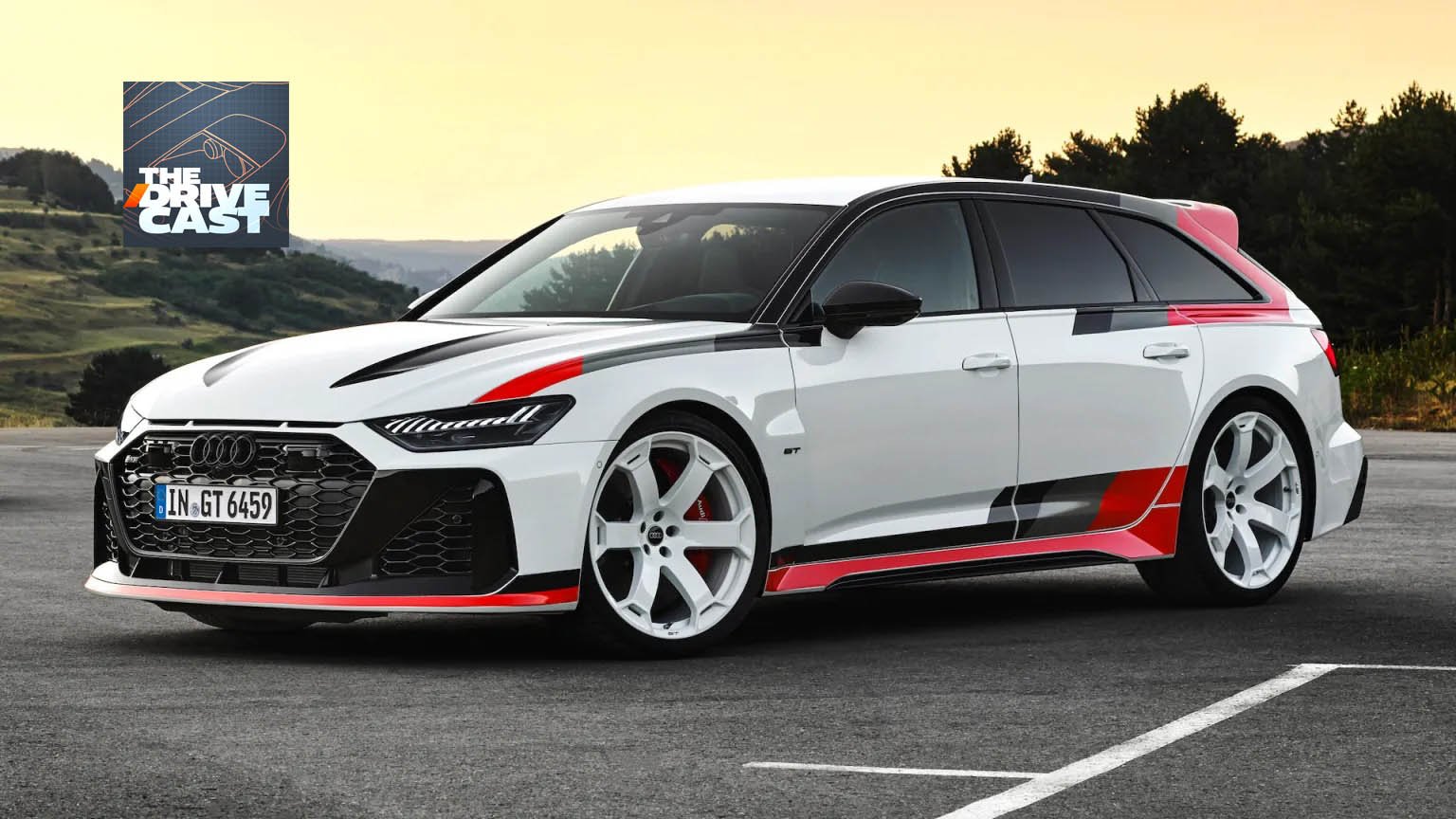
Ask any Audi fan and they will likely be quick to tell you the automaker didn’t just get into trouble, it’s seemed lost for the last chunk of time. From uninspiring designs to cheap materials and keeping the best models in Europe, it’s been a tough time to be a fan of the four rings. But then we got the latest RS6 Avant, suddenly door handles are coming back and we see buttons and knobs returning. There’s hope.
On the latest episode of The Drivecast, Audi of America Senior Vice President of Product Management Filip Brabec sat down with The Drive to discuss how Audi got in the position it’s in today, what’s coming, and why the course correction is taking place. For many enthusiasts and luxury car buy buyers this might feel like a much-needed revival, or return for form, if you will.
As someone that grew up in the house that quattro built, Audi has had a lot of ups and downs as of late. Currently, the automaker’s in a tough spot, and its parent company, the Volkswagen Group, is in an even tougher spot. Growing up, Audi was part of the contingent of German automakers that make things better because they’re over-engineered. The shtick that made them stand out were turbocharged five cylinders and legendary all-wheel drive systems. But I’m going to say it, things kind of peaked in the late ’90s and early 2000s with the B5 A4, C5 A6, and D2 A8. Remember scissor hinges for trunk lids? But in the modern era, things fell behind and worse. Audi was late to the SUV party, and even then it took forever to fill out the ranks there. We are just now finally getting a large SUV with the Q9 to fend off Mercedes and BMW. The TT sports car died and the R8 supercar didn’t get the expected successor, though the limited edition Nuvolari is stunning and we dig it even if only 499 will be made. At one moment, it looked like the future was clearly electric, which most automakers will say it still is, and will be at some point.
And Audi was all in on that. But political winds changed, especially in America, and it caught the German automaker and others flat-footed. Planning and development of cars takes a lot longer than an election cycle, typically. Now, Audi has no hybrids, lots of its EV plans have been shelved in America, and the new vehicles that arrived recently either don’t look like, or worse, feel like Audis with controls that aren’t user-friendly and cheap materials. The Audi Q9 and even the Nuvolari give the first hints of where we’re about to go and what we will see from Audi as the automaker starts to seemingly, hopefully, make its return to form. I mean, have you seen the over-engineered stalk and gear selector set up in the Audi Q3 that’s now making its way into the Q9 and Q7? But from some digital detox and over-engineering that will make things actually better to use, to a new design language that’ll give a serious nod to the past, while hopefully, maybe a slew of new RS models, Audi is giving the faithful and maybe even shareholders hope for return to form.
New here? The Drivecast is The Drive‘s weekly podcast that takes you behind-the-scenes on the largest controversies, stories, and characters shaping the automotive industry along with the way our roads look today. Powered by The Drive‘s inside access, original reporting, exclusives, and insights, The Drivecast aims to make everyone an insider.
Listen to The Drivecast via Spotify, Apple Podcasts, or Amazon Music. Love it? Like it? Want to help? Leave a five-star review on your platform of choice to help get The Drivecast
Full Transcript
Joel: Filip, thank you for taking the time.
Filip: My pleasure.
Joel: I know we’re limited on time, so we’re gonna move through topics real fast today.
Filip: All good.
Joel: Sometimes we’re on a launch of a vehicle and we’re just snagging the time we get. But I have to say, I heard you had a Camaro at one point. Mr. Audi over here had a Camaro.
Filip: Oh my goodness.
Joel: Tell me about the Camaro real quick.
Filip: All right. It was an ’89 RS V8. Of course. So, it was like dark blue. I couldn’t tell you anymore. It was like an Indigo kind of color. Really nice. It was my first car. I used it for college. Put at least 150,000 miles on it. So it was, yeah, it was a –
Joel: That’s a cool first car.
Filip: It was a college thing, definitely.
Joel: Yeah. Okay. So I don’t know if, how much, you know, your team backfilled you on this. I grew up in the house of quattro, so I grew up surrounded by Audis and we had 5000 CS Turbos. We had a V8 quattro, the original. I grew up around D2 and C5 and B5, like all these cool, cool cars. As a kid, the RS6, C5 RS6 Avant was like the whale, right? Like we never got that. We only got a sedan. So I have to ask, is the man… Because so for people that don’t know who you are, you’re not like this big public face at Audi, but you’re the man with the purse strings of what comes and what doesn’t come to America. You’re the man that makes some of the decisions of what’s the cool stuff we get and not get versus RS, S, et cetera, right?
So we gotta talk about the RS6 Avant. We actually got the RS6 Avant in this current generation that just is ending right now or just ended, right? And I have to know, do you guys view that as a success story? And does that parlay into future RS models we’re gonna get to unlock and bring to America
Filip: All right. So I gotta take a step back because you said a lot of things right now and I have to react to some of them.
Joel: Sure.
Filip: Um, so my first reaction is we talked about my first car, but actually, um, my admiration of Audi was quite early. I grew up in Europe, in the Czech Republic. And one of my first automotive admirations was definitely the urquattro. And I used to watch the rally races quite a bit. You know, it contained always the Lancias, and it was kind of the beginning I would think of something that became really a lifelong kind of journey with Audi. So that’s one. The other one is that part of my family is from Germany on my mother’s side and actually I had a distant uncle that worked at Audi, which is just kind of like those coincidental things that happen in life that you find out later that actually he was working in the technical development of Audi AG back in the, you know, 70s, 80s.
And, you know, and there I was. I, I joined Audi in, uh, ’98, so in the, in the previous century, as I mentioned earlier. And so I actually joined during the time when we were working on B5 product improvement, on D2 product improvement, C5 was actually just being launched. So I have quite a bit of history when it comes to kind of, you know, working on these various projects and working on deciding some of them for America and things like that. I can tell you that it took in a tremendous effort to bring any kind of RS into the, into the U.S. initially. As you know, we obviously didn’t get the the B5 wagon. That was kind of because Audi launched the thing in a very kind of a local way, if you would, in Europe. And very quickly it became a cult car, certainly.
But we were kind of gonna make sure that we don’t miss the next one. And so we were started working on the C5, on the wide body RS6. It shared the white body with a V8 at the time, which we did have in the market.
Joel: We owned that. My wife daily drove. That’s…
Filip: A great car.
Joel: My grandmother custom ordered a C5, A6, 4.2 widbody. Yeah. Comfort front seats, sport bucket seats came with Dunlop tires –
Filip: Yeah.
Joel: Originally from the factory. And it was ming blue on the outside and vanilla blue inside.
Filip: All right. Which is awesome, man, which is awesome. Did you get the five spoke forged wheels?
Joel: It had the fatty five s – uh, no, it had the, what were those – no, they were, they were fatty. They were, uh, fi – six spoke. They were, they were the fat ones that had –
Filip: Were they like the, the, the really covered ones or were they pretty open?
Joel: Yeah. No, they were not, they were not the ones that were on like a D2 and the A, and the, and the A6. They were, they were not the five spoke ones. Yep. They were not the polished ones. Yep. They were the other ones.
Filip: Okay, got it.
Joel: ‘Cause they had bigger rubber. They had, they were low, they were higher profile tires, but she had the navigation system in it. And my wife, when, when she passed away, we, we bought that. My wife and I, we had that as my wife’s daily driver for seven years. My kids grew up in that car.
Filip: So do you ever go back and change like the CDs in the navigation system or?
Joel: No. No.
Filip: I had to ask.
Joel: No. The, but that, but it did have the puck on the, on the rear.
Filip: Yeah.
Joel: I had the puck.
Filip: Yes. We had to put the GPS sensor on the, on the truck.
Joel: That was a cool, that was a cool era of car. We had scissor hinges on the doors.
Filip: Yeah.
Joel: They had these shims in the doors where you could align the doors as the metal aged. So the doors always align.
Filip: Yeah.
Joel: We’re getting ahead of myself with some of my questions, but like that was a different era of Audi. That was a different era of cars.
Filip: For sure. But, you know, fast forward, RS6 Avant, definitely, you know, something that, yeah, we call it forbidden fruit sometimes, you know? And, and we worked also a lot on that car. And low and behold, and it came and you asked me if, you know, if we considered a success, 100%. It superseded any kind of internal expectations. So, and the expectation was already very, very good. I think we were ambitious in the planning. I don’t think that we were, we submitted to Audi anything that we had to apologize for, but I will tell you that despite that, it, even that exceeded our, our internal expectations.
Joel: So now that we have established, you guys view that as a success, let’s talk about RS as a whole, right?
So I was, earlier in the year, I drove the new RS5. And at the time, it’s just the, you guys call a sedan. Let’s be honest, it’s a hatchback. You can call it what you want. But that, that is what’s coming to America. At the time, I saw the wagon. I saw it. I touched it. I wasn’t allowed to drive it. Talk about that later. But I’m curious if you guys are ready to say it’s gonna come to America. Will we get that kind of thing? Because the reason is the RS6 Avant was a success, right? And that’s supposed to be, like, essentially an RS4 wagon com – like, successor, es- essentially.
Filip: Yeah. And I, I will tell you, I mean, we’ve been, you know, if we, didn’t bring certain cars in the past, some of those were not due to lack of trying. So I will say that in the beginning. And I can’t go into every detail what went into each and every decision, but I will definitely tell you that we have, that we have tried various times. And so I would say that from the standpoint of a market potential and success story, definitely, we see the potential there. And, we’re kind of working through the process and, you know, we have nothing to announce today. But, you know, stay tuned, I would say.
Joel: I would note that’s not a no. I’m just saying? I didn’t hear the word no.
Filip: Not a no is fair. Not a no is fair.
Joel: So you’re saying there’s a chance.
Filip: But, you can also imagine that, of course, our emphasis is on the RS6 because it was in the market. We, we obviously wanna have continuity. We don’t wanna come into the market, drop out- drop in and, you know, get out. So we obviously have something for the fans there, and we, of course, wanna consider that a priority one, and that will continue to be the priority one for us.
Joel: So the next gen RS6 Avant will come to America again?
Filip: If there is globally an RS6 Avant, then it will come to America.
Joel: Well, we already have spy shots and spy video on The Drive. So we don’t need to make up things up. We already know it exists. So let’s talk about hybrids and powertrains, EVs, V8s. So obviously for a minute, we all though the world was gonna move to electric at a very rapid rate. And obviously, we are now in a different timeline. Obviously, the Germans were very early on this, whether it’s the Audi e-tron, the Porsche Taycan, the whole family of Volkswagen Group was, was very early on this. Obviously, Europe and China are still on that path and marching forward, but America is on a different timeline, a different ship, if you will. I am curious about, you know, we’re, right now, we’re, we’re doing this at the Q9 launch, and I noted that we’re getting a V8. We are getting an SQ9.
The rest of the world is not getting an SQ9. The rest of the world is not getting the V8. And I do know that your CEO told me in May that specifically he championed the V8, he championed it as coming to America. The SQ9 is his favorite variant and that he believes in V8. So I’m curious about there is no hybrid. Do we see hybrids coming to… And to be clear, I wanna mean hybrids that aren’t RS5s. They’re not plug-in hybrid RS models. I wanna just… No, not performance-oriented hybrids.
But do we see hybrids as a stepping stone that we’ll see in the SUV lineup? And more importantly, how do we see the proliferation or, or not, of V8s throughout the lineup since we’re obviously seeing it in the SQ9, SQ7? I believe that the non-existent RS6 Avant that’s coming, that doesn’t exist according to you, will have one. What’s the future of the V8 for us in America
Filip: Yeah, so obviously it’s an iconic powertrain. So, in a place where, like you said, the timelines have changed, and the emphasis and focus has changed, you know, back to some degree to combustion powertrains, then we will continue to stay focused on having V8 presence in, in this market without a doubt. You know, I think where the SUVs are, it makes perfect sense, and we are very fond of launching it. We’re also very fond of sharing, that, you know, that, passion with, with Gernot, and, certainly, you know, that’s something we enjoy kind of together. So from that standpoint, that’s good. Also, on your question, and I’m try – just trying to make sure that I answer all of them, you know, are there hybrids in the in the pipeline? Yes. So 100%, we see the trend toward electrifying the combustion engine, right?
So I, think that, that one is clear. You will see some choices in the plug-in hybrid beyond the RS. You can imagine that, you know, a natural one for us would be Q5 because we already had a predecessor with that powertrain. It was a successful variant, so it’s something that we definitely see a potential for in the future. And perhaps there are more SUVs that we can look at with, with plug-in powertrains. And then beyond that, of course, we will continue to look at mild and, you know, mild hybridization and hybridization throughout the car lines. Again, no specific announcements today, but, you know, starting fairly soon, in a matter of months, not years, we will be introducing certain electrification steps in our powertrains, um, you know, in general.
Joel: You got a little ahead of me. I’m glad you brought up mild and, and, and hybridization without a plug. I’m curious, plug-in hybrids, different automakers had different takes on this situation. What do you feel for at least Audi in, in your position, does the man holding the strings of what’s coming, we need as a minimum range. How much range does a plug-in hybrid need in the electric only situation to be viable, meaningful, makes sense?
Filip: Yeah, and I think, you know, we moved from the first generation where we were fighting between the, like, the 10 and 20 miles, which is really tough because that does not really cover most of commutes, you know? Now the technology has moved forward and we see kind of the bare minimum being 40. So, like, as long as you can hit 40 miles and more miles of electric range, you’re gonna get some people. We see that technology moving to that and beyond that as well, and we’re confident we can get to those numbers with the upcoming launches and beyond. So, but that said, you asked me specifically about portfolio, and I think in the portfolio, it’s a, you know, handful of cars kind of, kind of scenario. It’s not a scenario where plugins would just be proliferated throughout the car line.
From our standpoint, that’s not something we’re focusing on. There may be a handful that might make sense in this specific segment.
Joel: So some plug-ins, some mild, some… So, so there’s MEV, which would be the mild, there’s PHEVs or plugins, and then there’s HEVs, which would be just what most people consider a hybrid, like a Toyota RAV4. Yes. Will we see all three of these variants then?
Filip: Yes. Yes. And of course, it all depends a little bit on the timing, but in general, as you can imagine, as all other OEMs are kind of headed there because the simple, you know, combustion engine no longer gets you kind of the, you know, base requirements around emissions and fuel economy, efficiency, things like that. So we have to kind of go to the electrified side to get to those benefits and still have the performance levels that, you know, our customers expect from us. You know, it can be different in a, in a brand that’s maybe not focusing on performance, but for us, that’s obviously a key.
Joel: Yes, this morning I heard the words effortless performance a few times.
Filip: Thank you.
Joel: So I am curious, one last hybrid question. A couple of the competitors in the luxury space specifically are now moving from that 18 to 30. Now they’re moving into the 60, 70, maybe high 50 range in ra – in, in terms of electric only range. How much range, because you mentioned 40, how much range is it like, this is too big a battery, you don’t need this much range. Is 40 a sweet spot? Do you think you guys view 60, 70, 50, or is that just, we don’t need that much range?
Filip: I have yet to say or utter the sentence, we don’t need that much range. So I think in general, I have not come across a level where I would say that’s too much range. And, and that can be both in EV, but it can be also in a plug-in hybrid situation. So I think whether it’s 50 or whether it’s 100, I think people will gladly take it. Like everything, it’s a case of size, weight, cost that goes into the car, which then translates into some kind of compelling proposition for the customer.
Joel: Let’s shift gears a little. We’re gonna go back here a second for the context of, I say all this from a point of love, I think people that are the most passionate about the brand are also the people that are most critical, because they care, right? So whether it’s, you know, I grew up in a house that was full of Nissan Datsuns, quattro, and Mopar. Like those are the three. If you look at my family automotive history, which people on the podcast that listen regularly will know all these things. And that said, I will tell you that, you know, when I grew up, Audi was about two things, quattro and over-engineering. Like those are the two reasons you bought an Audi instead of a BMW or a Mercedes, right? All the Germans were known for engineering, but you guys were known for quattro, right?
Like those were the two things. And there was a moment here in the last, let’s call it 10, 12-ish years where I feel like Audi got a little muddied. They got a little, they got a little off track when it comes to those two core things, right? We were trying to be all these things. But, and I say that because all of a sudden it feels like we’re going back to that, whether it was the RS5 launch, whether it’s even the Q3 where we have this new all-in-one stalk, right? That must be the most over-engineered stalk that combines the drive selector, it combined the turn signals, combines the windshield wiper controls, everything is on one playing field and it’s all right by your fingertips. Everyone on the internet hated it. And I got to tell you, someone’s used it a couple times now, I love it and it’s awesome and I think it’s great.
Filip : Thank you.
Joel: But also, so that’s spreading throughout the lineup, but then also whether it’s the new quattro system in the RS5, whether it’s the new doors in Q9, like everything you guys are doing either over-engineering or we’re leaning into quattro again. And I’m curious if you, why are we back on track? Like what happened? Why are we suddenly leaning back into this over engineering in quattro?
Filip: I don’t know that it’s back on track. Let’s, let’s park quattro for a minute. We’ll come back to it in a second, but I think you hit kind of a more important trend. And I think the trend or the influencing factor to keep in mind is first of all, from a global perspective, the EV in general. So, and if you consider the EV sort of being in a big growth period, it goes back to, let’s call it 2017, 18, 19, and then obviously throughout the early 2020s, right? And at that time, I think you will have, you will find majority of OEMs questioning a lot of the, a lot of the kind of, kind of legacy, you know, principles that, that were there, with respect to, you know, whether it is interiors, whether it is interfaces of the car. You went, you obviously see a lot of OEMs going to screens and you see a lot of those interfaces, things like that. So I think we were not alone. I think that influence and that, that trend was there more than you could say for one single brand.
Joel: I would agree with you, for the record.
Filip: And so I think you see that influence, and I think you see that influence in, because in those times, obviously, we were in a concept phase for certain cars that, in the meantime, came to the marketplace. So now, of course, you’re starting to see, again, concept phase of vehicles that are maybe a little bit post that era, right? So you see, you see obviously then looking at some of the things that were, you know, again, kind of focus points before that era kind of began. So I think that’s the first kind of thing to keep in mind, because I think the EV influence, again, whether it is here in America specifically, but also on the global stage, of course, you know, obviously, you know, China being such a strong force in the Chinese market and to some degree also in the European markets, you obviously see some of that influence.
So I think that’s, that’s one. To quattro specifically, you could point to a similar thing. Of course, you could say, look, you know, obviously EVs started changing the principle of all-wheel drive because, you know, obviously emphasis on mechanical parts that connect driveshafts was obviously no longer there. So as a result, that definitely, you know, led to a certain amount of, let’s say, detour for, for some of these things. That said, I would say for the majority of time, you know, I think from a kind of a mechanical quattro standpoint and what we’ve put in our cars over the years, it’s always been true to the, you know, to the philosophy of what quattro is, which is to always have control and to always be very, you know, very stringently tested. And I think you can probably spend some more time with Dieter who’s actually here and who’s been involved in a lot of those developments to really always make sure that we are, you know, delivering on the quattro promise regardless of the technology that we’re using.
Joel: Fair enough. I will say to the C5 era and everything, I mean, scissor hinges. We’re talking about over-engineering hinges for a trunk lid. We’re talking about over-engineering door shims. Like this is, this is crazy town stuff. When you guys debuted that new stalk, that was the thing that lit me up as a passionate enthusiast who grew up with this stuff. I was like, okay, they’re back. Like that, this is, they over-engineered stalk. This is crazy. And that was cool to me.
Filip: Yeah. And I think, you know, I, think Audi’s always been very interesting in the way that it’s sort of leaped some of these things, right? And I think, we’re not necessarily always someone who comes very first with something. But you definitely see influence and you can see a lot of people really working those kind of details, you know? And we’ve been in testing of this stalk for a good part of probably last 18 months. So before it ever arrived in the market, which was on the Q3 for the first time. And it’s had actually really good response. It had really good response. And of course, you know, those of us who are involved in, you know, efforts around having good JD Power scores and things like that, we obviously spent a lot of time emphasizing on that center console, you know, and what are we putting in that center console?
And I feel with the Q9 now, we hit such a good spot because we were really given like a full, you know, and, I, you’re going back to our global CEO, he’s given us really a lot of latitude.
Joel: You’re about to go ahead of me. You’re about to, you’re about to go ahead with my topics. Hang on. Whoa, whoa, whoa. Before we move on to that, because that is on my list, you mentioned that, you know, maybe not, you’re not always first, but you’re working on stuff and, and, and that actually leads me into my question of we’re now getting Q9, which is the full size. Q7, it took forever to get a second gen. RS6 wagon took forever. Like certain things, cer – ev- even the Q5 wasn’t the first in that segment, right? I mean, X3 and GLC were playing for that GLK for a long time. Arguably, like, what the heck has taken so long? Like, it’s not like you guys looked on the sidelines and though, well, X7 and GLS aren’t a success. Nobody said that. You can look at that.
America runs an SUV. It’s not Dunkin Donuts. What’s taken so long to fill out this lineup of, let’s say, a Q9 or the Q3 or it, it always feels like you guys are arriving. And when you arrive, you arrive with a real competitor. It’s like legitimately a competitor, but it’s not first in these segments.
Filip: I’m just gonna make a general comment to try to answer your question. I think having been in this job for over two decades, which is very unusual in the business, I will say, I get to live with my, you know, with my successes, but also my sins and my mistakes. And I get to be quite accountable. Most people move on and take another job, but I get to live with a lot of decisions that I’ve made. The one thing I will tell you is that, and it points back obviously to the electric disruption, you know, this job used to always be kind of about incremental successes, you know? And you can always take a car and say, “Okay, my next one will be a little bit bigger. It’ll be a little bit more fuel efficient. It’ll have a little bit more power. It’ll have some great features that maybe weren’t on the previous ones. Maybe we’re bringing some down from the upper segments.” You know, things like that. Those are all things that you could do. There’s just been a tremendous amount of disruption in the business over the last 10 to 15 years. And yes, you can refer to the electric influence, but beyond the electric influence, just in terms of the business and in terms of the different directions that the different continents are taking and things like that, it makes the, it makes sort of the, the portfolio work and the long-term planning work really tough because you’re kind of shooting in the dark. I mean, if you look at kind of the environment in which we’re in now and creating business cases for cars now versus 24 months versus 48 months, even that is quite a bit different.
Joel: These are big investments.
Filip: And it takes longer to even develop a car. So, from that standpoint, it does change the rules of the game quite a bit, and we just have to be, you know, a lot more entrepreneurial in the way that we’re kind of planning these things, you know?
Joel: Speaking of planning, you know, a couple cars that are very iconic to you guys, the R8, the TT, obviously we don’t have these cars anymore.
But we have the Nuvolari now, which is a stunning car. Obviously, we’ve had the Concept C as a concept, but we’ve already know that multiple times it’s confirmed as this is coming. The Nuvolari is very much not an electric car. The Concept C is very much an electric car. I’m curious, do we get a TT replacement? The Nuvolari is arguably, in some regards, an R8 replacement. It’s very different. It’s lower volume. It’s made differently. But you could say it’s a successor in, in spirit. The Concept C is arguably kind of that in terms of shape, size, et cetera. But price point, we don’t know. Performance is gonna be completely different. It’s EV, but it’s an EV. Do we need, should we see, should we expect TT replacement or have we moved on? The Concept C is the next successor in spirit to that kind of Nuvolari way with the R8?
Filip: I think you’ve seen some of the directions that we’re taking with the sports cars. You know, I would also say never say never. Of course, we re-look at our portfolio options all the time. And, from that standpoint, you know, again, if, we were ever any, you know, I can’t, I cannot imagine over the last 20 to 30 years doing this job that we’ve been ever any closer to Audi AG and to the kitchen and to sort of where decisions are made. So from that standpoint, we are probably the closest ever. Back on the sports car topic, you know, I mean, I think we will continue to look at what makes sense. The two directions you have seen are the directions that we have for now, but again, never say never.
Joel: You mentioned the Q9. We’ve talked about your CEOs and decisions. We wrote a story about how it was originally electronic door handles and at the last minute they pulled the plug and they put real door handles. Thank you. Bless you. Um, I also noted in the Q9 I drove today, there’s a near absence, not complete, but near absence of piano black trim. Is piano black trim dead?
Filip: It’s not dead. I think maybe in the past, there were places where it got a little overused. That’s fair. That’s a fair comment. You know, as a material, it can continue to have place, but I think we’ve also learned certain downsides. And clearly one of the downsides is touch sensitive areas, areas that get touched very often or, you know, get handled very often because you’re putting things in and out and things like that. And so Q7, Q9 is a preview of where we’re definitely going with our center console designs, and you’re gonna see more of that in a very near future.
Joel: Bless you all. I also noted in terms of beyond the materials that we have roller knobs on the steering wheel.
Filip: Yes.
Joel: We have a real volume knob. And I can’t believe I have to say this, but we have real controls for our windows, for our mirrors. Like these are all, I mean, they’re literally, they could, for all I know, they’re out of a parts bin, but they’re, they’re not that black plastic panel out of the e-tron A6. Will we see more of the controls added back in? So like I know the Q9, for instance, has the digital touch controls for the vents. Where is the line for buttons and knobs versus digital controls?
Filip: For us, we, you know, and, in some cases you have to consider that we are part of a global equation and we don’t always have the strongest voice depending on what car is going where. That said, I would say the general tendency is definitely to more mechanical controls. We absolutely view that as the right thing. The rollers on the steering wheel are maybe only the beginning, you’re gonna see more. And, particularly as we go to the kind of the next generation of design that we’re calling Radical Next together with Gernot and Massimo Frascella, we are looking at sort of, you know, again, kind of the right placement of the right controls. And you’re gonna see us really kind of go back to basics and to clarity. This idea of just always having technology inside the interior is nice, but I think what’s really important is that the technology is always yielding the right effect and it’s in the right place for the consumer, that it’s almost in the background, you know, and from a kind of an intuitive standpoint.
And whether it is looking at more climate control buttons, whether it is looking at the door controls, and what we’re doing that. And again, we talked about sort of he trend that we’re now doing on the Q7 and the Q9. We’re gonna actually go ahead and apply some of these principles to our existing interiors in a very, very near future, as I pointed out. And that’s not just the console, it’s actually some of the door controls and things like that as well
Joel: On that vein, we obviously have seen the Concept C. We’ve seen the Nuvolari. Yes. You just mentioned toggles, climate controls, et cetera. Let’s talk a little about the interfaces. Obviously, no one is gonna accept everything not having a screen anymore. Like that’s crazy. We don’t live in that era. But right now, like Q9 has got in, it’s a wall of screens. Granted, one’s curved and then, then one’s over here. But like, there is three screens on the dashboard and every occupant has a screen upfront. Will we see a walk back of screens, do you think? Will we see more analog in terms of what we see inside or is it more about controls? How much in our face do we need technology?
Filip: I think so. I, I think we’ve again gone as far as we will possibly go. I think that we will see some correction in that trend. I do. I also think that we will see some more, again, some more tactile and sort of different experiences inside the interior. You know, very much of that, again, is going in our new philosophy, what we’re calling interior next. And I think you’re gonna see something that you really like that’s very Audi in sort of the next generation product. But, you know, that’s why there are opportunities to talk next and next time after that.
Joel: I think you just wrapped it up. That’s it. Thank you so much for coming on. We’ll have you back.
Filip: My absolute pleasure. I would love to come back.
Joel: Can’t wait. Next time. Thank you.
Filip: Thank you.
The post Audi Fans Want RS Wagons, V8s, and Real Buttons. The Man Who Decides Isn’t Saying No appeared first on The Drive.