
If you’re looking for your next hands-off, delicious one pot dinner, this is it: Hainanese chicken rice.
Why You’ll Love This Recipe
- Super fast one pot version of Hainanese chicken rice
- Chicken cooks at the same time as the rice instead of first
- Skin on chicken thighs instead of a whole poached chicken
- 45 minutes instead of a 3/24/48(!) hour process
At a glance
| Flavor Profile | Savory, ginger-garlic, deeply chicken-y, with fun sauces |
|---|---|
| Make Ahead Tips | None needed |
| Diet | gluten free, high protein |
| Storage | Store covered in the fridge for up to 48 hours |
| Reheating | Microwave is easiest, or steam |
| Difficulty | Easy |
| Pair It With | Nothing, it’s a whole meal |
I have a lifelong, deep obsession with Hainanese chicken rice. Growing up in a Singaporean/SE Asian household, I’ve been making it for over 20 years and eating it my whole life. This is my easy one-pot version of Hainanese chicken rice, refined over years of making the full version into the weeknight low effort version I run to when I’m lazy but want that Hainanese chicken rice hit, because not all of us want to poach a whole chicken on Tuesday night. This recipe hits all the right notes: deeply chicken-y rice, firm and tender chicken, all the sauces, but all in one easy step and with just one pot to wash.
My lifelong love affair with Hainanese Chicken Rice
Hainanese chicken rice is my ultimate comfort food, my all-time-favorite go to meal, my version of Anton Ego’s mom’s ratatouille. You know, the scene in the Pixar movie where Anton is taken back to his mom’s kitchen and she serves him ratatouille and all is right with the world. That’s Hainanese chicken rice for me. If someone is coming over to dinner last-minute no-notice and I have nothing planned, this is what I turn to. I would fight to the death to say that Hainanese chicken rice is the best rendition of chicken and rice out there. It’s so humble, so flavorful, and so pure.
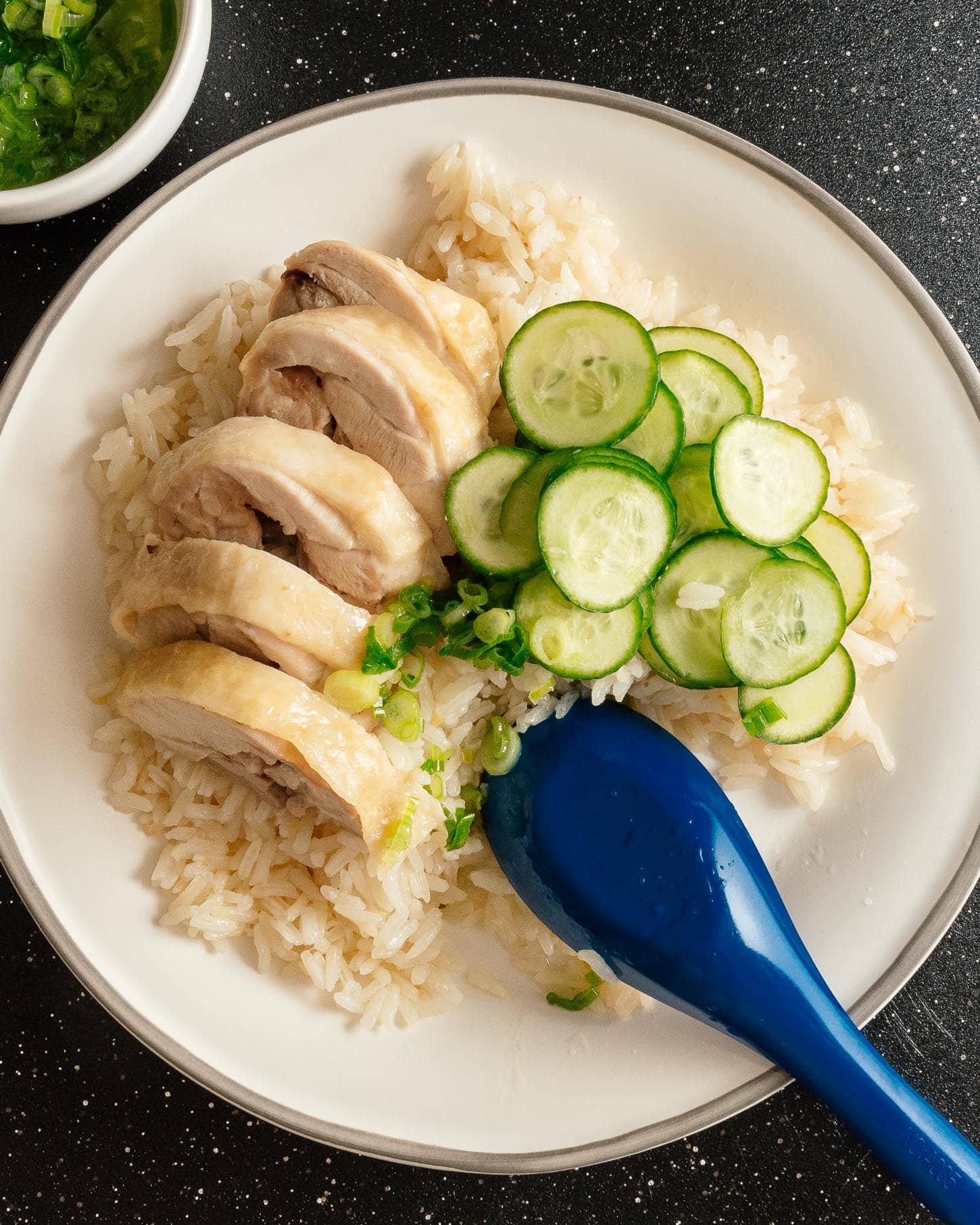
What is Hainanese chicken rice?
Hainanese chicken rice is a deceptively simple yet addictive dish of silky poached chicken and super chicken-y rice fried in chicken fat and then cooked with chicken broth. Traditionally it’s served with multiple sauces, cucumber, and a soup. It originated in Hainan in Southern China, but its spiritual home is Singapore, where you’ll find renditions of the ever popular dish everywhere, from hawker stands to high end hotels.
Traditionally, Hainanese chicken rice is a whole chicken poached in a simple yet flavorful broth scented with ginger, garlic, and scallions. The chicken becomes silky, firm, and tastes like the most perfect chicken you’ll ever have. But the broth that it makes is the real magic, we use that to make the rice, and the rice that comes with it should stand on its own: full of chicken flavor, slicked with fat, savory, and fragrant.
What’s so special about the rice?
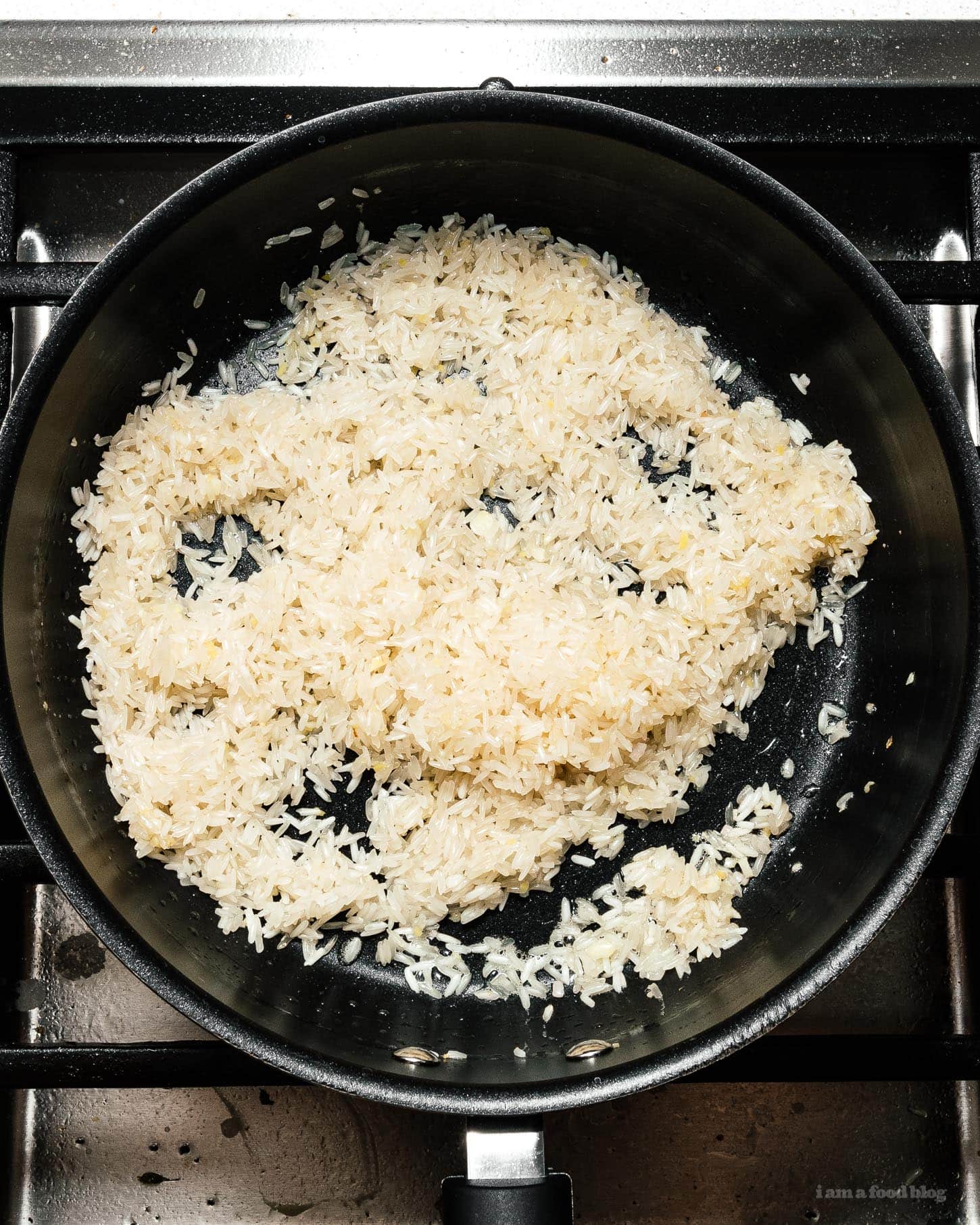
You’ve got to taste it to believe it, but I think the secret to why Hainanese chicken rice is so good is the rice. And the secret to the rice is chicken fat. Any good cook knows that when you cook rice in broth, the broth infuses the inside of the grain, giving it extra flavor. A lot of cultures do this, like how Mexican rice is cooked in tomatoes and onions. Chicken rice goes one step further by frying uncooked rice in chicken fat with garlic, shallots, and ginger before cooking in chicken broth, giving the rice another layer of toasty, aromatic deliciousness. The rice should be glossy, luscious and full of flavor.
The best chicken rice is the one you like making
There are a lot of Hainanese chicken rice recipes that call for 24 hour (or more) cures and other very complicated steps. It doesn’t need to be this way, especially if you just want good chicken rice and you’re not competing with a dozen other chicken rice hawkers at a market. It’s the rice that you need to pay careful attention to, and that’s an easy thing that doesn’t take much extra time.
Personally, I love making chicken rice, I find it therapeutic somehow. But sometimes I just want to eat chicken and rice without cooking a whole chicken. This easy recipe is for those times: skin-on boneless chicken thighs and rice are cooked in one pot for ease and fewer dishes to wash. Win-win!
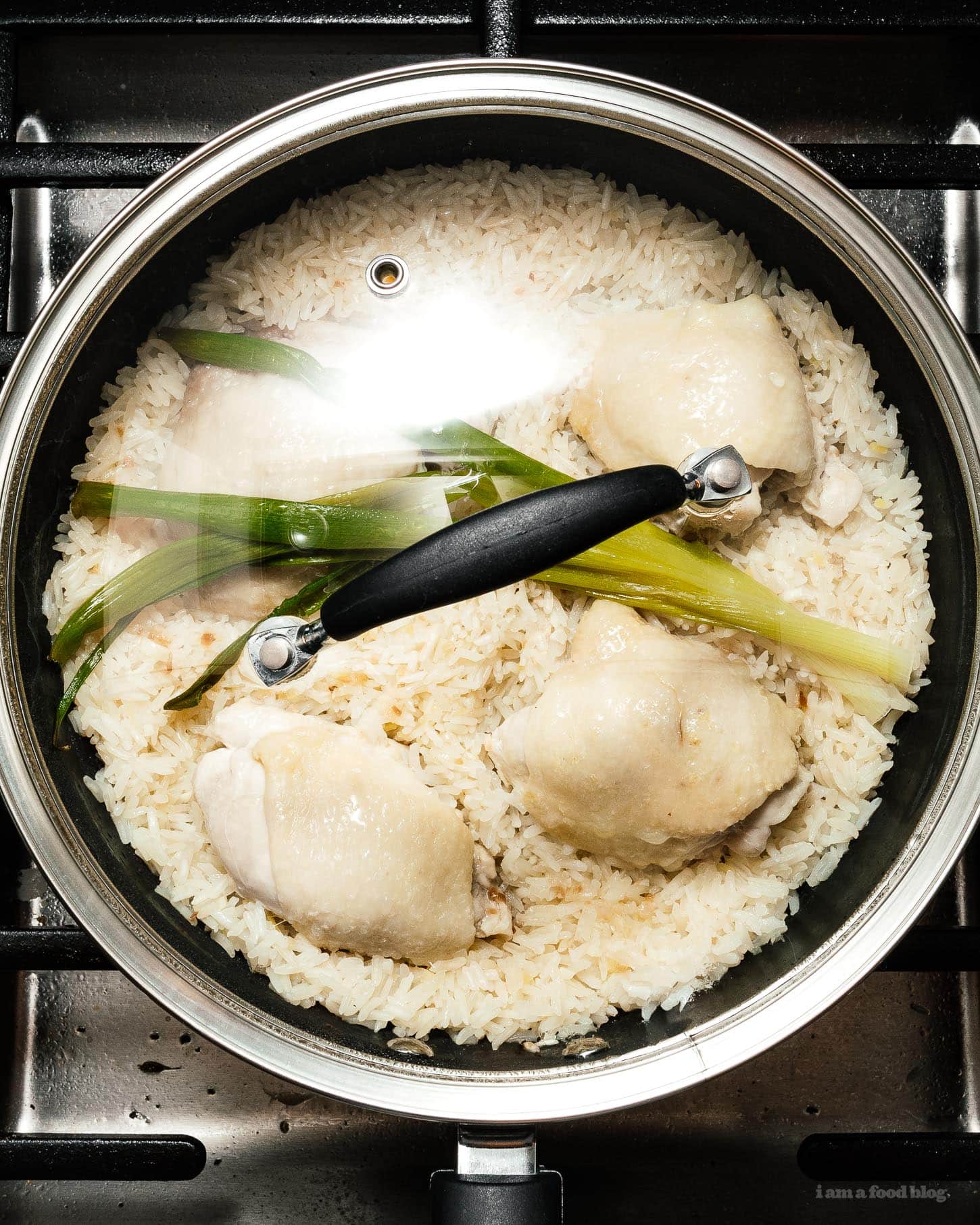
The secret to great Hainanese chicken rice
This is a basic one pot Hainanese chicken rice with all the flavor and none of the fuss. The recipe starts with chicken fat. If you’re like me and love chicken rice and make it on the regular, you’ll want to keep a jar of rendered chicken fat in the fridge. Even if you’re not like me and don’t want to make chicken rice every day of the week, you’ll want to keep a jar of chicken fat in the fridge. Chicken fat is PURE FLAVOR.
Chicken fat is what makes the rice part of chicken rice taste so good. But, if you don’t have any chicken fat, don’t worry, toasting your rice in any fat is going to give it a glossy, delicious flavor coat. The key is cooking the ginger, garlic, and shallots in fat so that the aromatics release their deliciousness into the rice.
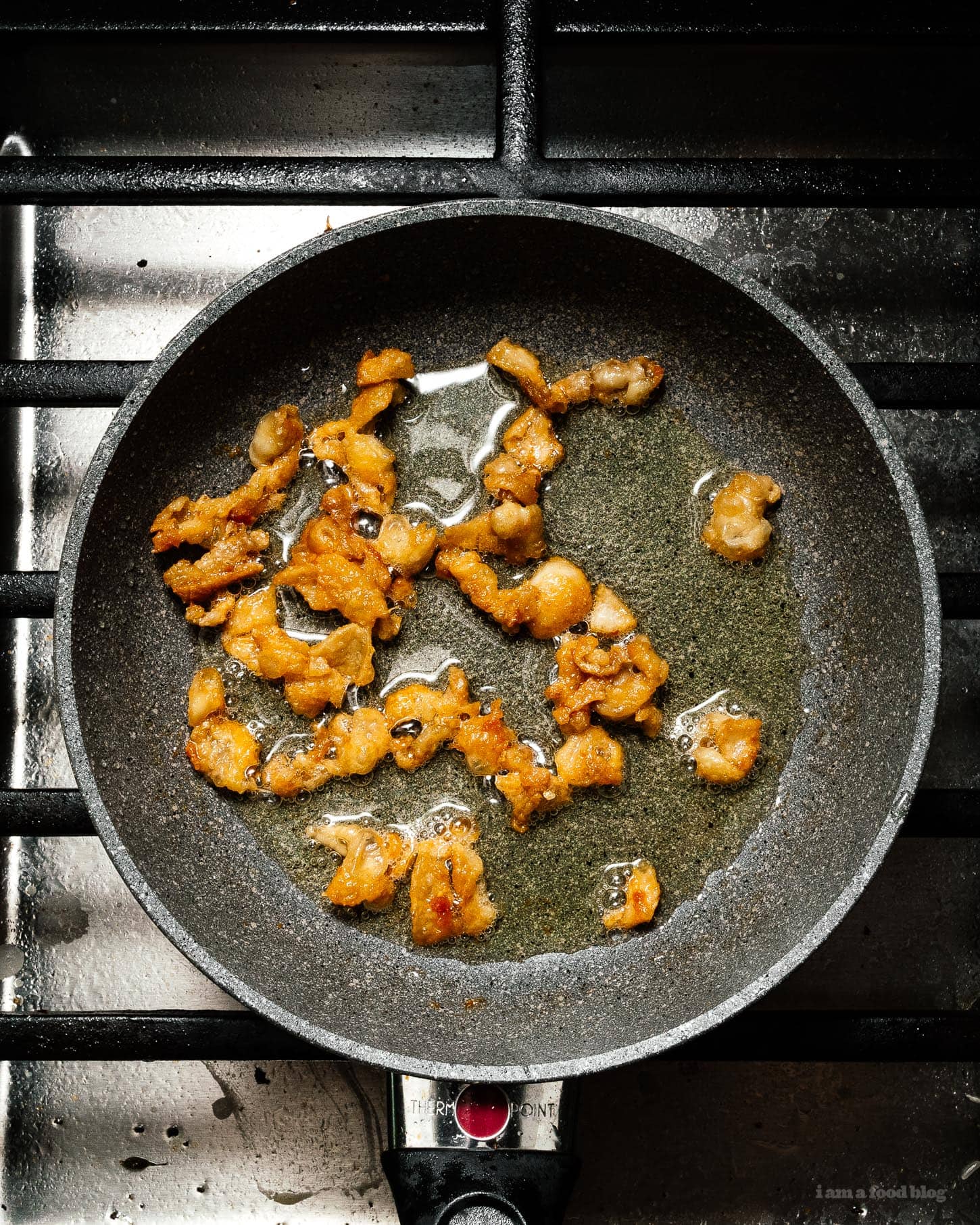
How to render chicken fat
Chicken fat is the key to a good Hainanese chicken rice. The chicken fat adds so much flavor to the rice, you won’t believe it.
- Collect. Trim excess skin off the chicken thighs. Every time you have a recipe that calls for boneless skinless chicken thighs, just buy skin-on, bone-in chicken. Debone and save the bones for stock and save the skin for rendering. I like to freeze a sizable amount then make a big batch of chicken fat and crispy chicken skin.
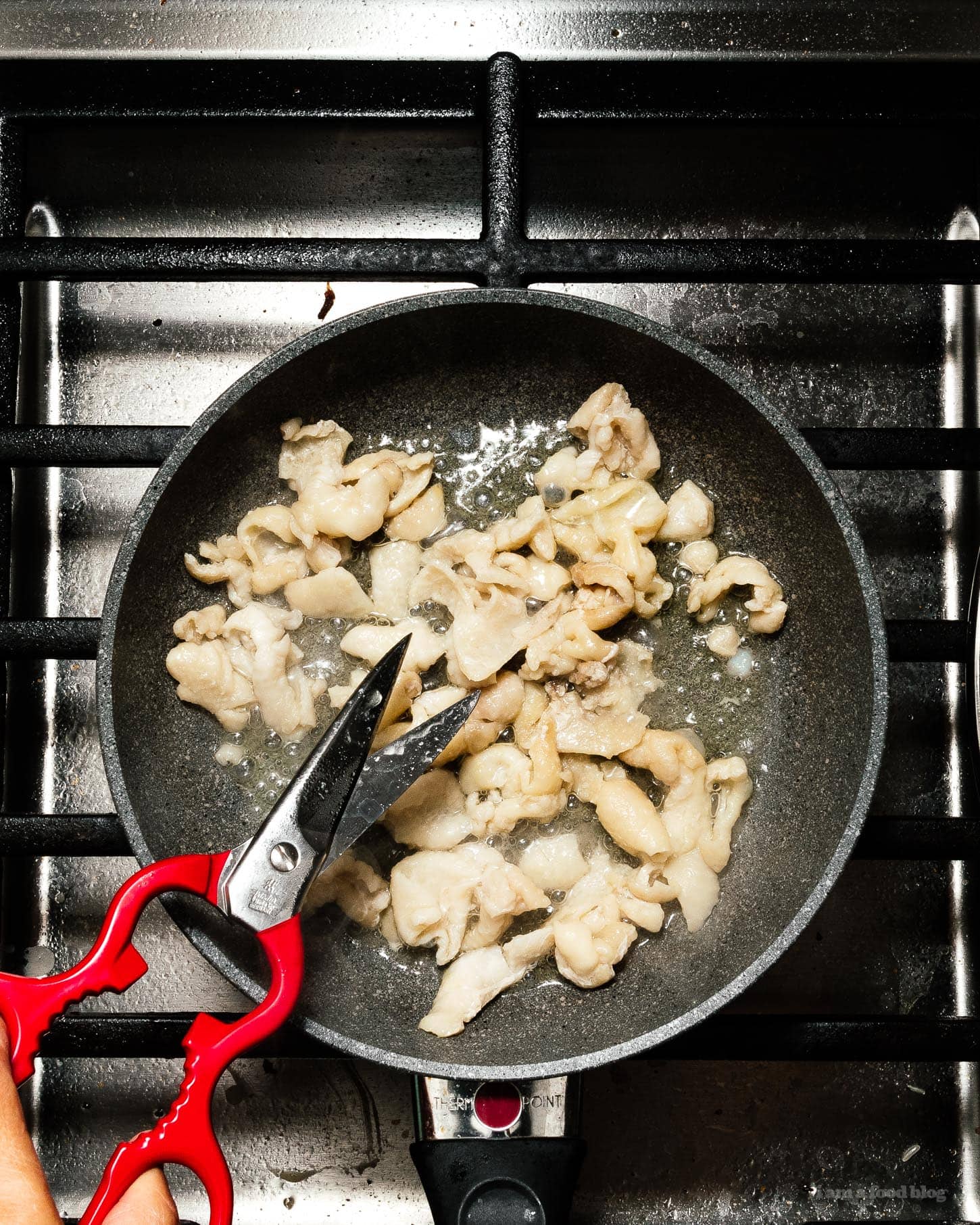
- Chop. Use a sharp knife and chop the chicken skin into small 1/2 inch pieces. You can use a pair of scissors for this too.
- Slowly render. Put all of the chicken skins in a non-stick (or cast iron) skillet, pot, or pan. I like using a pot to keep everything from splattering but it’ll be faster in a pan or skillet. Cover and cook on medium low for 15 minutes. The fat will start to render out and collect.
- Crisp. After you have a pretty pool of glistening fat, uncover the skillet and turn the heat up to medium. Let the skin and fat cook, stirring and breaking up occasionally, until the chicken skins start to crisp and brown.
- Strain. After all the skins are brown, remove the pan from the heat and use a fine mesh strainer over a heat proof liquid measuring cup to strain out the crispy skin. The rendered chicken fat is pure flavor. If desired, return the skin to the pan and crisp up further. The crispy chicken skins are the BEST. They’ll continue to crisp up as they cool, so don’t cook them too long. Store the strained fat in a jar in the fridge for several weeks and use to make chicken rice!
Chicken thigh vs chicken breast
But what about the chicken? Do you need a whole chicken? Should you use dark meat or light if you’re just going with individual pieces? Again, this is personal preference, but I think the whole chicken isn’t necessary. The only question is, do you go with thigh or breast?
When you’re in Singapore, you have to pay extra for dark meat (thighs and drumsticks) because the meat is silkier and more tender. I definitely prefer thighs to chicken breasts when making chicken rice but sometimes I like the texture of breasts too.
What kind of chicken for chicken rice?
Chicken thighs are clearly superior but they don’t tend to sell skin-on boneless chicken thighs. What I do is buy bone in skin on thighs and trim the bones out myself.
How to debone chicken thighs
There’s only one bone to remove from a chicken thigh, making it super simple.
- Place the chicken thigh, skin side down on a cutting board.
- Find the bone that runs along the length of the thigh. Use a sharp boning knife or paring knife along the side of the bone to reveal it.
- Use the knife to scrape along both sides of the bone, being careful not to cut all the way through.
- Angle the tip of knife underneath the bone and run the knife alongside the bone to cut the end of the thigh away. Repeat on the other side.
You can use the bones to make a simple chicken stock that will add EVEN more flavor to your Hainanese chicken rice. See below for the recipe.
Chicken and Rice
All cultures have some sort of chicken and rice. The Japanese have oyakodon, Latin Americans have arroz con pollo, and Southeast Asians (and Hainanese people) have Hainanese chicken rice. Like most chicken and rice dishes, it’s simple at heart: poached chicken and seasoned rice served with a variety of sauces.
Like lots of immigrant adapted foods, there are actually a bunch of different types of Hainanese chicken rices: Singaporean, Malaysian, Vietnamese, and Thai. Growing up, it was a staple in our house. Chicken rice is the food that can bring me back to my childhood and transport me to some of my favorite memories as an adult. I’m not embarrassed to say that chicken rice is my everything.
How do you eat Hainanese chicken rice?
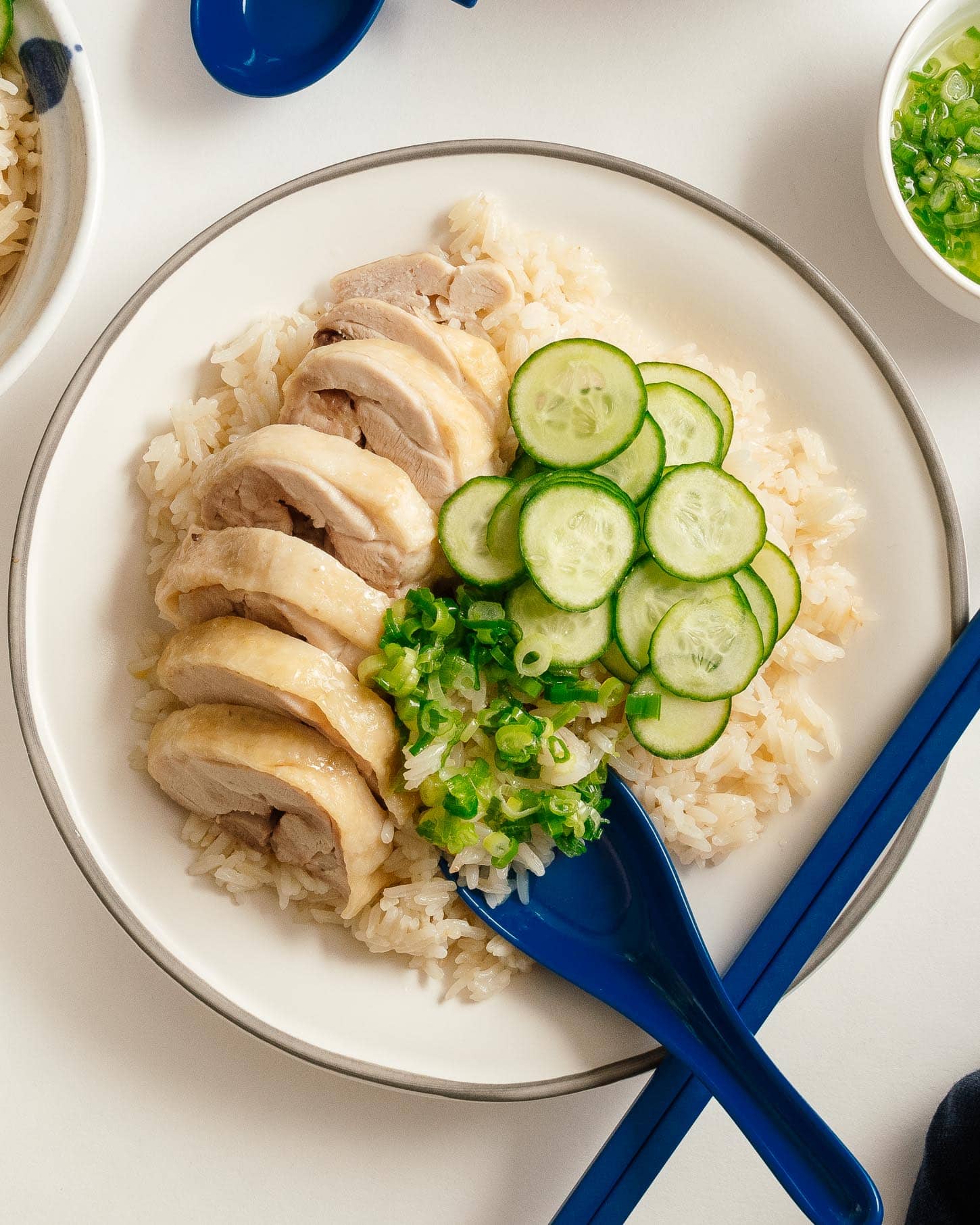
Everyone eats it differently! Some people like to pour all three sauces on top and mix it all up, some people only use certain sauces, really, it’s up to you. Authentically, like with curry rice, it’s usually served on a plate with a spoon and fork – NOT a bowl and chopsticks – to scoop everything up.
What to serve with Hainanese chicken rice
Traditionally it’s served with the poaching broth the chicken was cooked in, as well as chili sauce, scallion-ginger sauce, and dark soy sauce. In my version, I prefer a Hainanese ginger sauce instead of dark soy. If you’re in Singapore, they’ll probably give you a couple pieces of cucumber, and a sprig of cilantro on top. I go all out all-you-can-eat on the cucumber and skip the cilantro because what do you do with the rest of it (edit: you can make this green chile verde sauce).
Homemade Hainanese scallion oil
Sometimes I keep it simple with a pure scallion oil, but if you have the time to chop up some more aromatics, a ginger garlic scallion oil is an unforgettable umami bomb you’ll want to put on EVERYTHING.
Ingredients
- 4 cloves garlic
- 1/2 cup scallions
- 1 tbsp fresh ginger
- 1/4 cup neutral oil
- In a food processor – or by hand, you wizard you – chop up 4 cloves garlic, 2-3 scallions (about 1/2 cup), and 1 tbsp fresh ginger. Place everything in a deep heat proof bowl.
- In the smallest pot you have, heat up 1/4 cup neutral oil (grapeseed, sunflower, safflower, canola) over medium heat until it reaches 275°F. You can also test the heat by placing an uncoated wooden chopstick in the oil. If you see tiny air bubbles escaping from the chopstick in the oil, it should be hot enough.
- Carefully remove the pot from the stove and pour over the scallion mix. It will sizzle and bubble. Stir so everything is coated and season with salt to taste.
Hainanese chili garlic sauce
Ingredients
- 2 fresno peppers (or other red pepper)
- 1 Thai chili pepper
- 2 cloves garlic
- 1″ ginger
- 2-3 tbsp chicken stock
- 1 tbsp lime juice
- 1/2 tsp sugar
- In a food processor, chop 2 fresno peppers, 1 Thai chili, 2 cloves garlic, and a 1 inch piece of ginger until it comes together in a paste. Stir in 2-3 tablespoons of chicken stock, 1 tablespoon lime juice, and 1/2 teaspoon of sugar. Add salt to taste.
Hainanese ginger sauce
This is different from the scallion oil and I make it when I want a pure ginger taste. It’s not too spicy because cooking the ginger mellows it out. It’s a perfect “clean” tasting sauce for those Hainanese chicken rice purists out there.
Ingredients
- 1/4 cup fresh ginger, finely chopped
- 1/4 cup neutral oil
- 2 tsp rendered chicken fat
- salt, to taste
- In the smallest pot you have, heat up 1/4 cup neutral oil (grapeseed, sunflower, safflower, canola) over medium heat until it reaches 275°F. You can also test the heat by placing an uncoated wooden chopstick in the oil. If you see tiny air bubbles escaping from the chopstick in the oil, it should be hot enough.
- Remove the pot from the heat and stir in the ginger. It will sizzle and bubble. The ginger should be soft and tender. Stir in the rendered chicken fat and season to taste with salt.
Pro-tips
Here are some of my tips for making chicken rice. I do it so much that it’s pretty much second nature to me!
Use a food processor
I like doing prep work but a food processor makes everything easier and more enjoyable. There are a lot of aromatics in Hainanese chicken rice and it’s the aromatics that make everything taste amazing so you don’t want to skip out. A food processor will cut your prep time in half. This is the mini one we use on the regular.
Save your chicken fat!
I have a little freezer bag of frozen chicken fat/skin in the freezer. This is probably not that strange to people who know how amazing chicken fat is. I add to it whenever I’m trimming chicken or if I need skinless chicken in a recipe. Skin-on chicken is so much cheaper than skin-off so I just de-skin at home and happily add to my stash. When the bag is full, I render the fat, stash it in the fridge a clean jar and scoop it out to use whenever I have a chicken rice craving. The crispy chicken skins get eaten pretty much right away. Having a stash of chicken fat in the fridge means you’re never too far away from chicken rice.
Use homemade chicken stock
Because this is my easy one-pot weeknight version of Hainanese chicken rice, it calls for store-bought chicken stock. But the truth is, like my endless supply of chicken fat, I also have an endless supply of Hainanese chicken stock in my freezer. To make homemade Hainanese chicken stock, use trimmed chicken bones:
- Place as many trimmed chicken bones as you have in a deep pot and cover with water until it covers the bones by 2 inches.
- Add 1 inch ginger, sliced; 1 shallot, halved, 2 cloves garlic, crushed; and 1 whole green onion.
- Bring to a simmer over medium heat and when there are lots of tiny little bubbles, cover and turn down the heat.
- Simmer for 1 hour. When the hour is done, strain the stock. Use homemade Hainanese chicken stock as directed in the recipe.
Make it in the rice cooker
If you’re not a fan of cooking rice on the stove you can still make this one pot chicken and rice:
- Fry up the rice in chicken fat, along with the ginger, garlic and shallot until glossy.
- Add the fried rice to your rice cooker and add in the chicken stock, chicken, and green onion.
- Set the rice cooker and cook until the rice is finished cooking.
- Let the rice and chicken keep warm (on the keep warm setting) for 10 minutes before opening, fluffing, and enjoying.
Perfectly cooked chicken
I prefer to use boneless chicken for this quick and easy version because boneless thighs finish at the same time as the rice, making this quick and easy. If you want to use bone in chicken, make sure the chicken is tempered (not straight from the fridge) when you’re adding it to the pan. Cook the chicken and rice for 5 more minutes and let it steam with the lid on for an extra 5 minutes as well. The rice will be on the more tender side.
Super silky Hainanese chicken skin
Something people really love about Hainanese chicken is the super silky smooth chicken skin. It’s delicate, tender, and delicious. In Singapore, if the chicken is gelatinous and silky, it’s considered perfect. The secret to super silky chicken skin is a combination of salt scrubbing and temperature control. Because we’re making a one pot Hainanese chicken I’m going to talk mostly about salt scrubbing, but I will lightly touch on the importance of an ice bath too.
Salt scrub
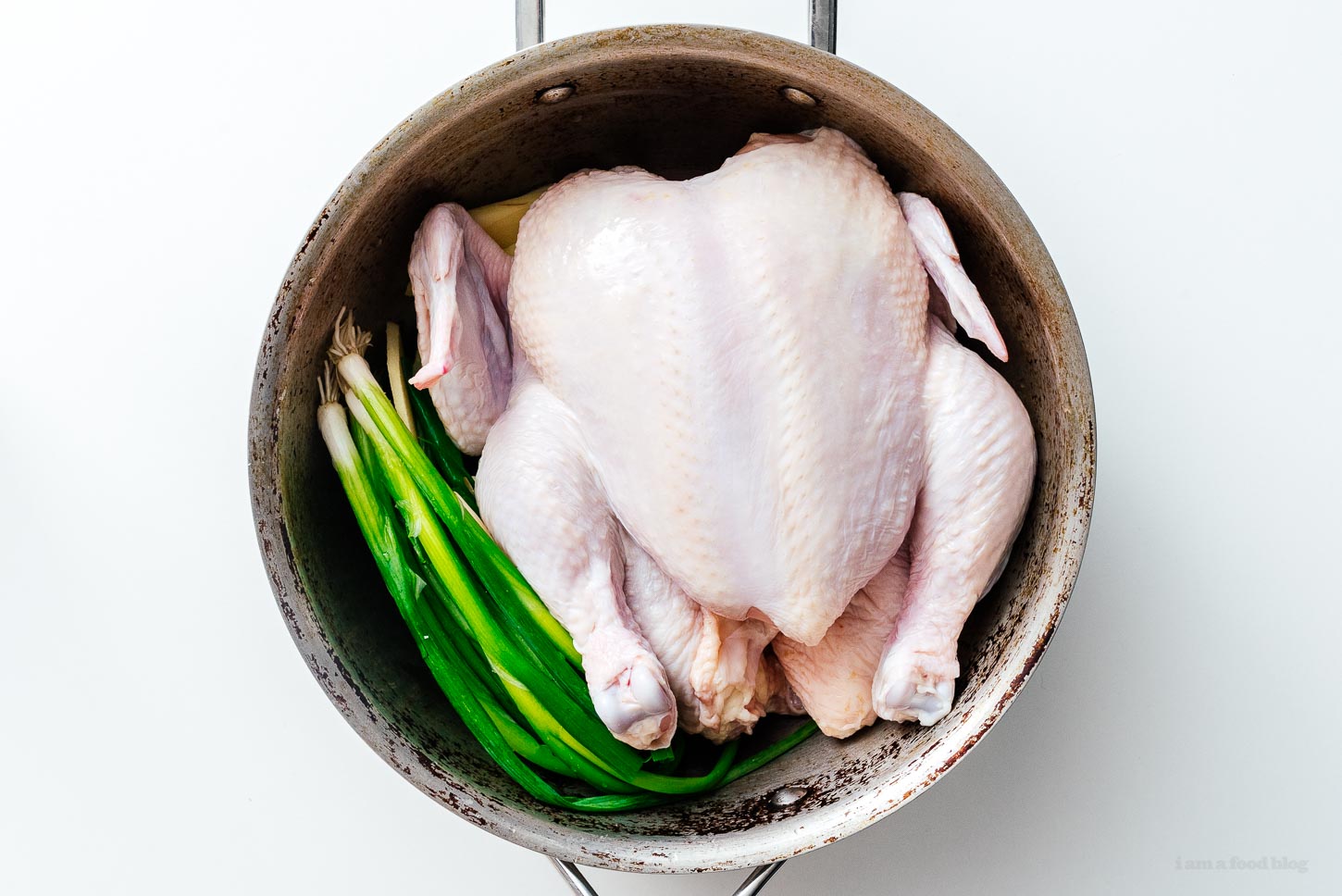
The first thing you should do, if you’re looking for super smooth skin is to give your chicken a nice salt rub. Sprinkle on a generous amount of coarse salt and exfoliate the heck out of the chicken skin, making sure that the salt gets into every nook and cranny of the skin. After exfoliating, rinse the excess salt off the skin (so the chicken doesn’t end up too salty) and the chicken skin should look tighter, cleaner, and generally very pretty. This works super well on whole chickens but it also works on cut pieces of chicken too. Do it, it will definitely make a difference.
Temperature Control
As for the other key aspect of silky skin, it’s temperature control. This recipe is for a super simple Hainanese one pot chicken and rice but when you’re making it traditionally (as I do quite a lot as well) you use a whole chicken and poach it gently. After scrubbing and exfoliating with salt, the chicken is gently submerged in a pot of just simmering water and aromatics (scallions, ginger, garlic, shallots) until it cooks through. Immediately afterwards, the chicken is put into an ice cold water bath. The hot then cold shocks the chicken skin, pulling it tighter against its body. The skin will be silky and perfect!
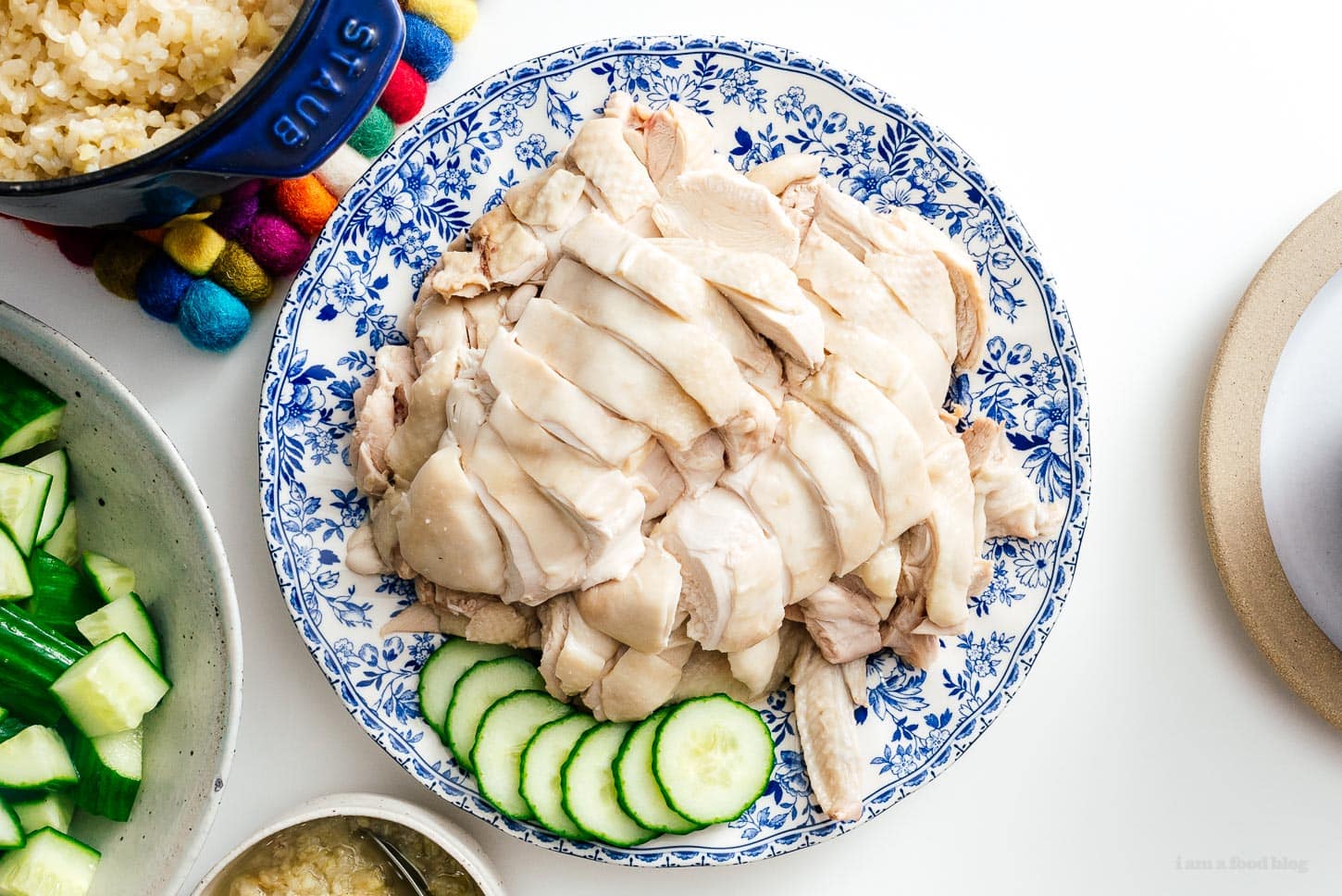
When chicken rice is done well, you almost don’t need the chicken! Mike pretty much just eats giant bowls of the rice with no chicken at all, that’s how good it is. I hope you give this recipe a try, it’s the perfect comfort food for chilly fall days.
Chicken rice forever and always,
xoxo steph
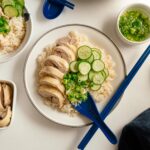
Easy One Pot Hainanese Chicken Rice Recipe
The best kind of food hug: an easy one-pot Hainanese chicken rice with juicy chicken thighs and ultra chicken-y ginger-garlic rice.
Serves 2
Chicken Rice
- 1/2 tsp kosher salt
- 4 boneless, skin-on chicken thighs
- 1 tbsp rendered chicken fat or neutral oil
- 1 tbsp minced ginger
- 1 clove garlic minced
- 1/2 small shallot finely diced
- 1 cup white jasmine rice
- 1 cup chicken stock low sodium preferred
- 2 green onions whole
- cucumbers sliced, as desired, to serve
Green Onion Oil
- 4 cloves garlic
- 1/2 cup green onions
- 1 tbsp fresh ginger
- 1/4 cup neutral oil
Hainanese chili garlic sauce
- 2 fresno peppers or other red pepper
- 1 Thai chili pepper
- 2 cloves garlic
- 1 in ginger
- 2 tbsp chicken stock or more if needed, low sodium preferred
- 1 tbsp lime juice
- 1/2 tsp sugar
Hainanese ginger sauce
- 1/4 cup fresh ginger finely chopped
- 1/4 cup neutral oil
- 2 tsp rendered chicken fat optional
- salt to taste
Rub the chicken skin with the salt and set aside.
- Optional: if you would like to render the chicken fat, trim the excess skin from your chicken thighs, then add to a non-stick pan. Cover and cook on medium low for 15 minutes. After you have a pretty pool of glistening fat, uncover the skillet and turn the heat up to medium and cook until the chicken skins start to crisp and brown.Remove the pan from the heat and use a fine mesh strainer over a heat proof liquid measuring cup to strain out the crispy skin. Set aside the skin to serve and reserve the chicken fat for the next steps.
In a pan or pot with a lid, heat up the chicken fat or oil. Add the ginger, garlic, and shallot. Cook, stirring, until fragrant. Stir in the rice and fry gently until glossy.
Add chicken stock, then place the chicken, skin side up, in the pan. Add the green onions on top. Bring to boil over medium high heat and when it starts to simmer, cover and turn the heat down to low. Cook for 17 minutes, turn off the heat, and let rest for 10 minutes.
- While the rice is cooking, make the sauces:Hainanese ginger sauce: Heat up the neutral oil in the smallest pot you have over medium heat until it reaches 275°F, then remove from the heat and stir in the ginger. It will sizzle and bubble. The ginger should be soft and tender. Stir in the rendered chicken fat. Once cool enough, transfer to another bowl and season with salt to taste.Green onion oil: Add garlic, green onions, and ginger to a blender and blend (or mince by hand). Place everything in a deep heat proof bowl. Heat up the neutral oil in the smallest pot you have over medium heat until it reaches 275°F, then pour over the scallion mix. It will sizzle and bubble. Stir so everything is coated and, once cool enough, season with salt to taste.Hainanese chili garlic sauce: Add 2 fresno peppers, 1 Thai chili, 2 cloves garlic, and a 1 inch piece of ginger to a blender and blend until it comes together in a paste. Stir in 2-3 tablespoons of chicken stock, 1 tablespoon lime juice, and 1/2 teaspoon of sugar. Transfer to another bowl and season with salt to taste.Note: you can use the same small pot and blender/food processor for all three of these sauces, especially if you do it in this order. If you don’t have a thermometer, you can also test the heat by placing an uncoated wooden chopstick in the oil. If you see tiny air bubbles escaping from the chopstick in the oil, it should be hot enough.
When the 10 minute rest is up, remove and discard the green onions. Remove the chicken and slice. Fluff up the rice and serve with thinly sliced cucumbers and sauces. Enjoy immediately!
Estimated nutrition facts don’t include sauces (or cucumbers, but that’s all zeroes anyway).
Nutrition Facts
Easy One Pot Hainanese Chicken Rice Recipe
Amount Per Serving
Calories 396
Calories from Fat 147
% Daily Value*
Fat 16.3g25%
Saturated Fat 0.9g6%
Cholesterol 0.01mg0%
Sodium 641mg28%
Potassium 369mg11%
Carbohydrates 23.2g8%
Fiber 1.3g5%
Sugar 0.5g1%
Protein 37.6g75%
* Percent Daily Values are based on a 2000 calorie diet.