
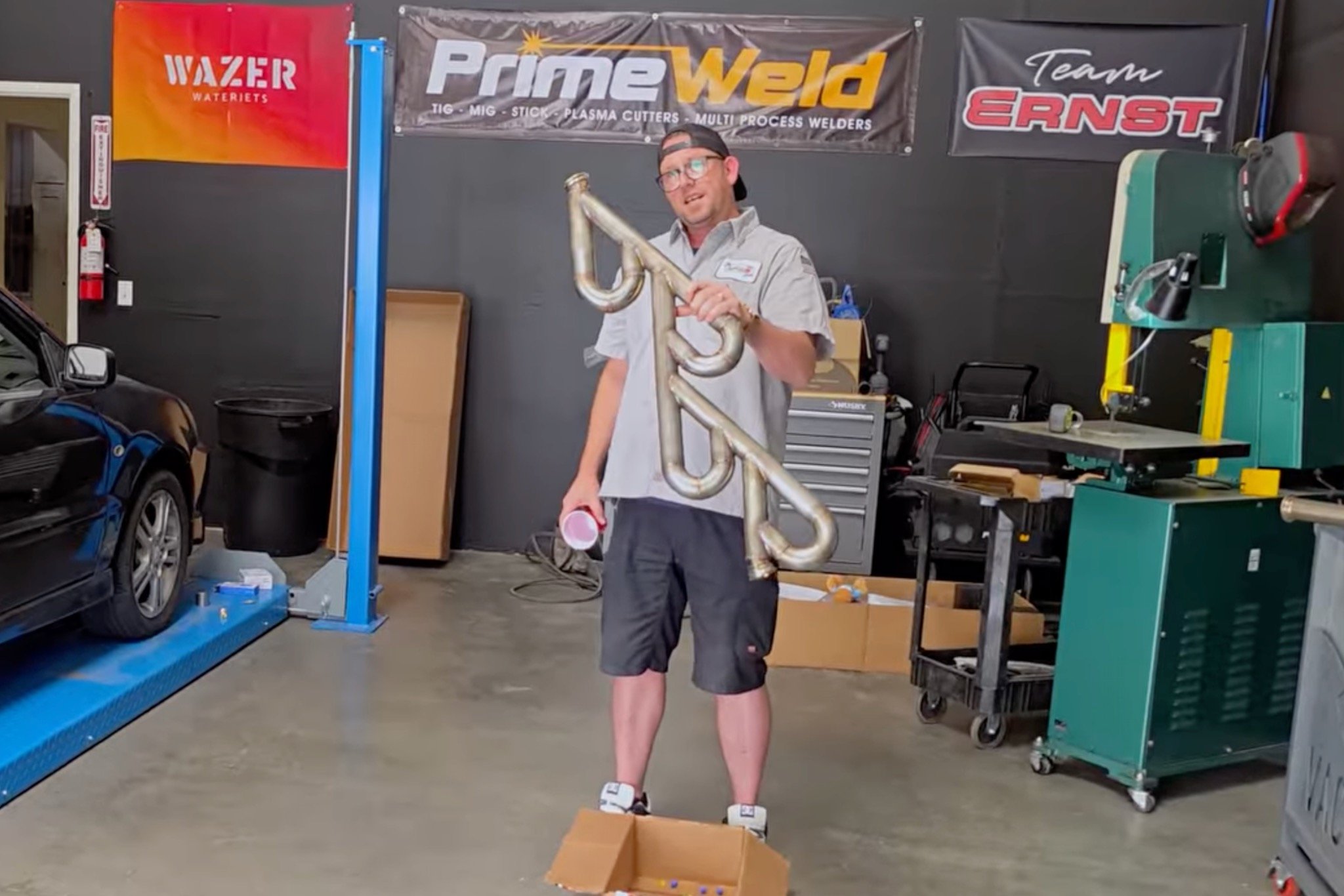
conventional and unconventional exhaust designs. Where does this group of fabricators head next? To a design not even meant for vehicles, clearly.
The focus of this video is a Tesla valve which, although named after inventor Nikola Tesla, is unrelated to the car company. A Tesla valve may resemble a whimsical straw design, but it serves as a one-way valve with no moving components. Curved sections that appear as half hearts permit fluids to flow in one direction but not the opposite. While most usages involve liquids rather than gases, this did not deter Justin and his team from creating a Tesla valve exhaust system and conducting a dyno test.
Patented in 1920, the Tesla valve’s channels guide the flow back onto itself in a single direction while providing a direct path in the other, stopping the flow from reversing. A significant number of these loop-like channels are necessary to achieve the desired effect, but due to the limited space under the vehicle (it wasn’t initially designed to accommodate so many bends in the exhaust), only four could fit. To assess its effectiveness (or lack thereof), the Tesla valve exhaust was tested on the dyno in both the correct and reversed orientations, using a stock exhaust system as the baseline.
With the exhaust set up correctly, the Mitsubishi Lancer Ralliart test vehicle produced slightly less power compared to its stock exhaust, showing single-digit variances: 142 horsepower for the Tesla valve against 146 hp for the stock system, averaged over three runs. The actual difference was in noise levels. The Tesla valve exhaust generated virtually no sound; all audible noise originated from under the hood.
Dyno Testing a Tesla Valve. Will it Function?
Reversing the exhaust didn’t fully halt flow—the engine was still capable of starting—but it maxed out the back-pressure gauge. The level of back pressure was also notably high with the exhaust correctly aligned, to be fair, but it appeared to affect performance more under these conditions. Unsurprisingly, the engine required more time to reach higher RPMs and produced less power, averaging 134 hp. The inverted exhaust also generated significant additional heat.
Thus, while a Tesla valve may diminish noise, it does so at the cost of making your engine operate much less effectively. It turns out that something not intended as an exhaust system does not perform well in that capacity. Nor does it function adequately as a Tesla valve. As Justin notes in the video, gases can compress, so forcing them through the valve’s channels creates pressure but does not completely stop the flow, as it would with a fluid. That’s the underlying principle of turbochargers, which is why you won’t encounter a Tesla valve exhaust at this year’s SEMA show.
**The Effect of Designing Car Exhausts Like Silly Straws on Performance: Dyno Test Outcomes**
In the field of automotive engineering, the design and arrangement of exhaust systems are pivotal to a vehicle’s overall functionality. Recently, a novel approach has arisen: crafting car exhausts resembling silly straws. This article examines the effects of this design on vehicle performance, supported by dyno test findings.
### Grasping Exhaust System Dynamics
The primary role of an exhaust system is to expel combustion gases from the engine, minimizing back pressure and improving efficiency. Traditional exhaust systems aim to optimize flow, reduce turbulence, and maintain appropriate back pressure for engine efficiency. However, the notion of emulating the shape of silly straws introduces a distinct variable into this landscape.
### The Silly Straw Design Concept
The rationale behind crafting exhausts in the shape of silly straws is to foster a more streamlined flow of exhaust gases. Silly straws, recognized for their flexible and intricate shapes, theoretically facilitate smoother transitions in fluid dynamics. This design aspires to lessen turbulence and enhance the velocity at which exhaust gases exit the system, potentially boosting engine performance.
### Dyno Test Methodology
To assess the influence of this inventive exhaust design, a sequence of dynamometer (dyno) tests was carried out on a standard performance vehicle. The tests compared conventional exhaust configurations with the silly straw-shaped exhausts under controlled conditions. Key metrics recorded included horsepower, torque, and exhaust gas temperature.
### Dyno Test Results
1. **Horsepower Improvements**: The dyno tests indicated a slight increase in horsepower with the silly straw exhaust design. On average, vehicles fitted with this exhaust configuration exhibited a 5-10% rise in peak horsepower compared to traditional exhaust systems.
2. **Torque Enhancements**: Torque output also saw a significant improvement. The silly straw design facilitated a smoother power band, resulting in increased low-end torque, which is essential for acceleration and driveability.
3. **Exhaust Gas Temperature**: Among the most significant discoveries was the decrease in exhaust gas temperature. The more streamlined flow enabled more efficient expulsion of gases, leading to cooler exhaust temperatures. This could positively affect engine longevity and performance consistency.
4. **Sound Characteristics**: Although not a primary aspect of the tests, the sound generated by the silly straw exhausts was notably different. The unique shape resulted in a distinct exhaust note, which some drivers appreciated, while others favored the more conventional sound profiles.
### Conclusion
The outcomes of the dyno tests suggest that shaping car exhausts like silly straws can positively influence vehicle performance, especially regarding horsepower and torque. While this design may not entirely replace traditional exhaust systems, it presents an intriguing option for performance enthusiasts wishing to enhance their vehicles. Further research and development could polish this concept, potentially paving the way for broader applications in the automotive sector. As with any innovation, the equilibrium between performance, practicality, and aesthetics will ultimately steer the acceptance of such designs in the mainstream automotive engineering field.