
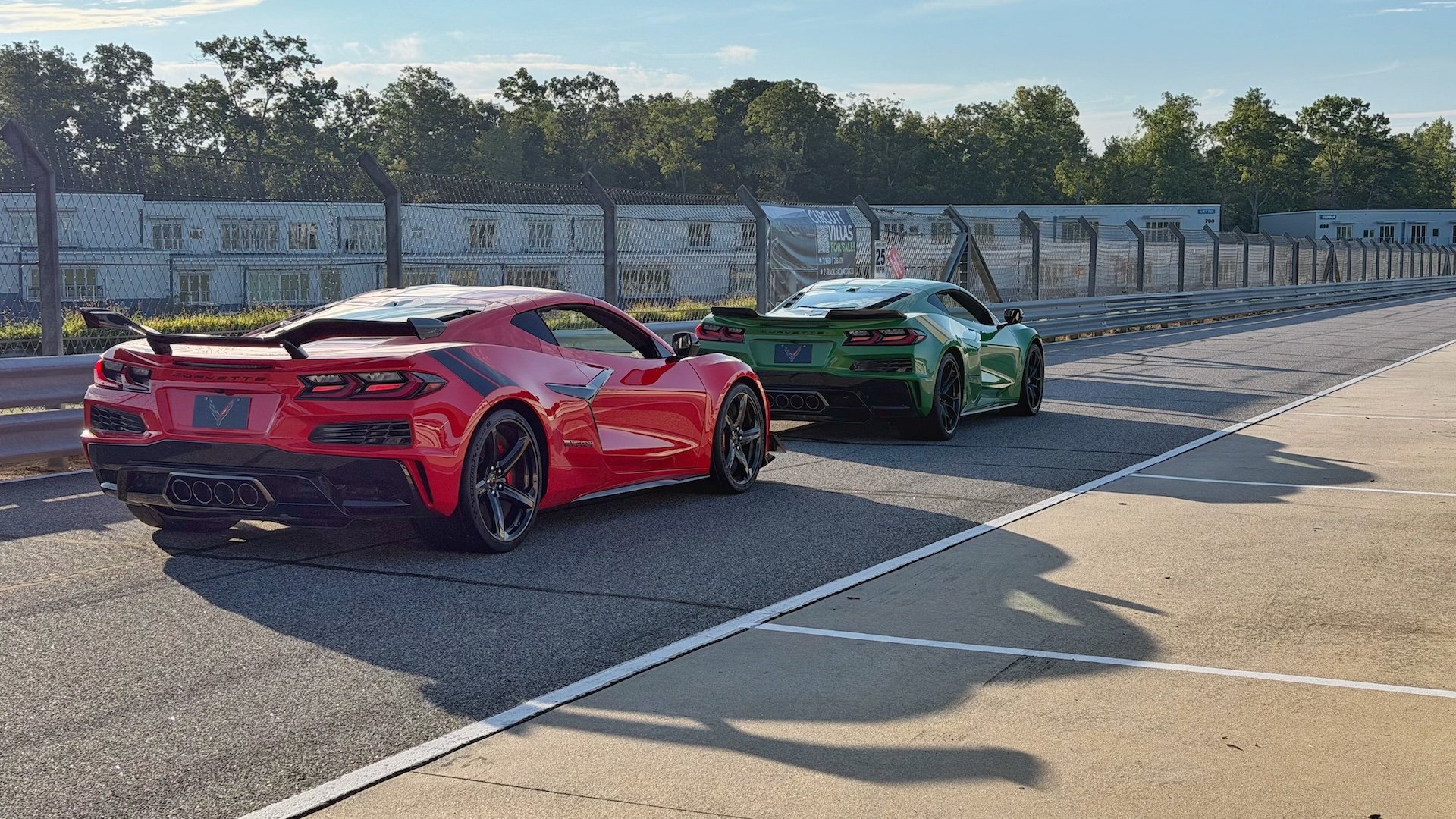
Chevrolet Corvette Grand Sport has arrived, accompanied by its electrified, all-wheel-drive counterpart, the 2027 Chevrolet Corvette Grand Sport X (farewell E-Ray). Nestled behind the driver’s seat of these performance-oriented editions is the brand’s latest high-performance V8: the LS6. The new 409-cubic-inch V8 is also being introduced in the base-model Stingray for 2027, giving consumers an abundance of options for selecting a mid-engine ‘Vette that aligns with their performance and budget requirements.
The Stingray boasts 535 horsepower and 520 lb-ft of torque, which carries over into the rear-wheel-drive Grand Sport (the GS comes with various handling and aesthetic enhancements; more on that later), while the top-tier Grand Sport X is assisted by a permanent magnetic drive motor on the front axle, enhancing its performance to 721 hp.
I recently had the chance to test drive the Grand Sport and Grand Sport X on both the track and the street, while I only took the base Stingray for a spin on the latter. While it may be surprising to find subtle distinctions among three variants of the same model fueled by the same engine, the individuality of each car is genuinely striking. This holds even for the GS and GS X, which, in theory, just differ in having the active front axle and extra power.
Without further delay, here’s your guide to the LS6 and the 2027 Chevy Corvette:
Introducing the LS6
GM stated clearly in the opening of its press release: “This next-generation V8 generates more torque than any other naturally aspirated V8 before it.” It’s accurate. Its 520 lb-ft of torque surpasses the previous LT2, which delivered 470 lb-ft of torque. Additionally, the engine displacement is upgraded from 6.2 liters in the predecessor to 6.7 liters in the new version. Furthermore, horsepower receives a substantial boost of 45, rising from 490 hp to 535.
Under the guidance of assistant chief engineer Mike Kociba, who firmly states that “there’s no replacement for displacement,” the new 6.7-liter engine features a 13.0:1 compression ratio—the highest in the Corvette lineup—resulting in sharper throttle response and a 95-mm throttle body with a tunnel ram intake that uses high-velocity ports to facilitate better airflow. There’s also a new lubrication mechanism, forged pistons and rods, and redesigned exhaust manifolds that ensure longevity in high-stress, high-temperature situations.
For transferring power to the ground, buyers have the option of an eight-speed dual-clutch automatic transmission or… well, that’s it.
2027 Corvette Stingray: The Everyday ‘Vette
Though it is the most affordable, while getting in and out of the three Corvettes that day, I never sensed that I was in a base model. Naturally, based on options and packages, some variances in materials, color selections, and performance might exist—but the Stingray successfully offers the essential Corvette experience.
The V8 in the Stingray delivers 535 hp and 520 lb-ft of torque. The test vehicle I drove on public roads near Atlanta Motorsports Park was a 3LT equipped with the Z51 performance package, which featured new suspension tuning via its optional magnetic ride control. The final drive ratio has been shortened for 2027 to enhance throttle response, and Chevy claims better aerodynamic performance, while opting for the new Michelin Pilot Sport S 5 as a standard tire.
The LS6 feels well-suited in the base model, providing powerful acceleration and, most importantly, a great exhaust note to enjoy during your daily commute or weekend escapades. The engine is inherently loud, but Chevy’s calibration of the programmable driving modes makes it sound assertive when desired—or subdued, should you prefer a quiet startup or a relaxed “Tour” setting. Shift to Sport or Track mode, and be ready for some auditory excitement, particularly on longer drives. A side exhaust continues to be the standard choice, yet buyers can now select a center exit, making a noticeable impact on the sound. This option delivers a deeper bass tone and a more robust sound profile.
On the road, the Stingray fulfills almost all your expectations and desires. It’s agile, and it accelerates aggressively when called upon. You’ll feel the added power, but the extra torque is particularly noticeable, complementing the car’s sports car essence with a hint of muscle car charm. It remains relatively manageable at high speeds, unless truly pushed hard. The ride quality in my test unit met expectations; a good thing given the notorious Atlanta traffic.
2027 Corvette Grand Sport: The Sweet Spot
Atlanta Motorsports Park is a demanding track. It serves as a genuine driver’s circuit that challenges your skills, but equally important, it tests many aspects of the car’s capabilities. The suspension and brake components face rigorous challenges with every lap due to elevation changes and banked or off-camber turns. Most importantly, it uncovers how effectively a car maintains balance and whether it can apply power onto the asphalt through extended high-speed corners—one of which is a left-hand turn exceeding 100 mph.
Press the accelerator, and the Grand Sport surges forward like a bullet, seamlessly carrying you through two esses that immediately demonstrate the precision of the steering. The GS is an instrument of finesse, and this ability comes alive in the following uphill left-hander that opens and then tightens as the elevation drops and the track fades from view. Both the front and rear right tires emit a chorus of squeals while navigating this 50- to 60-mph corner. Despite the LS6’s explosive power, it’s also smooth and progressively builds power, thanks to its larger displacement.
The track surface never entirely levels out, yet I manage to floor it for a couple of seconds before abruptly braking for yet another tight turn with a significant elevation change. In summary, AMP presents a repetitive scenario, and the Grand Sport feels perfectly suited with its abundant power and torque, well-tuned suspension, and superb driving dynamics. Unfortunately, both the GS and GS X I piloted at the track featured the more relaxed Competition Sport seats, which excel on the street but fall short in providing adequate support for the extreme cornering speeds that AMP demands. Fun fact: When custom-building a Corvette, you can now equip it with two different types of seats, allowing the driver to select the track-friendly GT1 and GT2 seats while opting for a more comfortable option for the passenger.
2027 Corvette Grand Sport X: The Modern Racer’s Corvette
JR Hildebrand came incredibly close to winning the Indy 500 (with the exception of David Malukas this year), but following that disappointment in 2011, he has delivered remarkable performances in IMSA and more recently at Pikes Peak. After setting the hybrid production car record at Pikes Peak this year in a 1,250-hp Corvette ZR1X, it made perfect sense for me to hop into a GS X with him for a few laps around AMP. But before enduring a wild ride with Hildebrand, I aimed to uncover the advancements stemming from the Corvette E-Ray.
The first detail that struck me, aside from the broadened Z06 body kit, was the noticeable heft at the front end, which isn’t merely a steering feel. (Though, I must admit, Track mode amplifies the steering more than I prefer in both the GS and GS X.) After sufficient laps, this sensation dissipates as you acclimate to it, yet this increased weight eventually becomes advantageous as it becomes clear just how much more front-end grip this car possesses compared to its rear-wheel-drive counterpart. A significant amount more. The two notably long, tight, and fast turns mentioned earlier seem more manageable at high speeds in the X. I’m not implying it’s any less intimidating, because it certainly is, but it does feel as if the car is better anchored, which instills a bit more confidence in pushing the front tires beyond their grip limits.
The primary distinction between the two Grand Sports, beyond the electrified front axle, lies in the power figures. It’s a considerable leap from 535 to 721, and you can certainly feel it. However, it’s not an overwhelming punch to the gut as one might anticipate. The extra power becomes apparent at the extremes of performance, both at lower and higher revs, like when exiting a corner at full tilt or approaching the upper limits of the rev range. You can even detect the additional power audibly, since Chevy has incorporated a somewhat ridiculous “spaceship” sound that activates at full throttle or when the battery power is deployed manually using a switch on the steering wheel. It’s pretty gimmicky.
This represents the pinnacle of the LS6, and it induces smiles from ear to ear—unless you find yourself in the passenger seat with Hildebrand, as then you’ll be preoccupied with trying not to lose your lunch all over the dash.
Conclusion
Three distinctive options, three varying performance levels, three different price points, one exceptional engine: the 6.7-liter LS6. If I were to invest my own money in one, it would be the standard Grand Sport, and I would opt for the $3,500 Z52 performance package, adding summer performance tires, (steel) performance brakes, and active dampers.
The X is an outstanding piece of engineering and an exceptionally capable track machine—and it also features an all-wheel-drive system that allows year-round driving, even up to about four inches of snow, as GM engineers drive their test vehicles through Michigan winters. Nonetheless, its cost is rather high. I favor the GS’s straightforward approach to classic performance modifications, and I don’t have to disable the silly spaceship sound every time I take it for a drive.
For those on a tighter “budget,” there’s always the Stingray, which, depending on the options selected, can effectively be a Grand Sport without the badge.
Chevy provided The Drive with travel, accommodations, and access to the vehicle for the purpose of composing this review.
2027 Chevrolet Corvette Stingray, Grand Sport, X Specifications
| Stingray | Grand Sport | Grand Sport X | |
| Base Price | $75,990 | $90,990 | $114,195 |
| Powertrain | 6.7-liter V8 | 8-speed dual-clutch automatic | rear-wheel drive | 6.7-liter V8 | 8-speed dual-clutch automatic | rear-wheel drive | 6.7-liter V8 and permanent magnetic drive single motor | 8-speed dual-clutch automatic | all-wheel drive |
| Horsepower | 535 | 535 | 721 |
| Torque | 520 lb-ft | 520 lb-ft | 520 lb-ft |
| Seating Capacity | 2 | 2 | 2 |
| Curb Weight | 3,520 lbs | 3,520 lbs | 3,800 lbs |
| 0-62 mph | 2.8 seconds | 2.75 seconds | 2.4 seconds est. |
| EPA Fuel Economy | 15 mpg city | 25 hwy | 18 combined | 15 mpg city | 23 hwy | 17 combined | 15 mpg city | 24 hwy | 18 combined |
| Score | 8/10 | 9/10 | 8/10 |
Email the author at [email protected]