
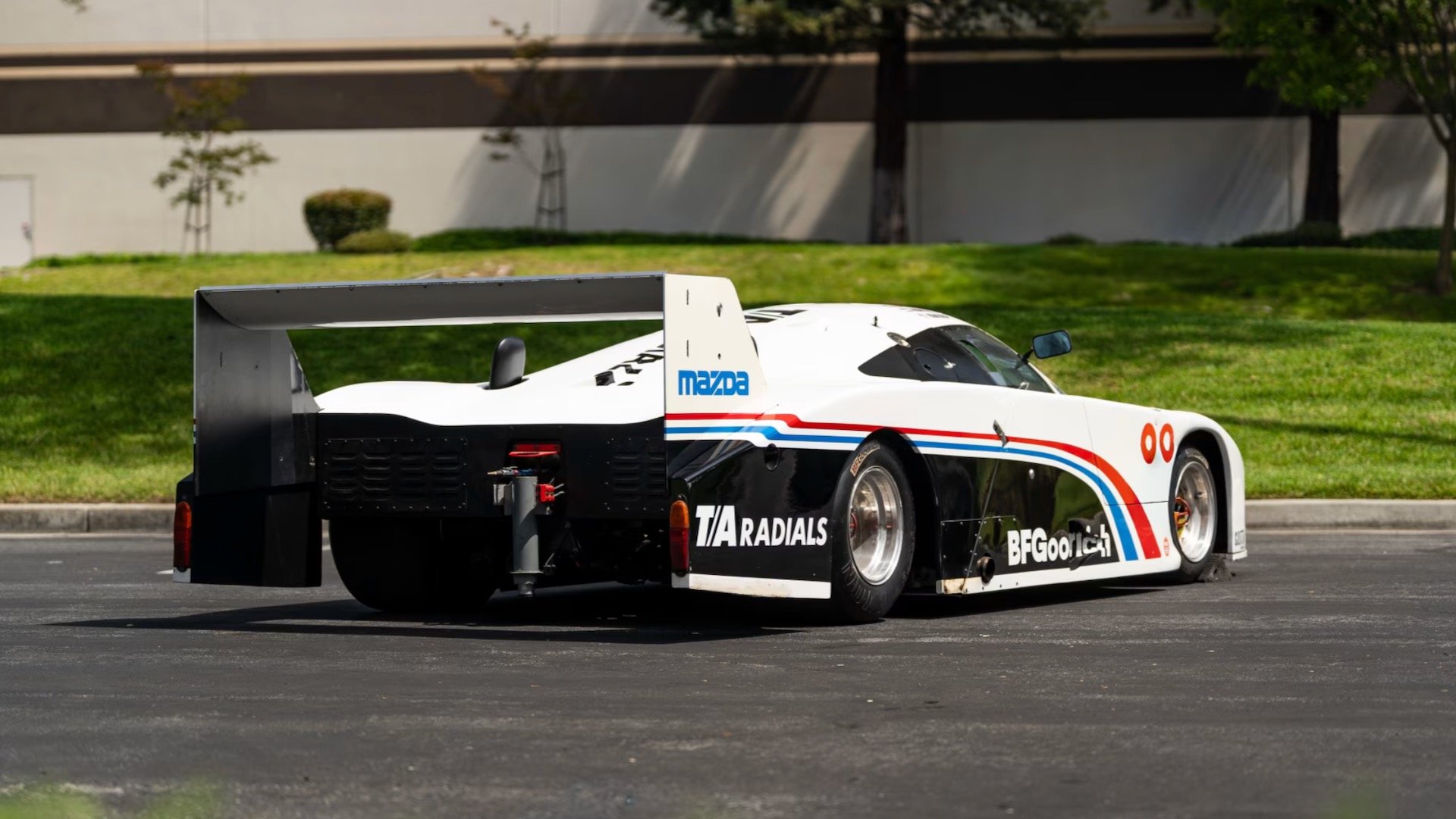
Whether it’s the homespun “win on Sunday, sell on Monday” or its bland MBA-inspired replacement “road relevance,” the link between road cars and race machines is a core element of the motorsport world. This usually manifests in actual vehicles, either showroom versions equipped for racing or homologation specials crafted solely to validate a racing team’s strategies. Four decades ago, BFGoodrich accomplished a similar feat with tires.
In 1984, in an effort to promote its T/A radial tires, the firm established a duo of race cars and entered endurance competitions in both the IMSA GT Championship and the FIA World Endurance Championship (WEC), including participation in the 24 Hours of Le Mans, where chassis HU-2 achieved a class victory using the street tires the team aimed to showcase. HU-2 will be featured among the important lots at Mecum’s 2026 Monterey Car Week auction, with its counterpart, chassis HU-3. It is projected to fetch around $300,000—roughly $100,000 more than its counterpart.
Tires are arguably the most crucial component of any vehicle, and extensive engineering is involved in optimizing their function. Regrettably, even the most ardent car aficionados often overlook this. In the early ’80s, BFG tires alongside a Mazda RX-7 chassis proved to be a successful pairing in the IMSA GTU category, but those victories were not garnering enough attention. Consequently, the tire manufacturer decided to enhance their efforts.
“The issue was, no one truly cared about any RX-7 performing well,” Chuck Patrick, at the time a BFG tire engineer, remarked in a 2005 Vintage Motorsport article discussing the initiative. “So the marketing team asked, ‘How can we showcase that we are genuinely creating a quality product?’”
The answer was to elevate to the FIA C2 category, then the second-tier class for prototypes in endurance racing. BFG engaged racing driver Jim Busby to lead the team, who selected the then-new Lola T616 chassis, which would be paired with the 1.3-liter 13B rotary engine derived from the RX-7. Although the essential street tires kept the same overall design as the retail variants, adjustments were necessary for the 13×11-inch front and 13×14-inch rear wheels mandated by the regulations. A 3,000-mile testing regimen ensured their readiness.
Both vehicles participated in significant IMSA races throughout 1984, including Sebring and Daytona (they are credited as the first cars to utilize street tires on that track’s steep banking), and chassis HU-3 clinched its class during that year’s Monza 1,000-kilometer event. The crowning achievement was at Le Mans, where John Morton, John O’Steen, and Yoshimi Katayama secured the C2-class win and finished 10th overall. The second vehicle, driven by Busby, Rick Knoop, and Boy Hayje, finished third in class and 12th overall.
Drivers cited in that Vintage Motorsport article noted that the tires were less significant than the engine, which was both less powerful and less fuel-efficient compared to most competitors (except for the factory Mazda 727Cs also racing that year). The T616 had to be driven relatively conservatively to conserve fuel, and the chassis was designed for a heavier, more powerful engine—both factors possibly obscuring any performance discrepancies between its street tires and the dedicated racing rubber used on other vehicles.
Team BFG’s class victory was also the second consecutive win for a Mazda rotary-powered car, boosting momentum for the Japanese manufacturer’s overall Le Mans triumph with the 787B in 1991. It’s hard to determine if the victory translated into tire sales, but it certainly tells an intriguing tale, one unlikely to be repeated in today’s more tightly controlled environment.
It’s equally surprising that both cars are still around to tell their story. They aren’t exactly as renowned as contemporary Group C vehicles like the Porsche 956, after all. Fortunately, Busby and Knoop purchased and restored the pair in the early 2000s. They’ve been regularly appearing in vintage racing ever since, showcasing an unexpected marketing strategy that yielded an extraordinary victory.
**1984 Lola featuring Rotary Engine – Class Champion at Le Mans on Street Tires**
The 1984 Lola stands out as a significant element of motorsport heritage, especially recognized for its distinctive fusion of engineering brilliance and competitive achievement. This specific variant, fitted with a rotary engine, has attracted interest not only for its performance but also for its notable accomplishments, including winning its class at the esteemed 24 Hours of Le Mans.
### Historical Background
The Lola brand has a long-standing reputation for innovation in racing. Established by Eric Broadley in 1958, Lola has developed a range of successful race cars across various categories. The 1984 model year saw the introduction of numerous advancements in aerodynamics and lightweight construction, positioning Lola vehicles as highly competitive in endurance racing.
### The Rotary Engine
Among the outstanding characteristics of this 1984 Lola is its rotary engine, a type of internal combustion engine that utilizes a rotary design for converting pressure into rotational motion. This engine style, famously used by Mazda, is celebrated for its compactness, light weight, and excellent power-to-weight ratio. The rotary engine in this Lola offers a distinctive driving experience, characterized by smooth power delivery and remarkable acceleration.
### Le Mans Achievement
The 24 Hours of Le Mans represents one of the most prestigious endurance races globally, where teams must balance speed, reliability, and strategic planning during a challenging 24-hour timeframe. The 1984 Lola’s class victory at Le Mans reflects its engineering excellence and the expertise of its drivers. Competing on street tires, designed for everyday use rather than racing, adds an extra layer of complexity to the vehicle’s performance. Achieving success under these conditions underscores the Lola’s adaptability and versatility.
### Features and Specifications
– **Model Year:** 1984
– **Engine Type:** Rotary engine
– **Performance:** Celebrated for its lightweight design and significant power output
– **Tires:** Street tires, highlighting versatility and practicality for real-world applications
– **Achievements:** Class victor at the 24 Hours of Le Mans
### Current Status
This iconic 1984 Lola equipped with a rotary engine is presently on the market, offering a unique chance for collectors and motorsport aficionados alike. Possessing a piece of racing history, particularly one with such a distinguished background, is rare. The combination of its class win at Le Mans and the innovative rotary engine marks this vehicle as a prominent addition to any collection.
### Closing Remarks
The 1984 Lola with a rotary engine transcends being just a vehicle; it embodies engineering innovation and racing legacy. Its accomplishment at the 24 Hours of Le Mans on street tires emphasizes its exceptional design and performance attributes. For those with an interest in motorsport history or seeking to include a distinctive vehicle in their collection, this Lola represents a rare chance to own a class-winning race machine with a rich history.
 admin
admin