
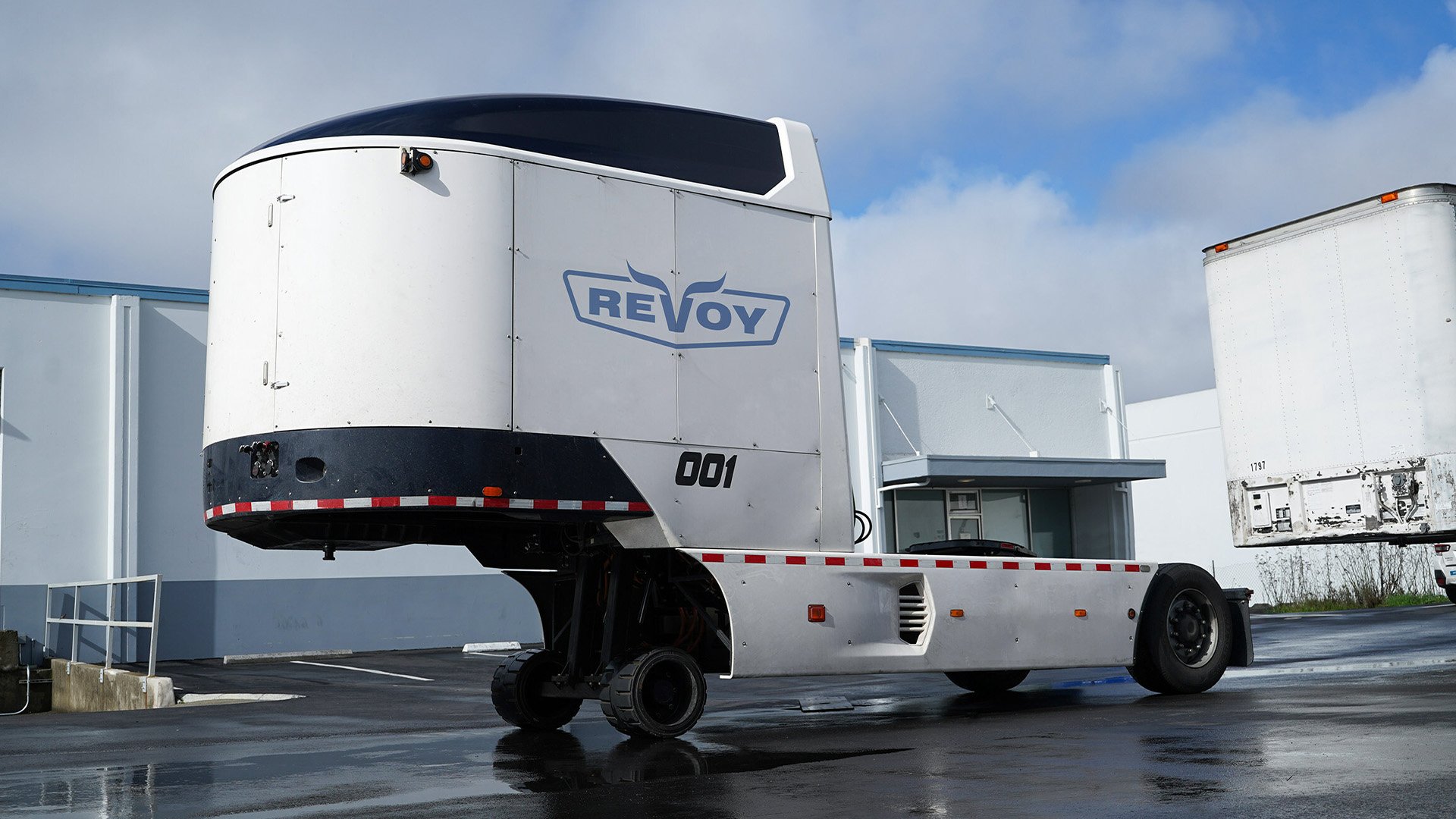
Semi trucks are similar to other vehicles in that they create tailpipe emissions that must be managed. However, while companies like Tesla are developing electric semis, the requirement for large battery packs to provide enough range for hauling presents greater challenges for large trucks compared to passenger cars. A startup based in California has proposed an alternative, though it’s quite unusual.
Established in 2020, Revoy has created a module that includes a battery pack and electric motor, which fits between the tractor and trailer, transforming any semi truck into a temporary hybrid. It might seem puzzling, but Bloomberg noted this week that Revoy recently raised $27 million in funding, indicating some believe it’s a solid concept.
Revoy asserts that the existing version of its battery booster can provide enough power for 200 miles of electric assistance for an 80,000-pound truck. Rather than functioning exclusively on electric power, it appears to focus on enhancing fuel efficiency by alleviating some of the burden from the truck’s diesel engine. This automated module is intended to augment power in sync with the engine’s revs, and facilitate regenerative braking to recharge the battery as needed. However, since the pack is too large to be fully charged using regeneration alone, Revoy envisions a network of “hubs” where drivers can exchange them, according to Bloomberg.
According to Revoy, the removable module can decrease carbon emissions by as much as 85%, and operating expenses should be similar to those of standard diesel trucks, even considering lower fuel prices prior to the U.S. conflict with Iran, CEO Peter Reinhardt told Bloomberg. The startup also promotes its technology as a means to prolong the functional lifespan of existing diesel trucks in light of potentially tougher emissions regulations.
In 2023, Revoy secured approval from the National Highway Traffic Safety Administration (NHTSA) to operate its equipment on public roadways and initiated a pilot program with Ryder the following year. The startup aims to commence commercial operations on a 200-mile route near Portland, Oregon, later this year, utilizing modules built from Chinese parts and a specially trained group of drivers. Moving forward, Revoy hopes to leverage the funds from its recent financing round to create a more affordable version with a smaller battery but with comparable range between charges. That’s if Revoy continues to exist.
Although it relies on pre-existing trucks, Revoy’s approach still fails to resolve another significant issue with battery-electric vehicles: the necessity for specialized infrastructure to accommodate them. Managing all these units could incur substantial costs and complications. The current sentiment in Washington is also not supportive of imported Chinese components, and while the $27 million is more than half of the $41 million Revoy has raised thus far, it’s merely a small fraction of the funds required to develop a replacement and scale up domestic production. All-electric semis are also poised to benefit in their key market from a California rebate initiative that could undermine the business viability of Revoy’s hybrid system.
**Battery-Powered Semi Truck ‘Backpack’ Converts Diesel Trucks into Hybrid Vehicles: An Examination of Its Function**
In the search for sustainable transport solutions, the trucking sector faces growing pressure to decrease its carbon footprint. One inventive strategy gaining momentum is the creation of battery-powered ‘backpacks’ aimed at converting conventional diesel semi trucks into hybrid vehicles. This article investigates the function, usability, and possible effects of this groundbreaking technology.
### Comprehending the Battery-Powered ‘Backpack’
The battery-powered ‘backpack’ acts as an auxiliary power source that can be attached to current diesel semi trucks. This modular system features a battery pack, electric motors, and control systems that synchronize with the truck’s existing diesel engine. The main objective of this innovation is to supply extra electric power, allowing the truck to function in a hybrid mode, thus lessening dependence on diesel fuel.
### Purpose and Advantages
1. **Emission Reduction**: A key aim of the battery-powered backpack is to significantly cut greenhouse gas emissions. By enabling trucks to run on electric power during specific segments of their routes—such as idling, low-speed driving, or in urban environments—these systems can help lower harmful emissions linked to diesel engines.
2. **Enhanced Fuel Efficiency**: The inclusion of electric power can enhance fuel efficiency. By utilizing the electric motor for low-speed activities or during stop-and-go scenarios, the diesel engine can function less often, conserving fuel and diminishing overall operational costs for trucking firms.
3. **Compliance with Regulations**: As countries globally enforce tighter emissions guidelines, the battery-powered backpack provides a practical answer for fleet operators aiming to meet these standards without needing to completely replace their current vehicles.
4. **Cost-Effectiveness**: Retrofitting existing diesel trucks with a battery-powered backpack may be more economical than purchasing entirely new electric or hybrid trucks. This method allows fleet operators to prolong the life of their present assets while adopting greener technologies.
5. **Adaptability and Scalability**: The modular design of the backpack system enables it to be customized for various truck models and configurations. This adaptability fosters wider acceptance across diverse sectors of the trucking industry, from long-distance transport to local deliveries.
### Challenges and Factors to Consider
While the battery-powered backpack offers various benefits, several challenges must be addressed to facilitate widespread use:
– **Weight and Space Limitations**: The addition of a battery system increases the overall weight of the truck, which may affect payload capacity. Engineers must devise these systems to be as lightweight and compact as feasible to alleviate this concern.
– **Battery Technology**: The performance and durability of the battery packs are vital. Progress in battery technology, such as enhanced energy density and quicker charging capabilities, is crucial for optimizing the backpack system’s efficiency.
– **Infrastructure Development**: The successful implementation of hybrid trucks necessitates adequate charging infrastructure. This includes rapid charging stations along major trucking corridors and in urban centers where these vehicles are likely to operate.
– **Initial Costs**: While retrofitting is generally more affordable than acquiring new vehicles, the upfront investment in battery technology can still be considerable. Financial incentives or subsidies may be needed to stimulate uptake.
### Conclusion
The battery-powered semi truck ‘backpack’ stands as a promising innovation in the drive for greener transportation solutions within the trucking sector. By converting conventional diesel trucks into hybrid vehicles, this technology not only addresses environmental challenges but also presents financial advantages for fleet operators. As technological improvements continue and challenges are tackled, the potential for widespread adoption of this technology could significantly influence the future of sustainable logistics and transportation.
 admin
admin