
It’s been a while since we checked in on one of the most unlikely restoration efforts in recent times. The team behind The Questionable Garage YouTube channel has been working to restore a rare General Motors EV1—VIN 212—acquired in late 2025 from an impound auction for the staggering price of $104,000. However, opportunities to purchase an EV1 are scarce as the cars were initially leased to consumers and notoriously recalled by GM when the leases came to an end, with most being destroyed.
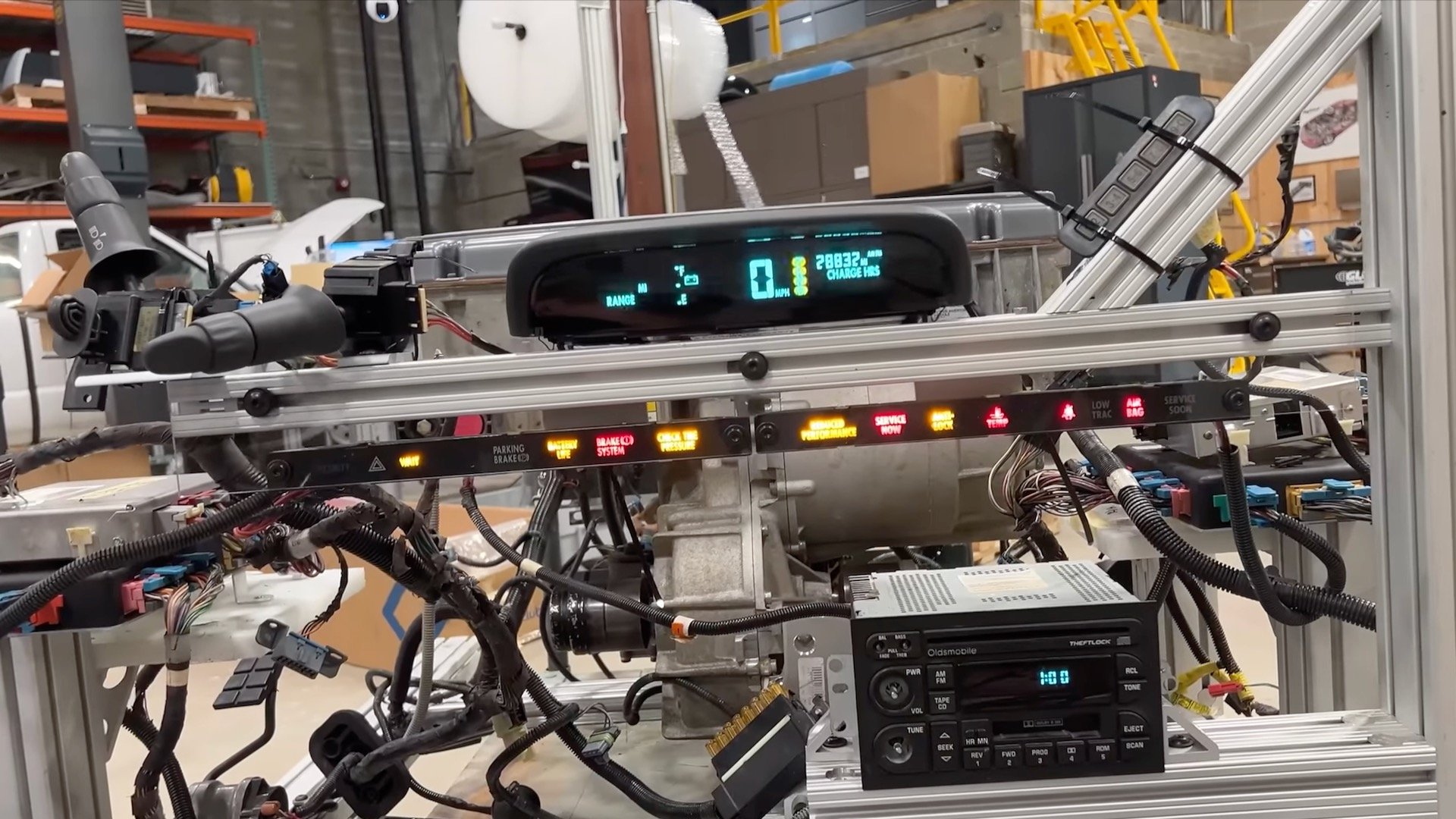
This poses a challenge for restoration, since spare components are not readily accessible (there are also notable differences between earlier and later models under the hood). But in its most recent video on the project, The Questionable Garage demonstrated that it is making significant advancements. The team successfully activated the 12-volt electrical system throughout the car’s wiring harness, powering the dashboard, radio, odometer (registering 28,832 miles), and brake lights. The vehicle also accepted its security code, a necessary step for making it operational once the high-voltage battery pack and motor are reconnected.
Having spent a lot of time outdoors, the first task was to eliminate decades of corrosion and dirt buildup from the harness’ connectors. Most of this was accomplished using an ultrasonic cleaner that employs vibrations to remove the debris. Everything was then mounted on a fixture outside the car for testing, making it easier to access.
Subsequently, the shifter panel was cleaned and reassembled, including installing new bulbs for the numerous backlit buttons on the panel, and the removal of a taped-on screw seemingly placed to disable the park-interlock switch as part of 212’s disbandment process. This may have permitted the car, donated by GM to Clark Atlanta University, to be moved in neutral after its powertrain was rendered inoperative (through the removal of components like the power control module). GM may have accepted some cars surviving as educational tools, but it did not want them to be on the road.
What Happens When You Power Up a GM EV1 After Decades?
Watching the detached instrument cluster, shifter, and Oldsmobile-sourced head unit illuminate is an exciting moment for anyone fond of unusual and unique vehicles. It indicates that this EV1 may soon be able to move again—once all of these components are reinstalled and connected to the powertrain, that is. A critical upcoming challenge will be integrating EV1 software onto the new powertrain control module, sourced from an S-10 EV, to ensure everything functions properly.
The EV1 is one of the most notable missteps in automotive history. GM began recalling and decommissioning them in 2003, only to reveal the Chevrolet Volt concept just four years later. One can only speculate how differently the scenario might have unfolded if GM had capitalized on the EV1’s momentum instead of rejecting it, but at least the automaker is currently supporting the restoration of EV1 212. Hopefully, this will advance the project toward completion sooner rather than later.
**Update on the Revival of the GM EV1 by Devoted Team**
The General Motors EV1, released in the late 1990s, is frequently celebrated as one of the initial mass-produced electric vehicles. Despite its pioneering technology and devoted fanbase, the EV1 was discontinued in 2003, prompting significant protests from its supporters. Recently, a dedicated team of engineers, car enthusiasts, and environmental advocates has embarked on an initiative to bring the EV1 back to life, aiming to merge its iconic design with modern electric vehicle technology.
**Project Overview**
The “EV1 Reimagined” project aims to restore the original EV1 while incorporating contemporary advancements in battery technology, electric drivetrains, and sustainable materials. The team is committed to preserving the vehicle’s classic aesthetics while enhancing its performance and efficiency to align with today’s benchmarks.
**Technical Developments**
1. **Battery Technology**: The original EV1 was powered by lead-acid batteries, which have since been superseded by lithium-ion technology. The team is seeking collaborations with top battery manufacturers to create a high-capacity, lightweight battery pack expected to significantly expand the vehicle’s range, potentially exceeding 300 miles on a single charge.
2. **Electric Drivetrain**: The original EV1 was equipped with a 137-horsepower electric motor. The team is assessing modern electric motors that deliver greater torque and horsepower, ensuring the reimagined EV1 not only retains its spirited performance but also offers enhanced acceleration and driving dynamics.
3. **Sustainable Materials**: In accordance with modern environmental standards, the team is sourcing sustainable materials for the vehicle’s interior and exterior, including recycled plastics and bio-based composites, designed to reduce the vehicle’s overall carbon footprint.
**Design and Aesthetics**
The design team is diligently working to maintain the iconic aesthetics of the EV1 while implementing essential updates. The exterior will uphold the sleek, aerodynamic profile that defined the original model, complemented by enhancements such as LED lighting and modern paint technology. Inside, the cabin will showcase updated infotainment systems and connectivity options, ensuring a mix of nostalgia and contemporary convenience.
**Community Engagement and Support**
The revival project has gained considerable attention from the automotive community and environmental advocates alike. A crowdfunding initiative has been launched to support the initial phases of the project, enabling fans of the EV1 and electric vehicle proponents to participate in its restoration. The team has also organized events and forums to connect with the community, gathering input and cultivating a sense of ownership among supporters.
**Challenges Ahead**
Despite the excitement surrounding the venture, the team encounters several challenges. Regulatory obstacles, the sourcing of original components, and the necessity of extensive testing to ensure safety and reliability are key areas demanding focus. Moreover, the team navigates the complexities of modern automotive manufacturing, including supply chain issues and compliance with current safety regulations.
**Conclusion**
The revival of the GM EV1 marks a unique convergence of nostalgia and innovation. With a dedicated team focused on honoring the legacy of the original vehicle while incorporating modern technology, the EV1 Reimagined project represents the potential to resurrect an iconic piece of automotive history. As the initiative progresses, it will attract attention from enthusiasts and industry experts alike, standing as a testament to the lasting appeal of electric vehicles and the promise for sustainable transportation solutions.
 admin
admin