
- Audi’s latest premium SUV. The 2027 Audi Q9 is the most spacious SUV ever produced by Audi, incorporating three rows of seating and state-of-the-art technology.
- Remarkable dimensions and aesthetics. Measuring 209 inches in length, the Q9 outstrips rivals such as the BMW X7 and Mercedes-Benz GLS-Class.
- Technology-rich cabin. Features a triple-display layout, Bang & Olufsen audio system, and a giant glass ceiling with PDLC innovation.
- Robust performance. The Q9 comes equipped with a twin-turbo V6, while the SQ9 offers a V8, both featuring quattro all-wheel drive.
Key takeaway: The 2027 Audi Q9 establishes a new benchmark as Audi’s most expansive and technologically advanced SUV, merging luxury, space, and performance.
AI assisted, editor reviewed
As Audi phases out the A8 luxury sedan, the automaker introduces its new flagship, unmistakably an SUV, reflecting the automotive trends of 2026.
On Tuesday, the 2027 Audi Q9 made its debut in New York, marking the automaker’s most capacious people mover, featuring three rows of adult seating, an expansive glass roof, turbocharged powertrains, cutting-edge technology, ample storage, and of course, quattro all-wheel drive. The German manufacturer’s flagship will hit U.S. dealerships right in time for the holiday season later this year, starting at $89,095, inclusive of a $1,395 destination fee, while the SQ9 will retail for $119,395.
The Q9 stands as the largest production Audi available, spanning 209 inches in length, with a wheelbase of 123.5 inches, a width of 86.8 inches, and a height of 71.4 inches. As a comparison, the recently discontinued A8L was 209.5 inches long but only featured a 123.1-inch wheelbase and lacked the Q9’s three rows of seating and storage capacity. The Q9’s dimensions are substantial; it is roughly 3 inches shorter than a Cadillac Escalade but 3 inches longer than a Mercedes-Benz GLS-Class and over 5 inches longer than a BMW X7. An Audi spokesperson indicated that the Q9 is as large as they could market effectively in Germany.
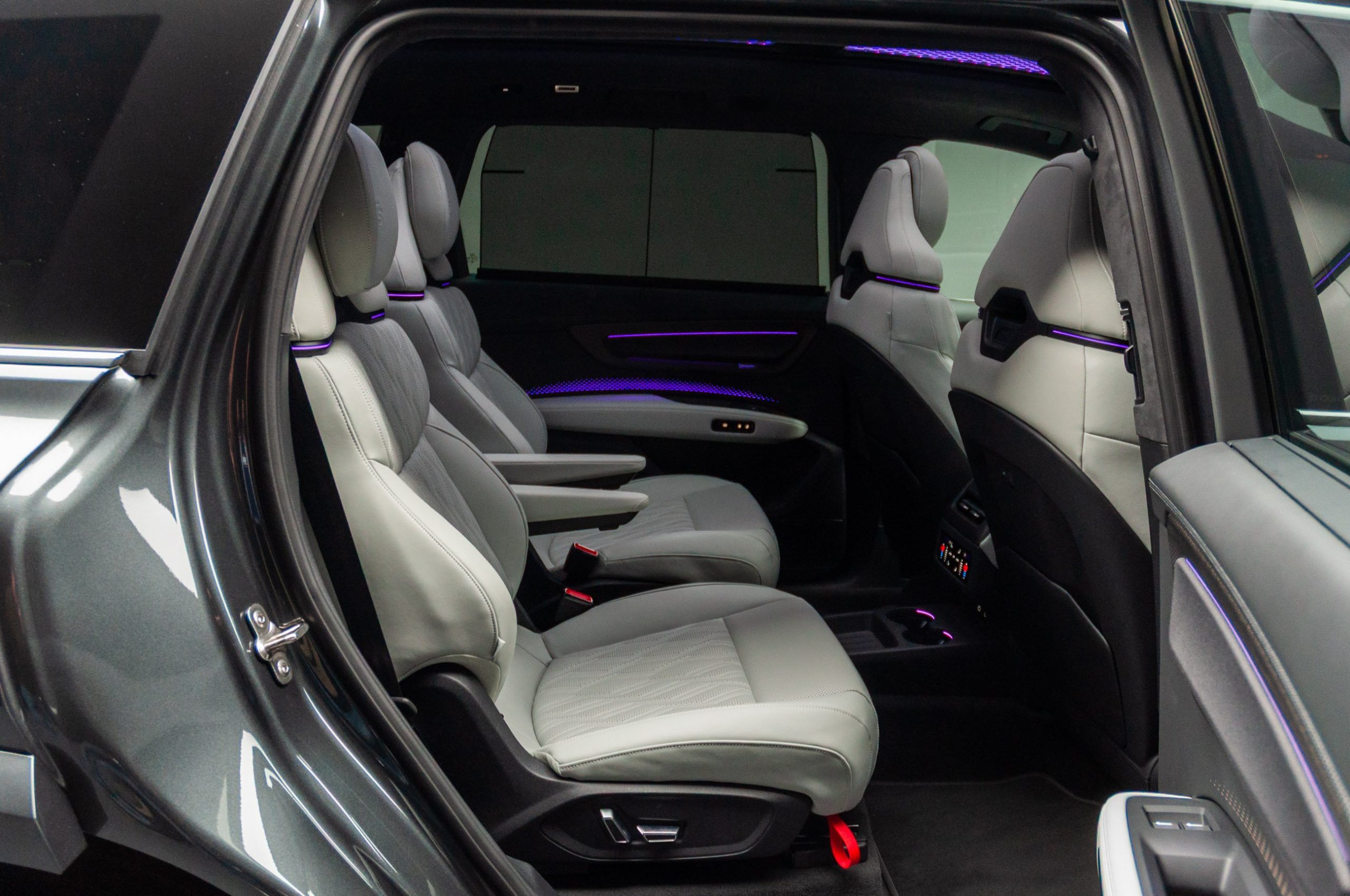
The Q9 will come in either six or seven-passenger formats with LATCH anchors on every second- and third-row seat, accommodating families no matter the configuration. The second-row seats slide and recline, easing access to the third row, which is sufficiently spacious for adult comfort. At 5-foot-10, I found ample foot, leg, and headroom, even with a 6-foot-5 adult seated in the second row. Rear doors that open at 90 degrees provide superior access, albeit resulting in large rear door dimensions. Motorized doors can be closed via a button on the front touchscreen.
For families intending to transport items ranging from soccer gear to luggage, there’s 19.3 cubic feet of cargo space behind the third row, expandable to 50.0 cubic feet with the third row down. Folding both the second and third rows results in a cargo capacity of 87.7 cubic feet.
Audi has reverted to a similar design concept with varying lengths in its latest offerings. The new design ethos was first revealed on the compact Q3 crossover in 2025 and was followed by the 2027 Q7 introduced in June. Now the Q9 adopts these design principles, extending them while preserving the vital elements from its smaller counterparts. The front features split lighting components with horizontal LED daytime running lights positioned above the headlights, which will be obtainable with the automaker’s new digital Matrix LED technology. The headlights flank a grille with vertical slats on the Q9, switching to an egg-crate design for S-Line and more potent SQ9 variants. The pillars, especially the D-pillar, stand more erect than any prior Audi SUV. The previous Q5 and Q7 models’ clamshell tailgate is now outdated, replaced by optional curved OLED taillights with three-dimensional effects and illuminated signatures that appear striking. However, repairs for these could be costly. The base models are equipped with 21-inch alloy wheels, with options for 22s and 23s to enhance the wheel wells.
In May, Audi showcased the Q9’s interior, revealing several surprises amidst an otherwise predictable overall design. The dashboard aligns with the style introduced by the A6 E-Tron, showcasing a triple-screen arrangement composed of a digital gauge cluster and touchscreen infotainment interface beneath a unified piece of curved glass. A touchscreen for the front passenger comes standard. Most controls are integrated within the touchscreen, although a dedicated volume dial is present on the center console. There are two wireless device charging pads located front and center, along with Audi’s sophisticated yet practical single-piece stalk that integrates the gear shift, turn signal, and wiper controls into one unit, remaining exceptionally user-friendly. Fortunately, shiny piano black plastic is nonexistent. Thank you, Audi.
A noteworthy detail that my daughter will appreciate: both front and rear cup holders accommodate Stanley mugs. Please, empathize with my plight.
The entire Q9 showcases outstanding technology with an optional Bang & Olufsen 4D surround sound system featuring 24 channels, 22 speakers, and 2 actuators in the front seats that make them vibrate to enhance the music experience. There’s also a 16-square-foot glass roof that tilts and opens, which can be equipped with an electrochromatic function enabled by Polymer Dispersed Liquid Crystal (PDLC) technology that transforms the entire panel or specific sections into opaque to block sunlight and 99.5% of UV radiation. Additionally, Audi will offer integrated lighting options within the glass featuring 84 LEDs that will create a memorable ambiance.
The Q9’s powertrain consists of a 2.9-liter twin-turbo V6 generating 429 horsepower and 442 lb-ft of torque, while the more robust SQ9 will feature a 4.0-liter twin-turbo V8 producing 591 hp and 590 lb-ft of torque, exclusive to markets outside Europe. Both models utilize an 8-speed automatic transmission alongside standard quattro all-wheel drive. Audi claims the Q9 can accelerate from 0-60 mph in 4.9 seconds and reach a top speed of 130 mph, while the SQ9 improves that to 0-60 mph in 3.8 seconds and a maximum speed of 155 mph. A five-link independent suspension with adaptive air suspension is tasked with controlling the weight of the over 5,000-pound SUV, and Audi has stated that both the Q9 and SQ9 can tow up to 7,700 pounds regardless of the engine variant.
Audi provided The Drive with travel, accommodations, some German pretzels, and access to the vehicle for the purpose of writing this story.