
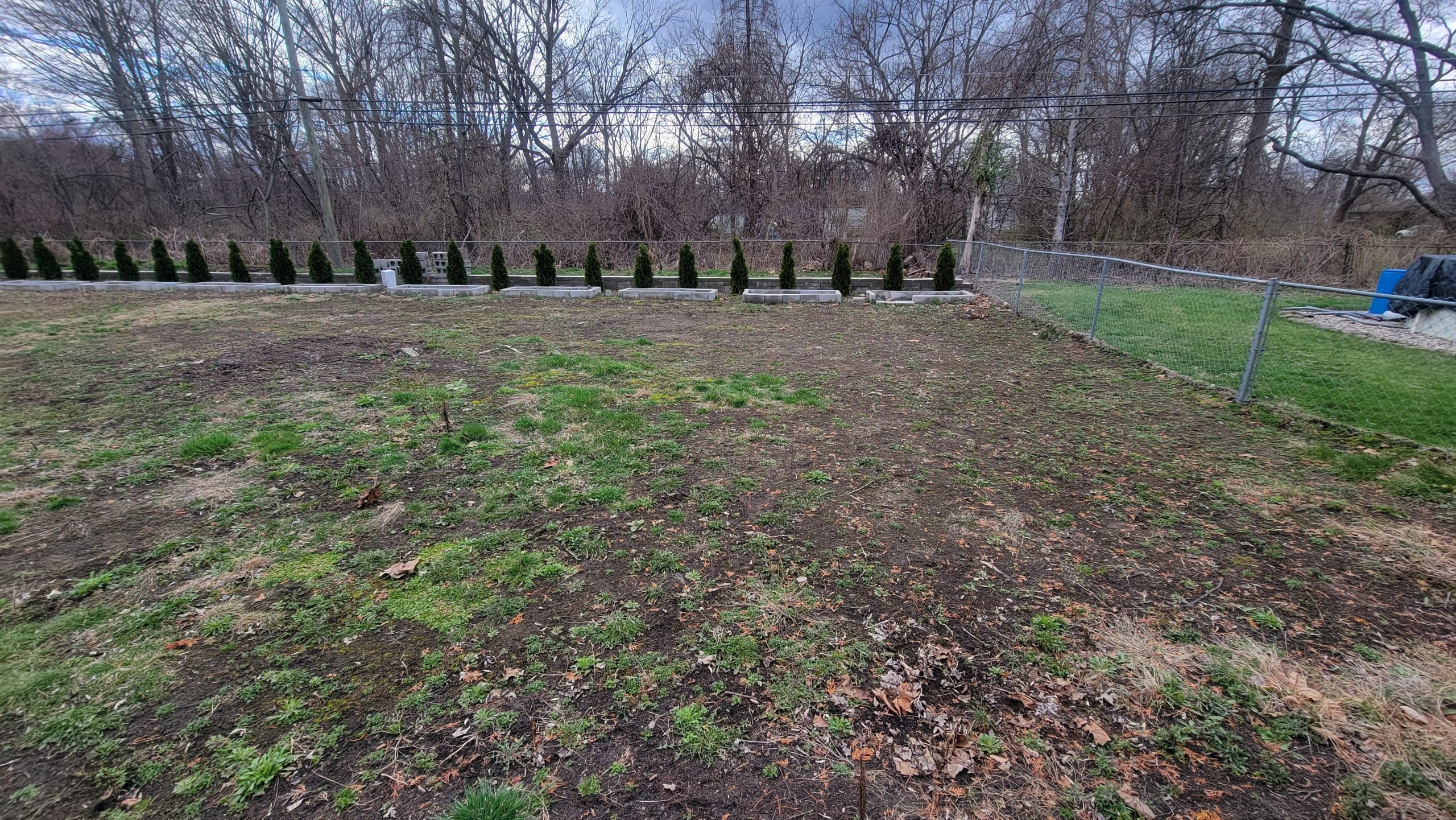
When I purchased my home in the Detroit suburbs in early 2022, it was, like many local century-old houses, somewhat poorly maintained. The interior was livable, and the families that occupied it from its construction in 1928 until the early 1990s took great care of it. But that was the turning point. The area wasn’t thriving at the time, and it was a tall order to convince people to invest significantly in properties whose values barely kept pace with inflation.
Three and a half years is a tight timeframe to make up for 30 years of neglect, and it was made more complex by the condition of the house when I acquired it. Consequently, my time for automotive hobbies has diminished to nearly nothing, yet tackling this job every day helps me stay connected to both worlds, so to speak—and much more aware of situations where they intersect.
This isn’t one of those “everything I need to know about the industry, I learned while gardening” posts, but the thought struck me while planting a tree, and it’s going to take a while before I relate this back to anything with four wheels. If that’s not your thing, I understand. This is your opportunity to leave.
In 2020, a young GM employee bought the property and began earnestly updating it. Among the projects was rejuvenating the 80-year-old landscaping, and by “rejuvenating,” I mean he hired someone with a mini-skid to push the back yard into a pile against the fence in preparation for laying pavers across the entire back yard. This property sits on half an acre; that’s a lot of bricks to cover.
But somewhere between tearing up an eight-decade-old lawn and ordering a few pallets of unattractive 16x8x4″ concrete blocks, he got his wife pregnant (again) and decided that while the lot was sufficiently large, the house itself just wouldn’t suffice for his expanding family. Being a seller’s market, he listed it for the amount he had purchased it plus the money he had put into it, and I happily came along and offered him an additional $20,000 on top of that.
So I ended up with a perfectly livable house with a muddy yard. Up front, I found some gravel, stumps, and a host of aggressively trimmed Japanese Yews that had long since left their bush phase decades prior. The wasteland in the back was the top priority; I moved into the house in March, and the first thistle leaves were already emerging by April. I scattered some mulch over the white gravel in front and put in a few arborvitaes and junipers along the retaining walls that line our front slope, but for the most part, my focus was elsewhere.
At that moment, I knew little about lawns except how to mow them. It took a solid two years to transform all the brown patches into greenery and to get the faux berm in the back under control. By the spring of ’24, I felt ready to address the part that people actually notice. I’d never planted a flower in my life aside from assisting my parents in the yard as a child. I was unfamiliar with garden design, but I knew I desired something other than the moat-like expanse of evergreens that typically envelops these old Tudor-style homes. I wanted something vibrant.
My search term was straightforward: “Trees with autumn color in summer.” My exploration down the rabbit hole introduced me to what I now recognize as a classic introductory plant: a red Japanese maple (a Bloodgood, for tree enthusiasts). I ordered it from a large online nursery equivalent. It arrived looking much greener than in the photos, but I trusted The Internet™‘s promise that it would thrive better the following year.
And wow, did it. From the moment it unfurled its bright crimson leaves last spring, I was captivated. I needed another one. I learned from previous research that other types existed and remembered seeing some rather magnificent (maybe too good to be true?) images pop up in my Google search from a small business in North Carolina called simply “MrMaple.”
In this industry, I receive countless pitches for mediocre items. I don’t solely mean cars, though many vaporware-style companies have attempted to sell me on various fantastical supercar concepts. Mostly, I’m talking about junk. Each week brings yet another “must-have,” “epic,” or “legendary” road trip accessory or another vibe-coded pile of rubbish produced by someone who confidently assumed (without verification) that they had thought of their brilliant idea first. Here I was, exploring the site of a business claiming to offer hundreds (nearly 1,500 now) varieties of this tree, some boasting leaves that render ornamental flowering plants dull. My skepticism came in as many shades as their stunning photographs.
If you have spent any time examining the tree selection at a local nursery, you likely perceive Japanese maples as somewhat pricey. And they certainly can be. Mature Japanese maple trees are typically smaller than their larger American red or sugar maple relatives, which just indicates they grow more slowly. The dwarf varieties that collectors cherish are even slower to develop. It takes years for some of them to reach just a few feet tall. The smallest trees usually found at a nursery are often in three-to-five-gallon containers or perhaps even larger, and those trees required years in a greenhouse to reach that size. That investment results in a heightened price—a steeper barrier to entry.
However, as I continued browsing MrMaple’s inventory, I discovered this wasn’t exactly the case. Most of the offerings were surprisingly affordable since they were all for smaller trees. $35-45 will secure you numerous varieties that you’d only find in significantly larger sizes if shopping locally. And it’s not merely common, standard varieties at those price points—they carry their rarest cultivars in the same small sizes. Some may command a slight premium due to the time and effort it takes to cultivate them, but we’re talking just $10-15 more than the typical big-box options.
And sure, you might stumble upon a one-gallon Tamukeyama or Crimson Queen (not a dig against either; I own one of the former) at Lowe’s or even Walmart, but that’s akin to saying you can always head down to the local used car lot and leave with a running Corolla. Meanwhile, if you care about driving and know where to look, you could grab a Miata or a Mustang for the same amount.
There you have it, folks: We’re back to wheels. And we’ve also arrived at my broader point: Like so many modern businesses, the car market heavily relies on FOMO. Why settle for the ordinary when you could achieve the extraordinary? Why accept what you own when you could acquire something newer and just a bit better?
Bottom: ‘Autumn Moon’ (spring/summer color) -Byron Hurd
The enthusiast market encapsulates this to its purest, arguably most toxic, form. Just examine Porsche. The 911 has transformed from being akin to Germany’s version of the Corvette to a model characterized not by accessibility but by scarcity. Not too long ago, it was reported that Porsche dealers were coercively requiring Taycan purchases from buyers just to secure chances for highly sought-after 911 allocations (think GT3, GTS). The MSRP of a contemporary 911 holds practically no significance; it’s a direct-to-speculator market. And this issue isn’t confined to Zuffenhausen; the R35 Nissan GT-R faced the same fate, along with numerous other examples within the enthusiast car scene, even among ostensibly “affordable” models like the Civic Type-R.
Traditionally, the enthusiast market has depended on replacement and depreciation to maintain a healthy excess of options in the secondary market. New cars emerge, making older ones less expensive and more accessible. However, the pipeline for new enthusiast vehicles is shrinking, which results in fewer enjoyable cars entering the secondary market, driving prices higher and further restricting the hobby’s accessibility.
A used car typically doesn’t have the same prestige as a new one, much like a one- or three-gallon ornamental tree lacks the wow-factor of a much more mature specimen, but eventually, they all converge to the same point, and for the aspiring hobbyist, merely being able to participate is a significant victory.
My Bloodgood was my introductory tree just as my 1995 Volkswagen Passat was my introductory car. Fittingly, that old green VW would complement the deep-crimson maple outside our living room window beautifully. We now have 27 of them in various sizes (each a unique variety) spread across the property. The Passat was the first of 12 manual-transmission cars I’ve owned (five new; seven used); only three of those (my NA, my JK, and CT4-V Blackwing) remain with me, but in my defense, it likely costs me less to water my yard monthly than it does to insure the least expensive of those three. Hobbies—even costly ones—don’t all have the same scaling.
I imagine that MrMaple could have positioned itself as a premium-oriented business providing a much smaller selection of more-mature plants and achieved similar profitability, but had it done so, I probably wouldn’t be sharing about it today. Instead, the family operating it opted to “go wide,” so to speak. The customer who begins with a $45 Purple Ghost might return next year for that $70 Golden Falls or that $100 Fireglow. In five years, they’ll arrive at the front with a U-Haul, driving away with thousands of dollars in purchases in tow—all because MrMaple was willing to forgo the promise of larger profits per unit to gamble on potentially reaching a broader audience.
Can you imagine that?
Have a news tip? Reach out to us at [email protected]!
**The Effects of Short-Sighted Profit Approaches on Enthusiast Vehicles and Their Future Community**
The automotive field has long been a realm of creativity, passion, and community. Enthusiast vehicles, known for their performance, aesthetics, and the emotional bonds they create among drivers, have garnered a devoted following. However, the emergence of myopic profit strategies among manufacturers threatens this dynamic community and the future of enthusiast automobiles.
**Comprehending Short-Sighted Profit Approaches**
Short-sighted profit approaches signify business practices that emphasize immediate financial returns at the expense of long-term sustainability and brand loyalty. In the automotive industry, this frequently presents as a fixation on maximizing sales volume, reducing production costs, and prioritizing mainstream models over niche alternatives. While such strategies may yield quick profits, they often overlook the distinct needs and aspirations of car enthusiasts.
**Consequences for Enthusiast Vehicles**
1. **Reduction in Niche Alternatives**: As manufacturers redirect their attention toward mass-market cars, the production of enthusiast vehicles—like sports cars, coupes, and performance-focused models—has decreased. This drop is visible in the cessation of legendary models and the hesitation to invest in new, imaginative designs that appeal to devoted drivers.
2. **Erosion of Brand Identity**: Many automakers possess rich histories linked to performance and enthusiast culture. Myopic strategies can dilute this heritage as brands prioritize profitability over the values that originally defined them. This erosion can alienate loyal clients and diminish the brand’s identity.
3. **Compromised Quality and Performance**: In the quest for cost reductions, manufacturers may compromise on the quality of materials and engineering that characterize enthusiast cars. This might lead to vehicles lacking the performance traits and driving experience that enthusiasts desire, ultimately causing dissatisfaction and detachment from the community.
4. **Decreased Community Involvement**: Enthusiast car communities thrive on shared experiences, events, and a feeling of belonging. When manufacturers focus solely on profit, they often overlook the importance of nurturing community engagement through sponsorships, events, and partnerships with enthusiasts. This detachment can result in a fragmented community and a loss of the camaraderie that has historically defined automotive culture.
**The Future of the Enthusiast Community**
The future of enthusiast vehicles and their communities depends on a shift in manufacturer strategies. Embracing a long-term vision that appreciates passion, innovation, and community involvement is crucial for rejuvenating the segment.
1. **Fostering Innovation**: Manufacturers should prioritize research and development for enthusiast vehicles, investigating new technologies and designs that resonate with devoted drivers. This investment could lead to the introduction of exciting new models that inspire both current and prospective enthusiasts.
2. **Reinvigorating Brand Heritage**: Brands can reconnect with their origins by celebrating their histories and the vehicles that made them famous. By honoring their legacy, manufacturers can cultivate loyalty among enthusiasts and attract new followers who appreciate the brand’s narrative.
3. **Boosting Community Involvement**: Cultivating strong relationships with the enthusiast community is vital. Manufacturers can support events, sponsor car exhibitions, and create platforms for enthusiasts to share their stories. Engaging directly with the community can assist brands in understanding their customers’ wishes and foster a sense of belonging.
4. **Sustainable Methods**: As the automotive sector progresses toward electrification and sustainability, manufacturers must discover ways to incorporate these principles without compromising the performance and excitement that enthusiasts seek. Developing electric performance vehicles that preserve the driving experience can merge innovation with passion.
**Conclusion**
The effects of short-sighted profit approaches on enthusiast vehicles and their future community are significant. As manufacturers navigate the complexities of the contemporary automotive landscape, a renewed emphasis on passion, heritage, and community engagement is essential. By prioritizing the wants of enthusiasts and investing in the future of performance vehicles, the automotive industry can guarantee that the spirit of driving survives for generations ahead.