
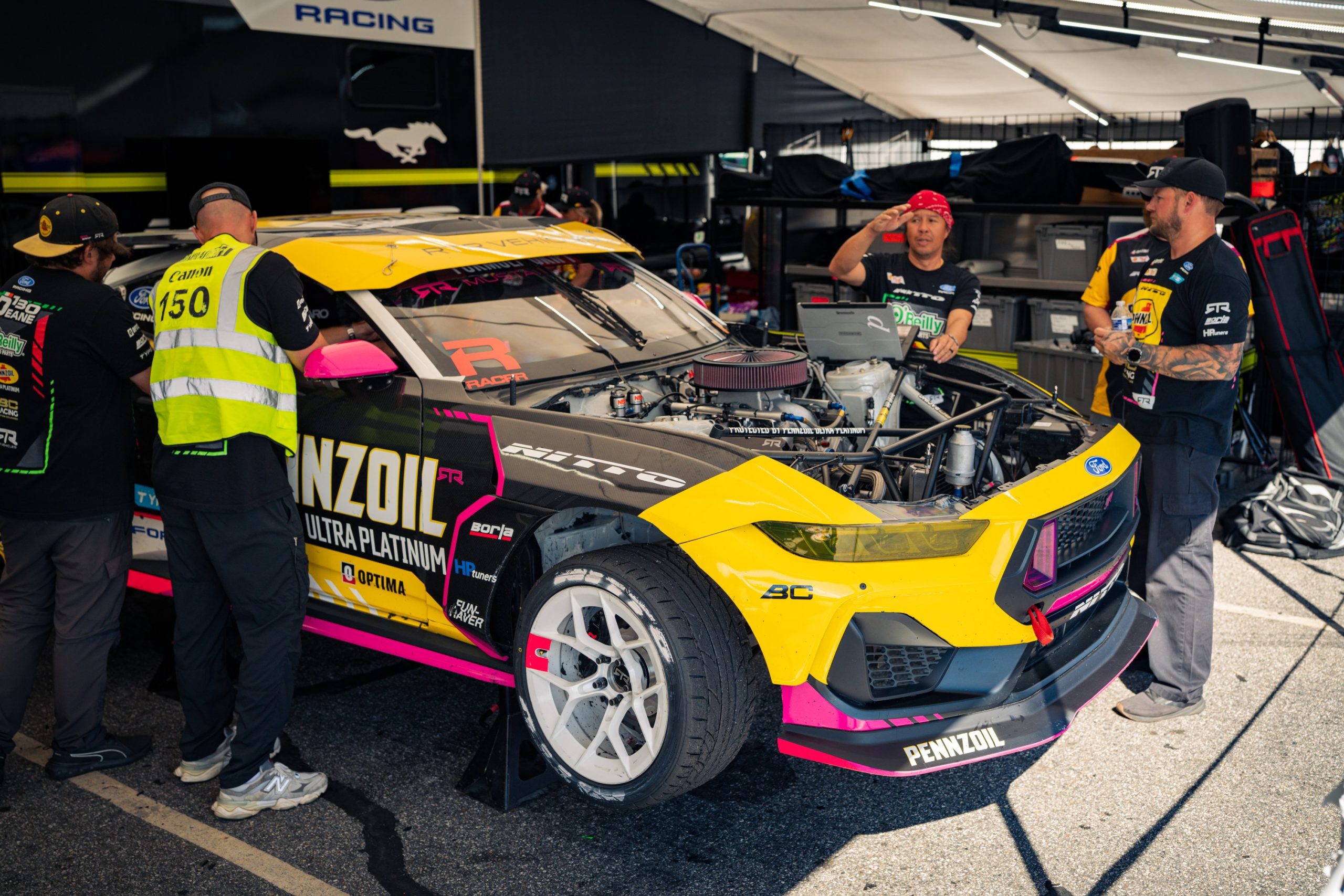
“The main challenge these vehicles face is low-speed performance”, remarked Josh Stroud, the Formula DRIFT crew chief for RTR Mustang #213, while showing me around Ben Hobson’s Pennzoil Ford Mustang RTR Spec 5-FD. A true drift car setup involves much more than just negative camber and hydraulic handbrakes.
Drifting was once a grassroots motorsport, but for over two decades, Formula DRIFT (often referred to as FD) has been expanding the boundaries of drifting, demonstrating a sport that prioritizes technique and style, rather than mere speed. The RTR team, known as “Ready To Rock,” has played a crucial role in the burgeoning drifting scene in the USA, introducing powerful V8s to a landscape previously dominated by import vehicles.
During a weekend at Formula Drift “Battle at the Springs,” I spent time with the RTR Team to discover what is involved in creating a cutting-edge professional drift car, particularly from the viewpoint of someone who has dedicated the last three years to constructing and driftying my own grassroots drift vehicle.
A professional drift vehicle has several notable differences compared to conventional racing cars, categorized into three primary areas:
- Steering and Suspension
- Powertrain and Engine
- Exterior and Aesthetics
Steering and Suspension
It is clear that any drift car is designed for lateral movement, but this is a competitive sport evaluated on how well you can drift while still achieving impressive forward momentum. This balance is accomplished through steering modifications, forgiving suspension, and rear-end grip. The RTR Spec-5 FD Mustang features a lower ball joint positioned further from the chassis than stock along with extended tie rod ends to match. This alignment alters the front knuckle’s position and imparts that signature “bulldog stance” to any drift vehicle.
By extending the bottom of the steering knuckle outward, the wheel can turn more before coming into contact with the body, which is beneficial for attaining maximum drift angle. Importantly, while the front wheels are capable of more angle lock to lock, this does not actually increase the number of steering wheel turns possible. Thus, each degree of steering wheel movement results in a larger degree of front wheel turning. This can lead to a drift car feeling overly reactive, as small inputs produce significant movement. This can be enjoyable for drivers adept at handling a steering wheel that oscillates back and forth in drifts, but can be unsettling for novices. In conjunction with this customized steering system, there is a long list of bespoke alignment settings.
“I can’t disclose the specific changes I made, but I’m aiming for better grip,” noted Shelby Crackston, crew chief for RTR driver James Deane. This suggests she was likely adjusting the rear toe arms inward toward the car. This positioning causes the rear tires to angle towards each other, effectively increasing traction (bite) during acceleration. While not ideal for regular driving conditions, when these drifting machines consume 315-width Nitto tires in just two runs, it’s not a concern! That’s all I managed to gather since she wasn’t divulging too much about her secret method, and understandably so.
Suspension configurations and tire pressures provide the primary avenues for drivers to gain a competitive edge. It’s common for beginners to start drifting without any of these steering modifications and focus solely on suspension settings. Adding angle kits prematurely can be jarring for those new to the sport.
Powertrain and Engine
One of the objectives of Formula DRIFT is to maintain accessibility in driving, meaning cars must be derivatives of their street-legal counterparts and usually equipped with components that any amateur mechanic can source online. So, yes, if you’re inclined, you COULD purchase one of these Mustangs. However, I would recommend opting for one of their more street-appropriate models.
RTR began as a speedshop launched by Vaughn Gittin Jr., concentrating on heavily modified Mustangs. It quickly evolved into a performance parts supplier and outfitter backed by Ford, so much so that the RTR Drift team services their procar Mustangs at Ford dealerships when unable to return to HQ in time for upcoming events. Can you envision your Ford Escape on a lift next to a 1,249-horsepower Mustang?
Jake Allen
Ben Hobson’s vehicle features a 455 cubic-inch V8 and releases at least a 300-shot of nitrous for every run on top of all that power. Following the weekend on the track, I had a discussion with Sean Nguyen, Pennzoil Technical Scientist and Automotive Lubricant Specialist, to learn how these engines manage to endure such significant stress consistently.
“They accelerate from 0 to 9,000 RPM in [one] shot. Naturally, this imposes substantial demands on the oil, the transmission… Hence, the product must be shear stable to cope with that,” Sean remarked after I was surprised to discover that these RTR Mustangs utilize standard Pennzoil Ultra Platinum 10W-60. This aligns with the notion of using accessible parts for straightforward maintenance. Anything the RTR team can implement to simplify processes and ensure reliability contributes to a successful race day.
Even a single run in amateur drifting involves full-throttle moments, swiftly followed by off-throttle drifting. This abrupt change in velocity and throttle can be challenging to manage without a dry sump system or baffled oil pan. Much like transitioning in drifting, a lot of Pennzoil’s oil engineering is designed to adjust and cater to any engine it’s placed in. These highly tuned RTR Spec-5 FD engines are constructed “loose” and require thicker oil to fill the gaps relative to a standard vehicle. Sean clarified, “Lose a seal, lose compression, lose power.” As a partner with RTR, they cannot afford to have their product be a concern, so Pennzoil collaborates closely with each RTR driver to understand their vehicle and driving approach prior to selecting oil that functions optimally.
Exterior Design
When diving into the drifting world, one must embrace a reality: crashes will happen. Once a driver acknowledges this, their mindset evolves, leading to improved driving (ask me how I know). With Ben Hobson’s RTR Mustang and numerous other drift cars in the paddock, everything “stock” in front of the shock towers and behind the rear windshield is removed and substituted with breakaway metal known as “tube frames,” designed to glide against guardrails or to come into contact with another vehicle in tandem drift without incurring lasting damage.
These design approaches give drivers the assurance to push their limits, knowing they have easily replaced parts readily available if needed.
Motivating Future Generations
As a participant in more than 10 drift days annually, I approached my first weekend at Formula DRIFT expecting something akin to my experiences in pit areas at other racing series across the nation. Instead, I encountered a professional league that doesn’t confine itself behind velvet ropes and exclusive access, but instead embraces everyone, allowing them to get up close and personal with the cars and drivers that many of us admire. I saw a friend drive their drift car to the event, approach a driver, and engage in discussions about suspension setups. About an hour later, they were witnessing that same vehicle circulate the track. This level of accessibility is what I cherish about the drifting community.
Full disclosure: Pennzoil, a sponsor for both Formula DRIFT and RTR, invited me to the event this weekend and covered my ticket.
### RTR Demonstrates Expert Methods for Tuning a Mustang for Formula Drift
The realm of Formula Drift is an exhilarating stage where precise engineering combines with the artistry of drifting. RTR, a distinguished name in the drifting sphere, has positioned itself as a leader in tuning vehicles for competitive drifting, particularly the Ford Mustang. This article explores the expert methods applied by RTR to enhance a Mustang for the rigorous expectations of Formula Drift.
#### Comprehending the Fundamentals of Drift Tuning
Drifting necessitates a distinctive set of vehicle dynamics that significantly diverge from conventional racing. Essential elements include power delivery, suspension arrangements, tire management, and weight distribution. RTR prioritizes these factors to guarantee that their Mustangs can excel at the highest level during competitions.
#### Engine Optimization
The core of any drift vehicle lies in its engine. RTR employs sophisticated tuning methods to maximize horsepower and torque, which are vital for retaining control during high-speed drifts. This process includes:
1. **ECU Remapping**: RTR alters the engine control unit (ECU) to improve throttle response and adjust fuel maps for peak performance.
2. **Forced Induction**: Several RTR Mustangs are fitted with superchargers or turbochargers to increase power output. These systems are meticulously calibrated for reliability and performance.
3. **Exhaust Upgrades**: Enhanced exhaust systems not only boost engine efficiency but also deliver the signature sound favored by drifting fans.
#### Suspension Calibration
A precisely tuned suspension is crucial for achieving the right balance and handling characteristics in a drift car. RTR concentrates on:
1. **Coilover Systems**: Adjustable coilovers facilitate fine-tuning of ride height and damping settings, providing drivers the ability to modify the car’s handling to suit their needs.
2. **Camber and Toe Fine-tuning**: RTR optimizes the camber and toe angles to improve grip during turns while enabling managed slides.
3. **Anti-roll Bars**: Enhanced sway bars minimize body roll, ensuring better stability during daring maneuvers.
#### Tire Selection and Management
Tires are central to drifting performance. RTR stresses:
1. **Tire Composition**: Selecting the appropriate tire compound is key for achieving desired grip and longevity during events. RTR frequently collaborates with tire manufacturers to create tires that endure the demands of drifting.
2. **Tire Inflation**: Tire pressure adjustments can greatly influence handling dynamics. RTR expertly calibrates tire pressures to enhance grip and control during slides.
#### Weight Balance and Chassis Reinforcement
Proper weight distribution is essential for maintaining equilibrium during drifts. RTR utilizes techniques such as:
1. **Chassis Reinforcement**: Fortifying the chassis preserves structural strength in high-stress conditions, reducing flex and enhancing handling.
2. **Weight Reduction**: RTR often removes superfluous components to lower the Mustang’s overall weight, amplifying agility and responsiveness.
#### Driver Instruction and Feedback
Though technical enhancements are crucial, driver capability is just as vital in drifting. RTR emphasizes:
1. **Training Workshops**: RTR conducts training programs for drivers to sharpen their skills, focusing on techniques that complement the vehicle’s configuration.
2. **Continuous Feedback Loop**: Ongoing dialogue between drivers and engineers enables real-time modifications to the car’s setup based on practical performance during practice runs.
#### Closing Thoughts
RTR’s proficiency in tuning Mustangs for Formula Drift exemplifies a fusion of engineering excellence and a profound understanding of the sport. By concentrating on engine performance, suspension dynamics, tire management, and driver education, RTR ensures that their vehicles are not only competitive but also enjoyable to operate. As the drifting landscape advances, RTR continues to lead the charge, establishing benchmarks for performance and innovation within the drifting community.