
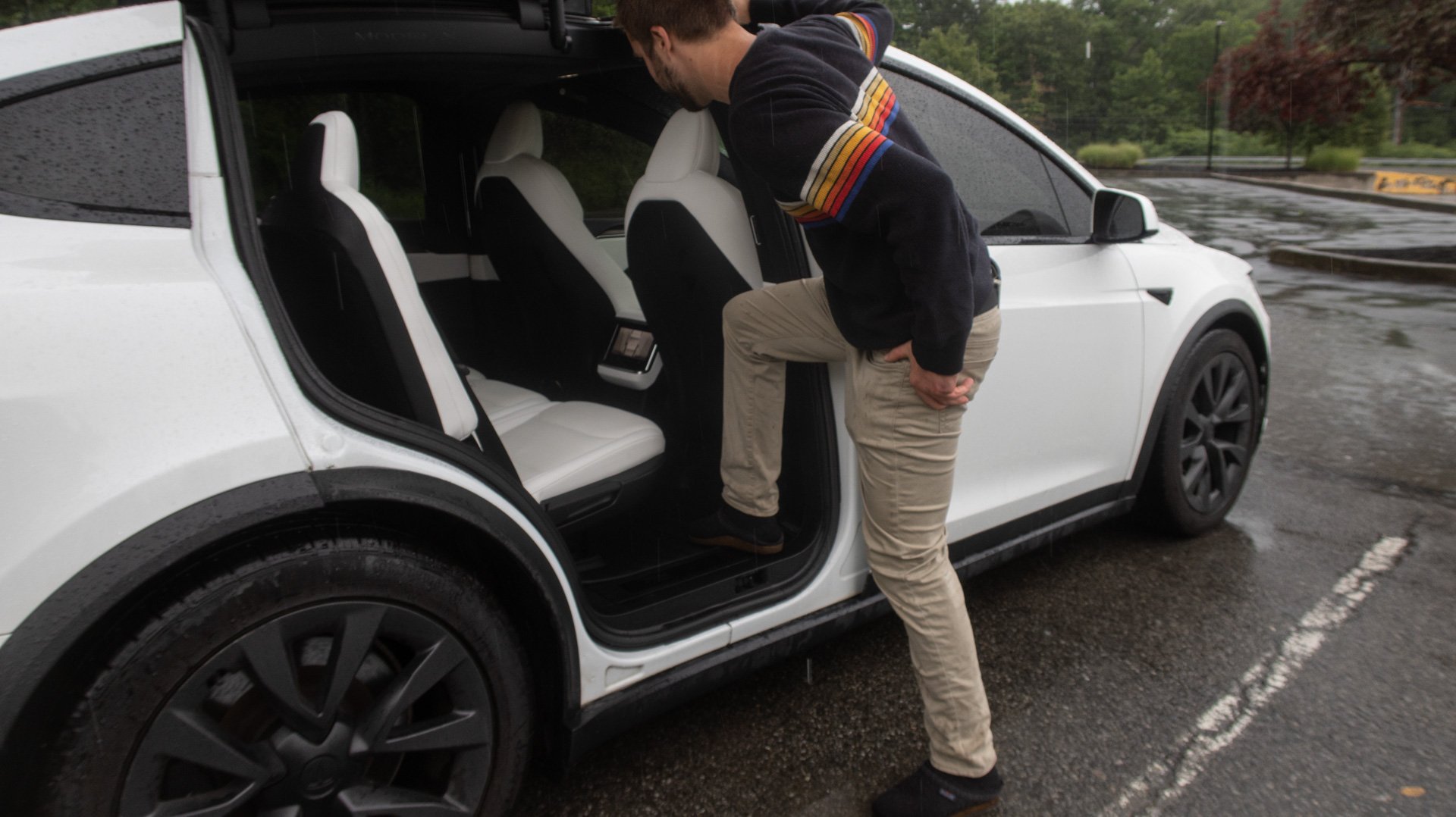
My initial encounter with TuxMat predates any formal product evaluation. I was once collected from a hotel in Miami by a Mercedes EQS equipped with TuxMat, and I distinctly remember appreciating how effectively these mats balanced a solid yet elegant look that suited the vehicle perfectly. Additionally, an impressive feature of these mats is how thoroughly they encompass the lower section of the car’s interior.
Since that time, we’ve installed them in sedans, crossovers, and trucks, and I’ve been happy to note how well TuxMat car mats are tailored not only to individual models but also to specific trim levels. A multitude of custom mat companies provide model-specific options, yet TuxMat truly delves into a level of detail that other aftermarket brands rarely consider. This expertise belongs to Sam Cheng, TuxMat’s Director of Product Development, along with his team.
I have a passion for industrial design in general and have recently gotten into 3D digital design since I ventured into 3D printing (these concepts are quite interconnected). It was enjoyable to geek out with Sam about how TuxMat develops the designs for its vehicle-specific mats.
TuxMat’s dedication to superior fitment with trim-specific design philosophy implies that product development is inherently more challenging than it would be for a standard make/model-specific mat set.
While discussing the company’s workflow and design methodology, Sam pointed out that newer car models often exhibit greater physical variations across trim levels than older models. He provided examples such as movable consoles, bench seats vs. captain’s chairs, and optional ice boxes. “That customer… purchased the vehicle with the ice box and the subwoofer, and the mat isn’t trying to wrap around it—it actually contours around those shapes.”
Naturally, acquiring all those measurements is more complex than simply tape-measuring lengths and widths. TuxMat engages in an intricate 3D scanning and data cleanup process to generate models of car interiors. Their development approach employs sophisticated scanning technology that uses “structured light,” which integrates laser lines, blue LEDs, and infrared light for efficiently scanning diverse textures and surfaces that absorb light.
Sam shared that the scanning procedure usually takes around two and a half hours, depending on the vehicle’s dimensions. Following this, the team refines the resulting polygon data. Blind spots in confined spaces are managed by conducting multiple scans from varying angles and combining them to create a high-fidelity model.
“We have a team of highly experienced designers who understand our coverage requirements, and they proceed to design the mat to the best of our ability without sacrificing safety. We’ll incorporate safety elements that ensure we clear the pedals and comply with OEM retention,” Sam mentioned. “Thus, we genuinely have numerous unique components. For instance, Mercedes has its own method of securing mats compared to Subaru, Kia, and others. So, we scan all those, document, and obtain the exact matching hardware that fits well with the OEM style. We do this for every area. Then we collaborate with our factory to create molds for these mats. And that’s only one step—then the mats are test-fitted and refined.”
TuxMat is currently delivering its second generation of mats, informed by the company’s continuously expanding knowledge and experience. “… at times, we’ll examine customers who’ve owned their cars for a while, and we actively search for scuff marks. Dirt marks and so on represent potential opportunities for us, truly, right? It’s like, you may not realize you’ll step there, but you will likely brush your boot against it.” Such observations sparked TuxMat’s journey towards comprehensive-coverage fitment in the first instance.
“Each vehicle presents a distinct design challenge,” Sam conveyed. In the case of the Tesla Model X, for example, “I distinctly recall those seat rails—the manner in which those seats adjust forward and backward, and the approach we had to adopt for that was fundamentally different from how we managed the recent Lucid Gravity, which had a unique folding geometry that required some simulations.”
Concurrently, with TuxMat now having a decade of experience, it possesses a rich library of internal knowledge that can still aid adjacent product development. Sam mentioned the new Toyota RAV4 and 4Runner as examples, as some models feature “a peculiar step” to accommodate hybrid batteries beneath the floor. “So, we simply consulted our data for insights and adapted a solution from a prior project to assist with this.”
While fitment is crucial, so is material selection. TuxMat car mats feature a unique multi-layer composition known as TriForce™, which delivers a plush sensation without sacrificing TuxMat’s signature sharp edges. Sam explained how it functions.
“We employ a tri-layer structure. The top layer is vinyl, the mid-layer is EVA foam, and the bottom features grip dots.” This TriForce™ construction allows TuxMat to produce a product that is both cushioned where needed and firm where required.
“And that’s what distinguishes us,” Sam elaborated. Cheaper mats often feel like hard plastic when stepping onto them—especially in winter, they give the sensation of ‘clack clack clack.’ In contrast, when you step on ours, it feels genuinely soft and plush. I recall installing TuxMat in my own car—I drive a van, so the entire rear received the new material. My two daughters were thrilled. They even removed their boots, saying, ‘Oh, I don’t want to make the mat dirty. It’s so soft.’ … Yet our top material is quite simplistic to clean … Even after an entire season of salt and mud, it’s easy to hose down and doesn’t stain.”
In addition to fitment and maintenance, one more crucial aspect is durability. TuxMat car mats must withstand boots, sandals, paws, claws, and anything else that will scrape against them for extended periods. “We constructed an in-house machine we refer to as a ‘fatigue tester’… it’s a remarkable device where you can strap on a boot with weights to simulate people walking and grinding [the mats] under various conditions for thousands of cycles, executing cycle tests.”
At the start of this piece, I described TuxMat’s aesthetic as “solid yet elegant.” What I meant is that its products showcase strong, clean structural lines along with decorative elements. The material provides some flexibility, resembling a James Bond wetsuit vibe rather than the Austin Powers faux leather look that some aftermarket mats exhibit.
The mats currently featured are installed in a five-seat Tesla Model X. I believe you’ll agree this is an excellent illustration of OEM-fitted clips, side-wall tucking, and a flawless zero-gap finish.
This combination of high-quality execution, impeccable fitment, and comprehensive zero-gap floor coverage makes TuxMat an exceptionally fine floor mat. To apply this to your vehicle, explore TuxMat’s complete fitment catalog—and ensure you select your specific trim level!
**Advanced Aftermarket Engineering: TuxMat’s Dedication to Achieving Perfect Fitment**
In the automotive aftermarket sector, precision and quality rank supreme, especially concerning accessories that enhance both functionality and aesthetics of vehicles. TuxMat, a frontrunner in custom floor mats, embodies this commitment through cutting-edge aftermarket engineering that ensures flawless fitment across a diverse array of vehicle models.
**Understanding the Significance of Fitment**
Fitment pertains to how accurately an aftermarket product aligns with the specific dimensions and contours of a vehicle. Inferior fitment can result in various problems, encompassing insufficient protection, safety concerns, and reduced aesthetic appeal. TuxMat understands that a flawless fit is crucial not only for the efficacy of their products but also for customer satisfaction.
**Innovative Design and Engineering Approach**
TuxMat follows a stringent design and engineering process that initiates with thorough research and development. This includes collecting precise measurements of vehicle interiors, accounting for the floor shape, contours, and anchor points. Employing cutting-edge 3D scanning technology, TuxMat captures the exact specifications of each vehicle model, facilitating the creation of floor mats that fit flawlessly.
The design stage also incorporates insights from automotive professionals and consumers, ensuring that the mats cater to users’ practical requirements. TuxMat’s engineering team concentrates on designing mats that not only fit perfectly but also offer enhanced protection from dirt, spills, and wear.
**Material Selection and Longevity**
Another vital facet of TuxMat’s commitment to perfect fitment is the choice of top-quality materials. TuxMat utilizes a blend of durable, waterproof materials that endure the demands of daily usage while preserving their shape and appearance over time. The mats are crafted for easy cleaning, ensuring they retain both functionality and aesthetic appeal.
**Testing and Quality Control**
Before any product reaches the market, TuxMat subjects its floor mats to thorough testing. This includes real-world simulations to evaluate fitment, durability, and performance under various conditions. Quality assurance protocols guarantee that every mat meets TuxMat’s high standards, instilling confidence in customers regarding their purchase.
**Customer-Focused Strategy**
TuxMat’s dedication to achieving perfect fitment is also evident in its customer-centric approach. The company provides a satisfaction guarantee, allowing customers to return products if they do not meet their expectations. This policy emphasizes TuxMat’s confidence in its engineering and design procedures, alongside its commitment to customer satisfaction.
**Conclusion**
TuxMat distinguishes itself within the aftermarket industry through its advanced engineering methodologies and steadfast commitment to perfect fitment. By leveraging innovative design, high-quality materials, and rigorous testing, TuxMat guarantees that its floor mats not only elevate the aesthetic appeal of vehicles but also furnish essential protection and functionality. As the automotive industry continues to evolve, TuxMat remains at the leading edge, setting the benchmark for quality and precision in aftermarket accessories.
 admin
admin