
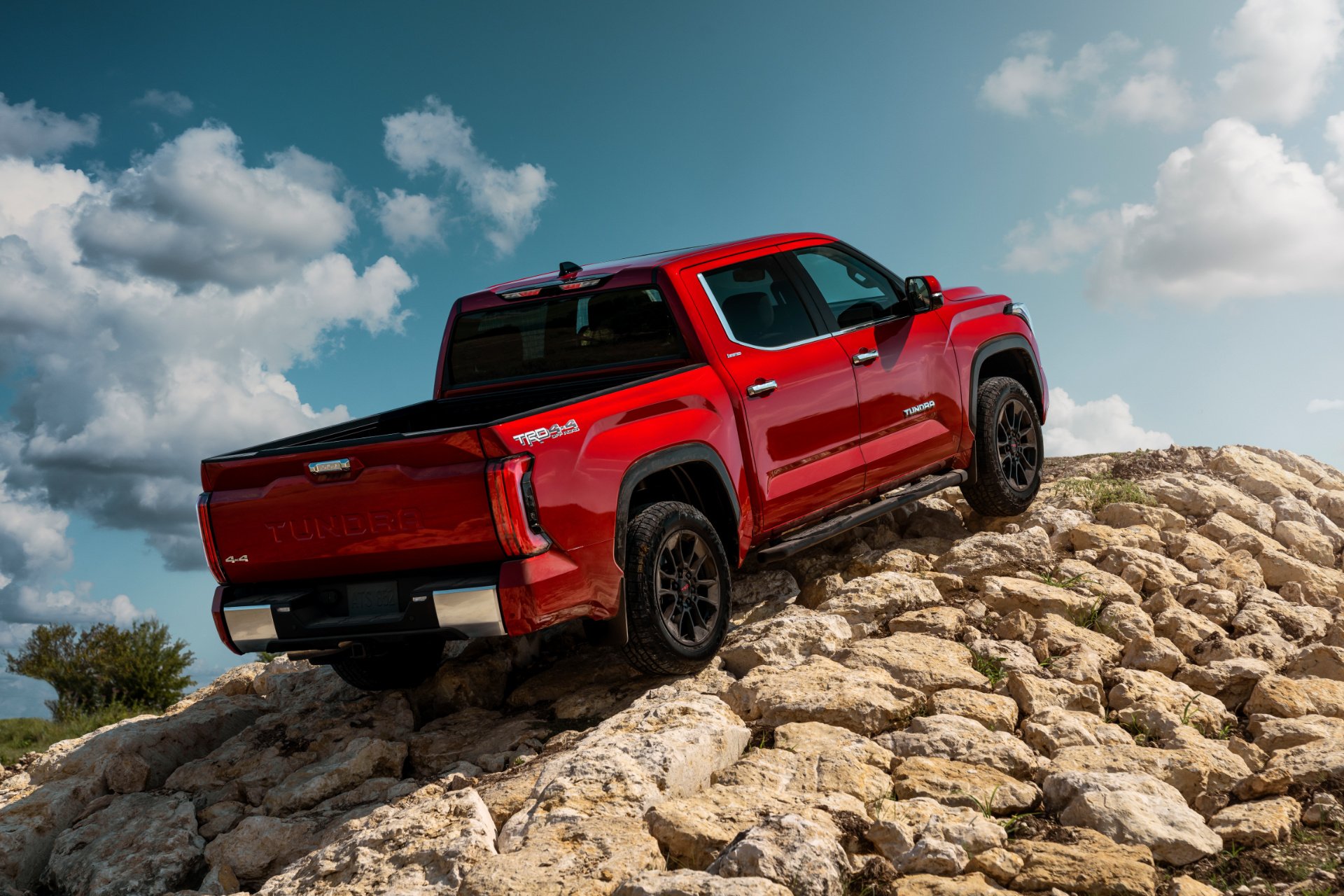
Toyota is facing a significant challenge with twin-turbo V6 engine repairs. Over 270,000 vehicles with the V35A-FTS engine have been recalled thus far, with the sole comprehensive solution being full engine replacements up to this point. This is still applicable for some Toyota Tundra trucks and Lexus LX SUVs, but now the manufacturer will mandate many to undergo dealer assessment utilizing new inspection software to ascertain whether their engines are indeed defective.
The new guidelines are outlined in a document from the National Highway Traffic Safety Administration, revised on June 15. It states:
“All registered owners of the affected vehicles will be contacted to return their vehicles to a Toyota and Lexus dealership. Utilizing inspection software, dealers will assess the #1 main bearing and gather available vehicle operating data to verify the condition of that bearing. If the inspection software cannot guarantee that the bearing will be free from unusual wear due to this issue, the dealers will replace the engine. The remedy will be offered at no cost.”
To quickly bring you up to speed, issues with certain Toyota V6 truck engines have arisen due to concerns with the aforementioned main bearing. Manufacturing debris, referred to as swarf, can cling to the main bearing and lead to knocking, rough idling, or complete engine failure. This has resulted in three significant recalls so far, with the first launched in May 2024, the second in November 2025, and the most recent in May 2026.
I had inquiries for Toyota regarding which vehicles this new protocol pertains to. When I sought clarification, a Toyota representative mentioned that earlier models, those included in the May 2024 recall, will still be eligible for engine replacements if they haven’t already been addressed. (To date, Toyota has swapped out over 70,000 twin-turbo V6 engines.) When I inquired if Toyota and Lexus owners who have already had their V35A-FTS replaced would undergo the inspection, the representative responded, “No. A design modification was implemented for the #1 main bearing beginning July 2024, which has been incorporated into vehicles that have undergone the recall remedy.”
I also asked about how this inspection software functions, given that the data is collected from driving patterns rather than engine disassembly. The Toyota representative explained, “Essentially, this inspection leverages the resonant frequency at the front of the crankshaft to evaluate the condition of the #1 main bearing. Toyota’s development of this inspection included testing multiple engines to pinpoint the frequency differences between a #1 main bearing with and without abnormal wear.
“Moreover, available vehicle operating data is gathered to confirm whether there has been sufficient load applied to the engine to ensure confidence in the assessment of the #1 main bearing’s condition. If vehicle operating data is inadequate, the engine will be replaced.”
However, this hasn’t reassured some owners, who suspect the problems are more profound. Ryan Gregg, a Tundra fan and owner advocate, is among the vocal drivers weighing in.
“The Tundra owners’ community is discouraged, to say the least, by the solution for the latest V35A engine recall,” Gregg stated. “I’m reminded of a powerful quote from Martin Luther King Jr., ‘The time is always right to do what is right.’ We urge Toyota to reconsider their recent decision and prioritize the customer over profit in all future decisions.”
Gregg further noted, “From my viewpoint, this is their method of slowing the financial deficit while not acknowledging that there is a fundamental design flaw or issue. It’s a way to buy them time.”
Others in the 2022+ Toyota Tundra Owners group on Facebook are equally exasperated. Members there have witnessed this saga unfold over the past two years, and whether they attribute it to a supposed design flaw or inadequate quality control, the result is the same: They’re dissatisfied with the ongoing back-and-forth. (Meanwhile, the owners who have never encountered an issue with their Tundra are weary of hearing about it.)
Toyota continues to manufacture new Tundras daily with the V35A-FTS. The automaker has implemented a series of modifications to the main bearing, claiming that while manufacturing debris might still exist in new engines, they are purportedly less vulnerable to damage as a result. Should failures occur in these revised engines, Toyota’s troubles could escalate even further. The entire scenario has cast the Tundra as a potential threat to Toyota’s reputation for reliability.
Have a tip or question for the author? Reach out directly: [email protected]
**Toyota Will Not Replace All Recalled Tundra V6 Trucks, Causing Frustration Among Some Owners**
In a recent statement, Toyota confirmed it will not be replacing every Tundra V6 truck impacted by a major recall, a choice that has incited frustration among numerous owners. The recall, involving thousands of vehicles, was triggered by concerns over possible engine complications that could result in performance problems or safety risks.
The recall specifically affects certain models of the Tundra that come equipped with the V6 engine, which has received accolades for its power and efficiency. However, reports of engine malfunctions and related issues led the manufacturer to take precautionary measures. While Toyota has pledged to rectify the problems, the decision not to replace all impacted vehicles has left some owners feeling unsatisfied and worried about their trucks’ reliability.
Toyota’s strategy concerning the recall involves a thorough inspection and repair protocol instead of replacing all affected vehicles. The company has asserted that many of the trucks can be repaired adequately, stating that replacement is solely necessary where the damage is considered irreparable. This approach seeks to limit waste and ensure efficient resource utilization.
Despite Toyota’s justification, several owners are expressing anxiety regarding the long-term consequences of the recall. Some worry that repairs might not eliminate the root issues, creating potential safety hazards in the future. Others are annoyed by the inconvenience of needing to bring their vehicles in for evaluations and repairs, particularly if they depend on their trucks for daily needs.
Toyota has guaranteed customers that it is devoted to upholding the highest safety standards and that the recall process will be conducted with transparency and diligence. The company has also highlighted its commitment to customer satisfaction, offering assistance and support to those affected by the recall.
As the situation develops, owners of the recalled Tundra V6 trucks are encouraged to remain updated regarding the recall process and to reach out to their local dealerships for direction. Toyota has established dedicated hotlines and online resources to help customers with any inquiries or concerns they might have about their vehicles.
In summary, while Toyota’s choice not to replace all recalled Tundra V6 trucks might stem from a desire for efficiency and sustainability, it has nevertheless resulted in frustration among certain owners. As the company manages this intricate situation, effectively communicating with their customers and ensuring that all safety concerns are appropriately addressed will be essential.