
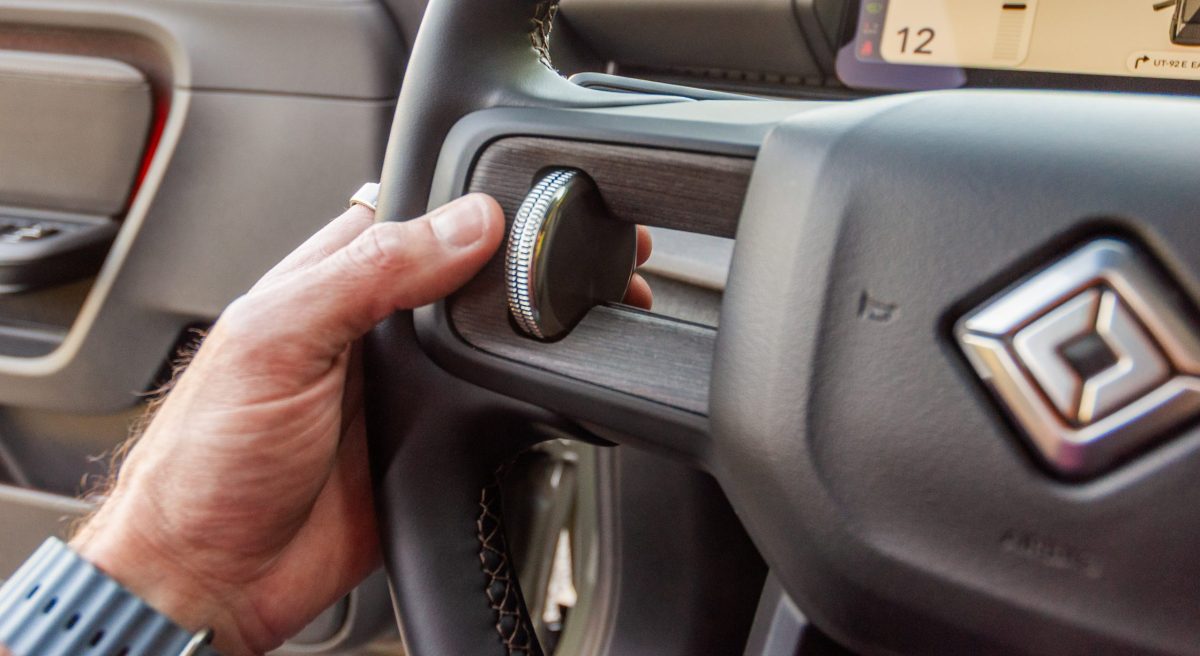
- Rivian unveils revolutionary Halo wheels. These tech-driven controls provide a customizable haptic experience, enhancing user engagement.
- Simplicity rooted in intricate engineering. The Halo wheels integrate motors and software for adjustable feedback, similar to iPhone’s haptic feedback.
- Adaptive functionality. Halo wheels manage drive modes, climate settings, audio, and additional features, adapting based on screen interactions.
- Distinct market advantage. Rivian’s Halo wheels deliver an unparalleled tactile experience compared to rivals, distinguishing the R2.
In summary: Rivian’s R2 model features state-of-the-art Halo wheels, merging software innovation with tactile feedback to elevate vehicle control and user engagement.
AI assisted, editor reviewed
Getting into a Rivian these days reveals a shortage of buttons, dials, and toggles. The emerging automaker acknowledges your concerns and has taken the feedback to heart. Who hurt Rivian? Almost everyone, but they channeled that energy into reimagining how drivers can manage vehicle functions.
During an exclusive discussion in Park City, Utah, on the most recent episode of The Drivecast, Rivian Founder and CEO RJ Scaringe stated, “We aimed for a more haptic experience, and thus the creation of those [Halo] wheels was a major focus, involving substantial engineering effort.”
Tune in to the full conversation as Scaringe discusses tangible controls, the Halo wheels, and interacting with a Rivian below.
Scaringe candidly expressed that developing the Halo wheels was no small feat. “Yes, the haptic wheels on the steering wheel demanded significant engineering as when you turn them and experience the haptic clicks, that’s driven by software, meaning there are no physical indents like in a standard wheel that provides that click,” Scaringe explained.
Detailing the elaborate engineering challenge, Scaringe said, “What it involves is a small motor generating that torque rise and fall.” This is akin to the silent/vibrate function in current iPhones. Scaringe elaborated, “Yes, it’s all powered by software. The appeal of this is that these wheels can be entirely customized. So while they provide all the haptic clicks, when you switch screens, the wheels adapt, or if we decide to implement an over-the-air update to modify some vehicle functionalities or change how the haptic wheels operate, that’s fully achievable. This versatility in using a multi-touch screen initially resonated with our philosophy; we appreciated the opportunity for regular refreshes and updates. But like you remarked, we desired a more haptic experience, making the development of these wheels a crucial focus, requiring greater engineering resources than it may appear at first glance. Inside each wheel, there’s a PCBA, a motor, a motor driver, cooling systems—truly complex. Moreover, as you pointed out regarding the stalks, we put more intentional design into some controls, including a dial for adjusting speed in self-driving mode.”
Rivian’s Chief Software Engineer Wassym Bensaid shared with The Drive, “We’re adopting a first-principles approach to creating a tactile experience and a touch interaction, without overwhelming the entire user interface.”
Bensaid added, “That’s how we developed software-defined haptics, which uniquely offers different feedback based on the action. We can configure them from a software perspective as needed.”
The head of the software framework at Rivian is right. During our initial evaluations at the R2 unveiling, the Halo wheels on the steering wheel emerged as revolutionary, unlike anything available currently. Mounted on an axis, these silver wheels feature satisfying notches and allow rotation, lateral pushes, and forward-backward movement.
Positioned on either side of the steering wheel, each Halo wheel corresponds to functions displayed on the digital gauge cluster based on their movements. The right Halo wheel adjusts drive modes, climate control (including fan speed and temperature), and display settings. The left Halo wheel manages audio volume, display efficiency, audio functions, and vehicle diagnostic information such as tire pressures.
The Halo wheels are delightful to use, providing a gratifying click sensation with each interaction. Bensaid pointed out, “Depending on the menu, the functionality will vary, and even the feedback from the action will differ significantly.”
Bensaid is correct. The Halo wheels operate uniquely compared to anything on the market and genuinely make the R2 stand out.
Do you have a lead on emerging tech? Reach out to us at [email protected]
**Rivian Addresses Touchscreen Feedback by Launching Upgraded Scroll Wheels**
In a notable effort to enhance the user experience, Rivian, the electric vehicle company recognized for its innovative designs and technology, has revealed the rollout of upgraded scroll wheels in response to customer insights regarding its touchscreen interface. This advancement signifies a crucial change in how drivers engage with their vehicles, aiming to bolster accessibility and functionality while driving.
### Background
Rivian’s models, including the R1T pickup and R1S SUV, are outfitted with expansive touchscreen displays that manage various aspects, from navigation to climate controls. While these touchscreens present a modern and polished interface, some customers have raised concerns about the practicalities of depending solely on touch interactions, especially while driving. The feedback pointed out challenges such as distractions and difficulty in quickly making adjustments while on the move.
### The Upgraded Scroll Wheel Solution
To tackle this feedback, Rivian has introduced upgraded scroll wheels that offer a tactile option to touchscreen controls. These scroll wheels are intentionally positioned within easy reach of the driver, enabling intuitive adjustments without requiring them to take their eyes off the road.
The new scroll wheels are crafted to manage various functions, such as audio volume, climate control settings, and navigation, presenting a more ergonomic and safer approach to interacting with the vehicle’s systems. By integrating physical controls, Rivian seeks to harmonize modern technology with the practical requirements of drivers.
### Features of the Upgraded Scroll Wheels
1. **Ergonomic Design**: The scroll wheels are designed to comfortably fit in the driver’s hand, allowing for effortless manipulation without requiring significant movement or attention diversion.
2. **Multi-Functionality**: Each scroll wheel can be programmed to manage multiple functions, offering versatility and minimizing the number of physical controls necessary in the cabin.
3. **Haptic Feedback**: The scroll wheels provide tactile feedback, delivering users a physical response that enhances the sense of control and accuracy when making adjustments.
4. **Customizable Settings**: Users can adjust the functionalities linked to each scroll wheel, tailoring the experience to their preferences and driving styles.
### Impact on User Experience
The rollout of upgraded scroll wheels is anticipated to significantly boost the user experience for Rivian drivers. By addressing the challenges noted concerning touchscreen dependency, Rivian is reinforcing its commitment to customer feedback and safety. The tactile quality of the scroll wheels allows for quicker modifications, reducing distractions and enriching overall driving comfort.
### Conclusion
Rivian’s proactive initiative to incorporate upgraded scroll wheels into its vehicles exemplifies the company’s focus on innovation and user-centric design. By responding to customer feedback and enhancing the driving experience, Rivian is not merely enhancing its product but also establishing a benchmark for the electric vehicle sector. As the automotive industry evolves, Rivian’s dedication to merging technology with practicality is likely to resonate with consumers seeking both innovative features and safe driving experiences.