
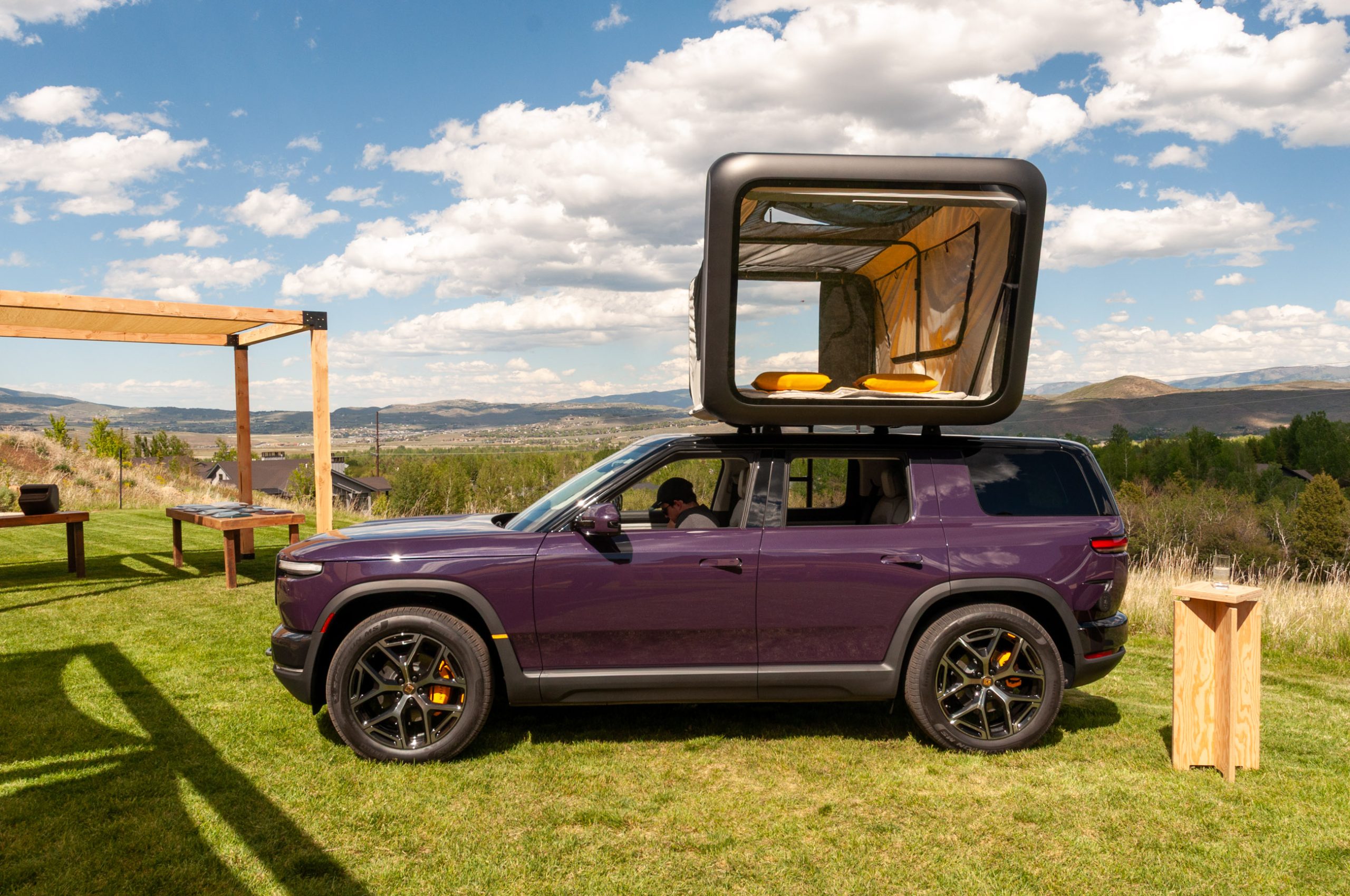
- R2’s honed simplicity. Rivian’s R2 is more polished than the R1, emphasizing economical design without compromising quality.
- Creative design modifications. Features like built-in turn signals and improved rear doors boost usability while lowering costs.
- Streamlined engineering. R2’s optimized wiring and unified electronics simplify construction and maintenance, decreasing expenses.
- User-centered enhancements. Design decisions prioritize user comfort, including a distinctive rear seat setup and cleverly repositioned charge port.
Bottom line: Rivian’s R2 showcases the benefits of thoughtful simplification, resulting in a more sophisticated, cost-efficient, and consumer-friendly vehicle.
AI assisted, editor reviewed
The Rivian R1 was developed through addition while the R2 was crafted through subtraction, according to Rivian’s Chief Design Officer Jeff Hammoud in an interview with The Drive.
The R2 originated as a minimized version of the R1. However, the development team gathered extensive feedback over the years, refining the R2 into an even more sophisticated offering than its larger, pricier counterpart.
What stands out as absent in the R2 compared to the R1? The intricate hydraulically-controlled active roll control system along with the costly and bulky air suspension system. A closer inspection reveals that the optimization and enhancement emerge throughout its design.
Hammoud stated that the team dedicated effort to, “discovering methods to engineer and design the vehicle that lowers costs without penalizing the customer.”
One noteworthy example is the rear door. “Most vehicles in this segment don’t allow for the rear door glass to drop completely. It’s either partially cut, as we designed an adventure vehicle—something crucial for us. Alternatively, there often exists a division bar, present in many other cars, including the R1 due to its size. However, this division adds another metal piece, additional glass, and necessitates belt molding. We conducted extensive engineering to optimize the wheelbase positioning, align the B-pillar accurately, and utilize the C-pillar to ensure proper visibility outside. This allowed for a full glass drop while eliminating the belt molding. It’s simpler to manufacture and less costly,” Hammoud explained.
Hammoud highlighted that the R1 includes turn signal lights on the sideview mirrors, a Rivian badge on the front doors, and turn lights on the body near the wheel wells. The team consolidated these three features into a unified design with an integrated turn signal indicator above the air vent on the fender, which was carried over from the R1.
This trend persists in other areas. The window molding on the R1 has been removed on the R2, which offers a sleeker appearance, improved aerodynamics with reduced drag, and, importantly for Rivian, lower costs relating to materials and production.
Significant funding has been allocated towards improving aerodynamics. The team emphasized that the tailgate will have a dropdown window similar to the Toyota 4Runner, except for the Standard trim. Combining the rear roofline, spoiler, and integration of the rear wiper posed a complex engineering challenge, resulting in an intricate engineering task to merge the rear wiper within the tailgate itself.
The movement towards simplification without compromise continues within the R2. “Small adjustments, like our seat design approach. In the R1, the complete metal band and small headrest bezels existed, but in the R2, we’ve retained a badge while reducing its size. The interior has been simplified too. The instrument panel in the R1 features both PU wrapping (referring to the wood trim). There’s also a metal piece present, which we’ve reduced for simplicity. The wood application in the R1 includes segments that are more challenging and costlier to produce. Therefore, we’ve streamlined this aspect—hopefully, it appears cleaner yet not as if we’ve removed valuable features,” Hammoud stated.
However, cost-cutting was not made at the expense of customer satisfaction. Hammoud affirmed that the rear seat still splits in a 40:20:40 arrangement, a rare feature in this compact category. “We could have opted for a 60:40 split, yet we opted against it. It was a matter of achieving suitable trade-offs,” Hammoud added.
“For instance, the hood on the R1 both opens and closes automatically. This model opens via power through the E-latch but requires manual closure. We prioritized the ability to open with power as essential,” Hammoud noted.
The charge port location was moved from the driver-side front bumper on the R1 to the driver-side rear quarter panel on the R2 for several reasons that benefit both users and Rivian’s budget. “Damage mitigation was a key factor. Secondly, it provides access to Tesla chargers, where they [customers] frequently charge. Lastly, the wiring pathway is shortest from our treehouse where the power electronics systems are located. This reduces weight as well as costs, which was the main reasoning for this change,” Hammoud explained.
Other unseen design modifications include relocating the two primary front speakers from the front doors to a center panel beneath the dashboard. This change minimizes wiring and is anticipated to decrease door rattles, Hammoud stated.
Rivian’s Senior Vice President of Electronic Hardware, Vidya Rajagopalan, informed The Drive that the team has already reduced the original R1’s wiring harness by 1.6 miles in transitioning to the second-gen R1. This change also reduced the vehicle from an incredible 17 ECUs to a zonal structure comprising only 7 ECUs. The R2 has further streamlined by removing an additional 2.3 miles of wiring from the harness and power electronics combined. The team managed to integrate five components from the R1 into one, which now combines the onboard charger, DC-to-DC converter, DC-to-AC converter, cell zone controller, and battery management system, now forming “a powerhouse,” according to Rajagopalan.
Collectively, these changes make the R2 simpler to produce, more cost-effective, easier to service, and reduce complexity and expense for consumers during ownership. This serves as a prototype and insight into Rivian’s future today.
Have information about a design element? Contact us at [email protected]