
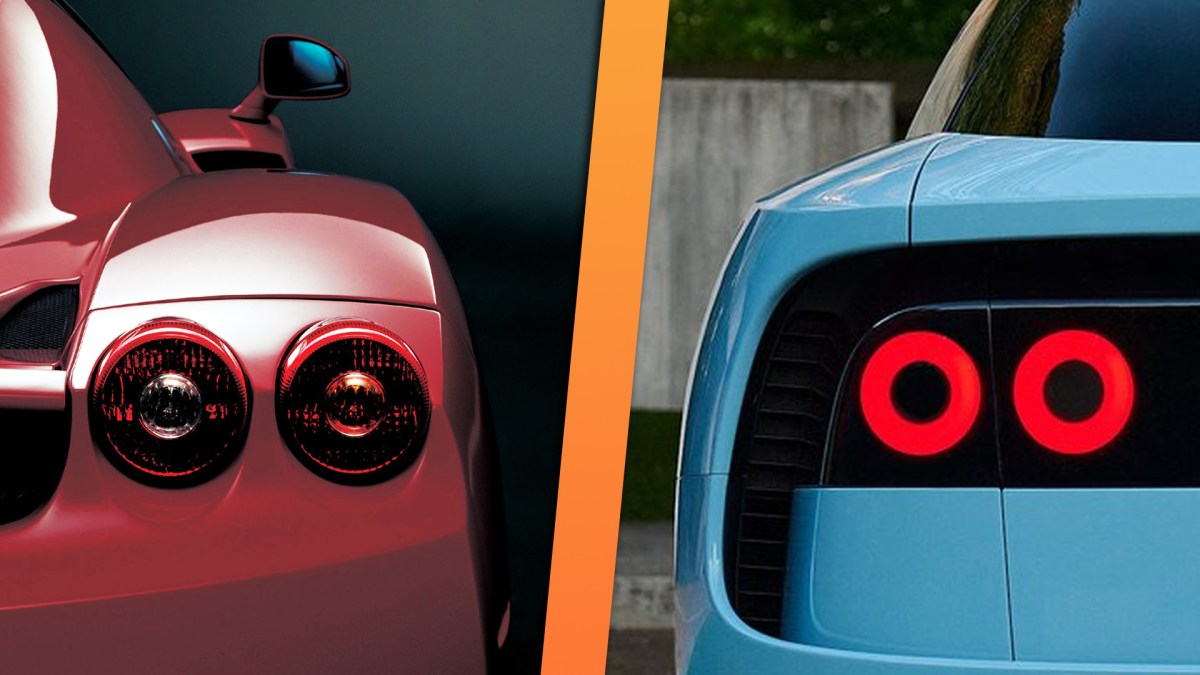
Images of the world’s debut electric Ferrari, the Luce [“loo-che”], have circulated long enough for both first impressions (the brand’s stock dipped when the car was introduced) and some counterarguments (influencers steeped in corporate culture are writing lengthy LinkedIn articles). Much of the commentary I’ve encountered in automotive circles has been: “Enzo would be turning in his grave!” However, that’s not the case. If Ferrari’s founder were here today and spotted a Luce on the road, he likely wouldn’t give it a second glance. That’s the true tragedy of this unnecessary vehicle. Ultimately, it mirrors the state of our industry as a whole.
The design of the Luce is approachable, sleek, orderly, non-offensive, and forgettable. As a contemporary everyday car, it appears satisfactory. However, when your brand centers around dramatic aesthetics and your latest $600,000 supercar can be likened to a Nissan Leaf, something is amiss. Some observers classify Luce’s appearance as “a significant gamble” or a bold statement, but in reality, it is the contrary. It’s a four-door daily vehicle—it’s the most universally appealing item Ferrari could have possibly designed. Yes, it will boast sufficient horsepower to reach orbit, and a price tag that guarantees only the ultra-wealthy will be the first purchasers. Yet, every function will be electronically controlled, each display simulated on a screen … just like any Honda or Hyundai. Well, OK, not exactly like—Ferrari has done a fine job placing its screens in attractive housings. Thus, the issue arises—as every car morphs into a computer, all that makes automobiles genuinely special is inevitably lost in translation.
There was some curiosity surrounding the Luce post-cockpit reveal, and I admit I was intrigued myself. “The iPhone designer created a Ferrari;” I even made a TikTok about it. Jony Ive, known for contributing to numerous Apple products, and Marc Newson, who has also worked with Apple and, more pertinently, the Ford 021C concept, are credited with much of the Luce’s presentation. Thus, it shouldn’t come as a surprise that the Luce resembles more of a consumer electronic device than an automobile. Credit to those involved, the Luce indeed strives to deviate from the “monolithic black mirror” vast screen-focused cockpit by utilizing a collection of smaller screens instead. However, even when the designers behind the iPhone actively attempt to preserve tactile, mechanical knobs, the overwhelming reality of the present EV setup is still so fundamentally streamlined that the vehicle ultimately feels like an appliance anyway.
Here’s where we arrive at my title—this Ferrari isn’t unattractive. In fact, it’s an exemplary modern interpretation of what a futuristic Ferrari ought to resemble. The current sleek futuristic aesthetic resonates as an austere, corporate template cleaned to the point of being lifeless. The introduction theme from Weeds comes to mind.
What defines today’s sleek futuristic aesthetic? Look at contemporary washing machines, lawn mowers, homes. Practically everything resembles Call of Duty, EVE from Wall-E, or some blend of both. (The Luce firmly lands in the maternal robot category.)
It’s not merely about the aesthetics, or even the fact that it’s an EV, or a practical people-mover. It’s the amalgamation of these elements. And the realization that it’s not truly an original concept—it’s a modern twist on something that has existed before. That can be said for every car that has piqued interest lately, right? “New Bronco!” “New Defender!” There’s nothing novel, just old notions morphing into what resembles an app-icon version.
What the Luce highlights is that various facets of consumer experience have followed this path. Compare images of a McDonald’s exterior from the recent past to the present. The ones we were familiar with sparkled with fun and creativity; today’s look like external storage devices.
Vehicles (and, to be honest, all consumer experiences) are undergoing such homogenization across our landscape that it’s difficult to get excited about anything. Every gauge cluster is merely a design overlay. Every vehicle is a coupe-SUV-omni-mobile. Everything seems optimized for sales volume, which is innately uncool.
What’s particularly disheartening is that, one would think, with billions of human beings connecting with one another now, there would be an extensive array of variety among cars and designs of everything else. However, stuff continues to progress in bland, sans-serif, soft-edge mass-market forms with capable yet characterless foundations and a technological isolation separating you from all the vehicle’s functionalities. Everything is groomed to reduce production costs and maximize ongoing profit.
It’s somewhat ironic that Ferrari, a name synonymous with distinct mystique, would adopt an iPhone-like aesthetic. An iPhone, after all, is one of the most prevalent items ever; therefore, it’s as normcore as something can be. Yet this is how everything is produced now—approval through focus groups and marketability uber alles.
I recently took a much-needed break from screens last week, which meant I missed the initial conversations surrounding the Luce’s launch. However, this week, I explored the internet seeking anyone who was enthusiastic about this vehicle—and other than a few remarks reminding us that the driving experience might redeem it, options were limited.
The most insightful evaluation of Ferrari’s present situation that I did uncover is a Reddit thread in r/Ferrari, where a semi-anonymous user articulately describes precisely why the Luce is what it is. More crucially, they also explained why it will struggle to attract fans. As u/BrienneOfFuckinTarth put it:
So who exactly are Ferrari attempting to target with this vehicle?
Current Customers (The Petrolheads) – The Petrolhead clientele won’t take notice of this vehicle, simply بسبب it’s a crossover and is an EV. They were already mostly disenchanted by Elettrica.
Current Customers (The Loyalists) – The Loyalists who were amenable to an EV Ferrari were, in my view, turned off by the aesthetics and the absurd price tag.
Silicon Valley Tech Enthusiasts – The Tech Enthusiasts I know will either opt for a traditional ICE supercar or take pride in stating that their Plaid or Taycan Turbo GT “surpasses a Ferrari at a fraction of the cost.” They value statistics and figures, and those vehicles outperform the Luce comfortably.
“Silent Wealth” – The essence of silent wealth is that they don’t wish to showcase their wealth. If they desire an EV crossover, they’d simply purchase a standard EV crossover.
Whoever that Redditor is, they’re absolutely correct (and they provided some other insightful observations, too).
What individuals who aren’t car enthusiasts fail to realize is: there’s significantly more to a rewarding driving experience than just performance, or even exhaust sound, or ride comfort. It’s about the physical connection with elements like door handles, throttle cables, ignition keys, and toggle switches. The genuine feedback of pedals straining against cables. Shifter connections. Gauges presenting depth and creativity. Sturdy plastics and narrow A-pillars. Ferrari established its fame by executing all these elements so remarkably well that its offerings felt animated. Now that none of these aspects seem to matter, the brand is reduced to merely … a black horse emblem.
Thus, when I encounter statements like “legacy automakers must adapt or perish, all cars should transition into computers,” I have to respectfully respond with a shrug. If we genuinely are moving towards a near future where all automobiles become ultra-fast transportation pods bearing different emblems, the automotive hobby as we know it will need to center around maintaining the vehicles that are already in existence.
No child is going to display a poster of a Luce on their bedroom wall, nor will anyone be restoring one three decades from now. I’m not suggesting that “cars are over,” but, if you truly appreciate machines for their essence, the shareholder-driven manufacturers of today are never going to produce what you really desire. For the general public merely seeking transportation, these pods have never been more efficient. For the most wistful car enthusiasts, stop fretting about saving for a down payment on something modern and start acquiring skills to repair the vehicles crafted before smartphones.
Have a tip? Contact us at [email protected].
**The Ferrari Luce: A Distinctive Design Outlook Amidst Future Challenges**
The Ferrari Luce marks a daring leap into the future of automotive aesthetics, encapsulating the brand’s dedication to inventiveness while confronting the changing obstacles of the car industry. As the globe shifts towards sustainability, electrification, and advanced technology, the Luce emerges as evidence of Ferrari’s capability to merge tradition with modernity.
**Aesthetic Philosophy**
Central to the Luce’s aesthetic is a philosophy that prioritizes both visual allure and functional performance. The car showcases streamlined contours and a dynamic shape that embodies speed and agility, quintessential elements of the Ferrari legacy. The incorporation of lightweight materials, such as carbon fiber and aluminum, not only boosts performance but also enhances energy efficiency, aligning with global sustainability objectives.
The interior of the Luce is equally commendable, revealing a coherent blend of luxury and state-of-the-art technology. The cockpit is tailored with the driver in mind, featuring an intuitive arrangement that fuses advanced infotainment systems with classic Ferrari craftsmanship. High-grade materials and customizable selections guarantee that every Luce reflects a unique statement of its owner’s identity.
**Ecological Considerations and Electrification**
As the automotive landscape faces mounting pressure to decrease carbon emissions, the Ferrari Luce embraces electrification while preserving the exhilarating driving essence that Ferrari epitomizes. The Luce is outfitted with a hybrid powertrain that merges a high-performance internal combustion engine with electric motors, providing both vigor and efficiency. This dual approach not only enhances performance but also facilitates reduced emissions, rendering the Luce a more eco-friendly choice in the luxury sports car arena.
Ferrari’s dedication to sustainability extends beyond the engine. The Luce integrates eco-conscious materials into its build and interior aesthetics, mirroring a broader industry tendency towards sustainable production practices. This commitment to sustainability is critical as buyers grow increasingly cognizant of their ecological footprint and begin to favor brands that resonate with their values.
**Technological Innovations**
The Ferrari Luce stands at the forefront of technological advancement, boasting advanced driver-assistance technologies (ADAS) that elevate safety and driving dynamics. These systems employ sensors and artificial intelligence to deliver real-time insights and support, thereby ensuring a more secure driving environment. Moreover, the Luce features connectivity functionalities that enable seamless interaction with smartphones and smart devices, enhancing the comprehensive user experience.
The incorporation of technology also influences the vehicle’s performance substantially. The Luce utilizes advanced aerodynamics and adaptive suspension systems that respond to driving conditions, ensuring optimal handling and stability. This level of engineering sophistication not only improves performance but also positions the Luce as a frontrunner in the competitive luxury sports car market.
**Prospective Challenges and Prospects**
Despite its groundbreaking design and state-of-the-art features, the Ferrari Luce confronts various hurdles as it enters the marketplace. The transition towards electric vehicles is reshaping consumer anticipations, and Ferrari must skillfully navigate this shift while safeguarding its brand essence. Additionally, competition from both established manufacturers and emerging players in the electric vehicle sector presents a notable challenge.
Nevertheless, these obstacles simultaneously offer Ferrari prospects to redefine its narrative. By embracing electrification and sustainable practices, the Luce can captivate a new generation of eco-conscious consumers while maintaning the loyalty of classic enthusiasts. The brand’s capacity to innovate whilst honoring its heritage will be pivotal in securing the Luce’s triumph in an evolving automotive environment.
**Final Thoughts**
The Ferrari Luce transcends being just a vehicle; it symbolizes the brand’s commitment to innovation, sustainability, and performance. As it navigates future challenges, the Luce emerges as a distinctive design viewpoint that respects Ferrari’s rich history while welcoming the opportunities of tomorrow. With its striking aesthetics, advanced technologies, and hybrid powertrain, the Luce is set to redefine the luxury sports car experience for a new generation.