
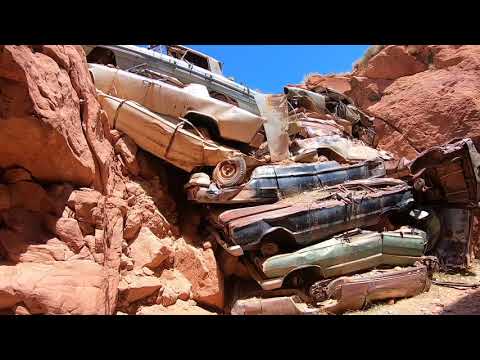
Located just off Highway 89 in Utah near mile marker 25, slightly above the Arizona border and approximately 80 miles east of Zion National Park, there exists a peculiar sight: the remnants of Detroit vehicles in various colors, stacked from the canyon’s base up to the roadway. These abandoned cars have been present for nearly sixty years, yet they now appear entirely out of place in the arid landscape. There is a compelling reason for their presence—or at least there was.
This region is known as Catstair Canyon, featuring the junked car installation known as the Catstair Riprap. The term “Riprap,” for those unfamiliar with river management, refers to any material placed along banks to safeguard the adjacent land from erosion. This may include rocks or concrete, but in the mid-20th century, some experts preferred using discarded car bodies filled with gravel secured against a slope.
As odd as it may seem today to view a pile of dismantled Bel Airs, Continentals, and Corvairs within climbing reach (although we advise caution as demonstrated by the explorer in the accompanying video), this method was quite prevalent back in the day.
Catstair Canyon
Along the banks of the Loup River near Columbus, Nebraska, one can observe lines of cars arrayed along the river, approximately a car’s width apart, extending nearly as far as the eye can see. Although it appears vastly different from the installation at Catstair Canyon, the intent was identical: to impede the flow of water and protect those riverbanks from erosion over time. In the case of Catstair, the concern centered on rainwater flowing into those channels.
Did it prove effective? Indeed, but not without a notable downside. “It was part of a long-standing custom of treating rivers as little more than sewers and recreational waterways,” noted David L. Bristow of the Nebraska State Historical Society in a 2022 article. “For many years, a town’s riverfront was predictably its most neglected, unattractive, and industrialized area.”
By the early 1970s, the practice of utilizing cars as riprap was beginning to decline, according to Hot Rod Magazine’s Steven Rupp, due to the introduction of the Clean Water Act of 1972 and advancements in construction technology and methods. However, even with the cessation of this practice, the debris remains.
Visitors can reach the Catstair Riprap from small dirt parking areas situated to the east and west of the site itself. The western lot is considerably closer than the eastern lot, with a simpler path, making it the preferred option. If you proceed past the vehicles from that side, you will encounter a 10-foot drop and a much tougher journey, according to My Zion Vacation.
Have you visited Catstair Canyon? Let us know in the comments and share pictures if you have!
**The Unveiling of Vintage Cars Piled in a Utah Canyon: A Journey into Their Origins and History**
In an astonishing discovery that has intrigued both car aficionados and historians, a group of vintage cars has been found stacked within a secluded canyon in Utah. This unexpected collection has ignited intense investigation into the provenance and history of these automobiles, revealing a unique chapter of American automotive heritage.
### The Unveiling
The finding was made by a group of trekkers exploring the rugged Utah canyons. While traversing the rocky topography, they came across a concealed alcove where numerous vintage cars were discovered piled in a seemingly random arrangement. The automobiles, many of which date back to the mid-20th century, were cloaked in dust and debris, indicating they had been abandoned for many years.
### Initial Investigations
Upon hearing about the discovery, local officials and automotive historians swiftly mobilized to investigate the site. Early assessments unveiled a varied assortment of vehicles, featuring iconic models from manufacturers like Ford, Chevrolet, and Dodge. Many of these cars were in varying degrees of disrepair, while a few appeared to be relatively intact, prompting inquiries about their storyline and how they came to be situated in the canyon.
### Theories on Origin
Various theories have surfaced concerning the origin of the stacked vintage cars. One prevalent speculation suggests they might have been part of a secretive operation, potentially involving illegal dumping or a makeshift junkyard. The remote nature of the canyon would have conveniently masked such activities, particularly in an era when environmental regulations were less rigorously enforced.
Another theory suggests the cars were left behind by a collector or enthusiast who may have had plans for restoration but ultimately faced insurmountable obstacles of time and resources. This notion is supported by the presence of rare models, which would have been highly prized by collectors, hinting that the original owner was genuinely passionate about classic automobiles.
### Historical Context
Understanding the importance of this revelation necessitates examining the historical context surrounding the classic car era in America. The mid-20th century represented a golden age for car manufacturing, with American firms producing a diverse range of innovative and stylish vehicles. The emergence of car culture during this period resulted in a surge of interest in classic cars, many of which have since morphed into valuable collector’s items.
The emergence of these vehicles in Utah not only emphasizes the nostalgia tied to this era but also provokes reflection on the fate of countless automobiles that have been lost throughout history. As restoration practices and interest in classic cars continue to expand, the possibilities for reviving these neglected treasures become increasingly appealing.
### Preservation Efforts
In response to the find, initiatives are in motion to ensure that the site is safeguarded and that the vehicles are carefully documented. Automotive historians are collaborating to catalog the cars, identifying their make, model, and potential historical importance. There is also a movement to consider the restoration of some of the vehicles, allowing for a tangible connection to the past and celebrating the enduring legacy of classic automobiles.
### Conclusion
The discovery of classic cars piled in a Utah canyon has unveiled a captivating glimpse into the past, inviting further exploration into their origins and the tales they carry. As researchers dig deeper into the narratives of these vehicles, the find serves as a reminder of the rich fabric of American automotive heritage and the mysteries concealed within the landscape. Whether these cars are eventually restored or remain as artifacts of a bygone era, their discovery has certainly revitalized interest in the history of classic cars.