
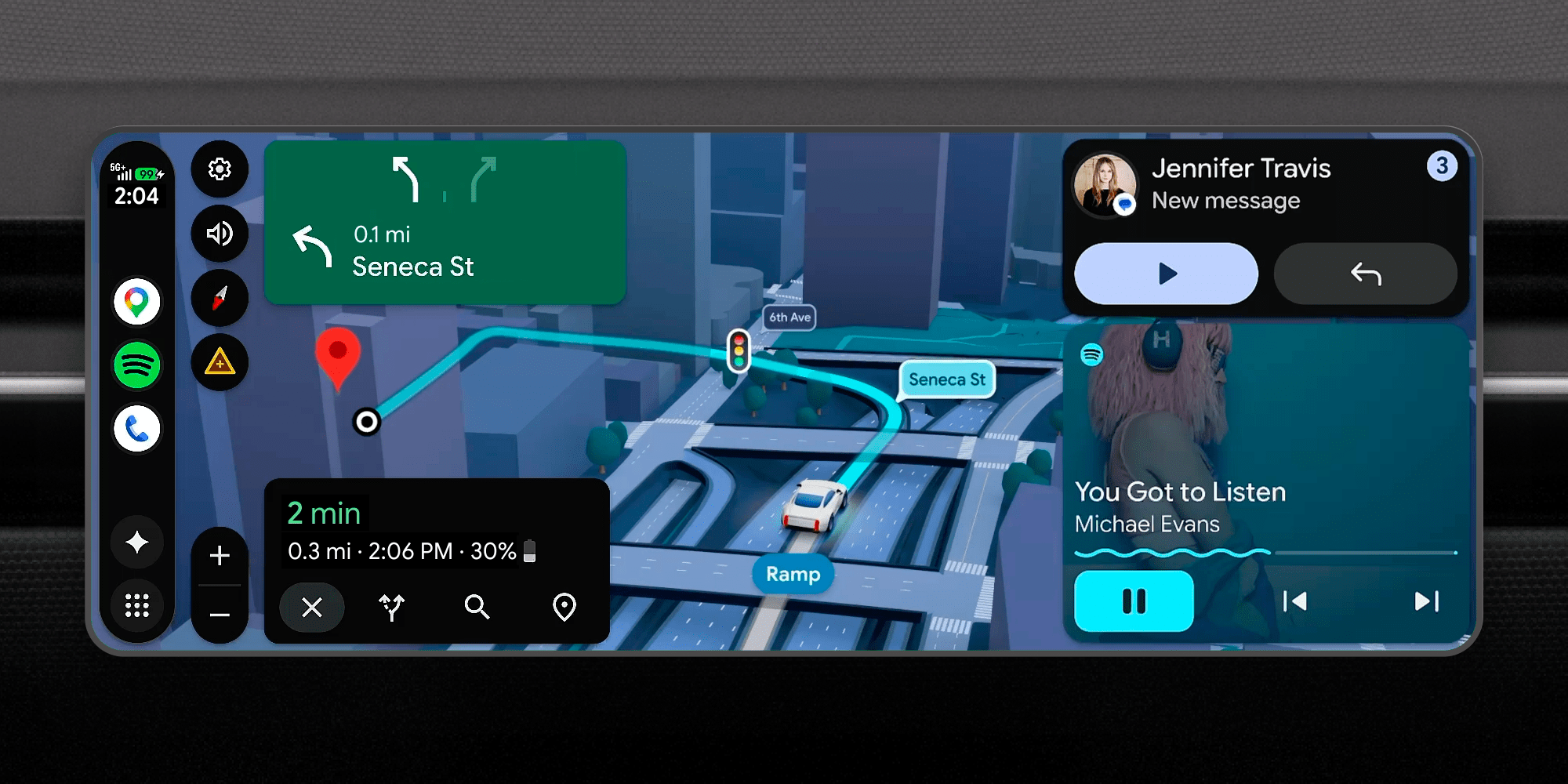
Every few years, Google revamps Android Auto to enhance its functionality and, ideally, make it even more user-friendly. The infotainment experience for Galaxy and Pixel users is set for a major upgrade, which Google claims is possibly its most significant improvement to date.
The upcoming version of Android Auto scheduled for this year is designed to properly adjust across various display sizes and shapes, ranging from a rhombus (as seen in BMWs) to a circle (like those in Minis). It features a new interface that facilitates entirely customizable widgets, which you can create with Gemini and position prominently, providing easier access to the applications, tools, and contacts you need while driving. Google Maps will align with the advancements Apple has achieved with its more immersive 3D view that visualizes topography and structures. And, perhaps most exciting, Android Auto will soon support video playback in compatible vehicles when stationary.
For automobiles with infotainment systems incorporating Google Built-In, navigation will become even more detailed, featuring live lane guidance that offers a ground-level perspective of your required position on the highway. These vehicles will also enable Gemini to respond to specific questions about your car, such as whether a television will fit in the trunk. Unsurprisingly, Gemini will play a crucial role in all future Google infotainment developments, providing text reply suggestions while you’re engaged in driving tasks.
Returning to Android Auto’s new video capabilities, this feature could be very useful for anyone waiting around in their vehicle. To ensure media is displayed safely, specific makes and models must be approved first. Google explained that Android Auto uses “signals from both the phone’s GPS and the car, through our partnership with the OEM, which includes driving state, selected gear, and speed” to determine the current status of the vehicle.
In simpler terms, the vehicle must inform your phone that it is parked for video playback to be enabled on the car’s screen. This functionality will first be available in BMW, Ford, Genesis, Hyundai, Kia, Mahindra, Mercedes, Renault, Skoda, Tata, and Volvo models, with additional vehicles to follow.
Once you start driving, Android Auto is programmed to switch the video you were viewing to audio only, similar to how it currently operates if you’re playing a video through Android Auto—you will only hear the sound. You’ll also retain playback controls while in motion. This will be beneficial for users who often prefer watching podcasts instead of merely listening. An example of how this will function in real life is displayed below.
These are minor updates, yet they hold significant importance. Phone projection applications such as Android Auto and Apple CarPlay are essential because they effectively enable individuals to enhance their car’s infotainment capabilities without having to purchase a new car. Furthermore, these are interfaces we are all familiar with, as we use them on our smartphones every day, and the content you engage with on your phone transitions smoothly into the in-car experience—your media is precisely where you last left off when you enter the vehicle.
Regarding the timeline for when you can expect these updates in your car, Google states they will be arriving “throughout the year.” Unfortunately, due to the clearances required from each automaker for the upgrade, that’s probably the most precise information we can anticipate.
Have a tip? Contact [email protected]
**Significant Android Auto Upgrade Brings YouTube to Vehicle Screens**
In a notable advancement for in-car entertainment, Google has revealed a substantial upgrade to Android Auto that enables users to access YouTube directly from their car displays. This update signifies a crucial evolution in how drivers and passengers interact with multimedia content while traveling, enhancing the overall driving experience.
**Improved Multimedia Experience**
The inclusion of YouTube into Android Auto aims to deliver a more interactive and enjoyable experience for passengers. With this feature, users can view their favorite videos, music, and vlogs straight through their vehicle’s infotainment system. This development aligns with the increasing trend of in-car entertainment systems expanding beyond basic navigation and communication tasks.
**Safety Considerations**
While the new feature is thrilling, safety continues to be a primary concern. Google has set rigorous guidelines to ensure that YouTube can only be accessed when the car is stationary. This measure is intended to mitigate driver distractions, thus promoting road safety while allowing passengers to enjoy content during stops or when parked.
**User-Friendly Interface**
The YouTube interface on Android Auto has been tailored for user convenience. The layout is crafted to be straightforward, enabling users to browse, search, and select videos with minimal hassle. Voice commands can also be employed, allowing users to manage playback without diverting their attention from the road.
**Compatibility and Availability**
The YouTube feature is anticipated to be made available to compatible vehicles equipped with Android Auto in the upcoming months. Users will need to confirm that their Android Auto app is updated to the latest version to utilize this new capability. As with previous updates, the feature will cater to a broad range of automobiles supporting Android Auto, enhancing the platform’s adaptability.
**Future Implications**
This update could set the stage for further improvements in in-car entertainment systems. As more streaming services aim to integrate with automotive platforms, drivers and passengers may soon gain access to an even wider array of content options. This shift mirrors the evolving expectations of consumers, as connectivity and entertainment become increasingly integral to the driving experience.
**Conclusion**
The launch of YouTube access on Android Auto signifies a major leap in in-car technology, opening up new entertainment opportunities for users. As the automotive sector continues to adopt digital innovations, features like these are likely to become the norm, reshaping how we engage with our vehicles and the content we consume while on the road.
 admin
admin