
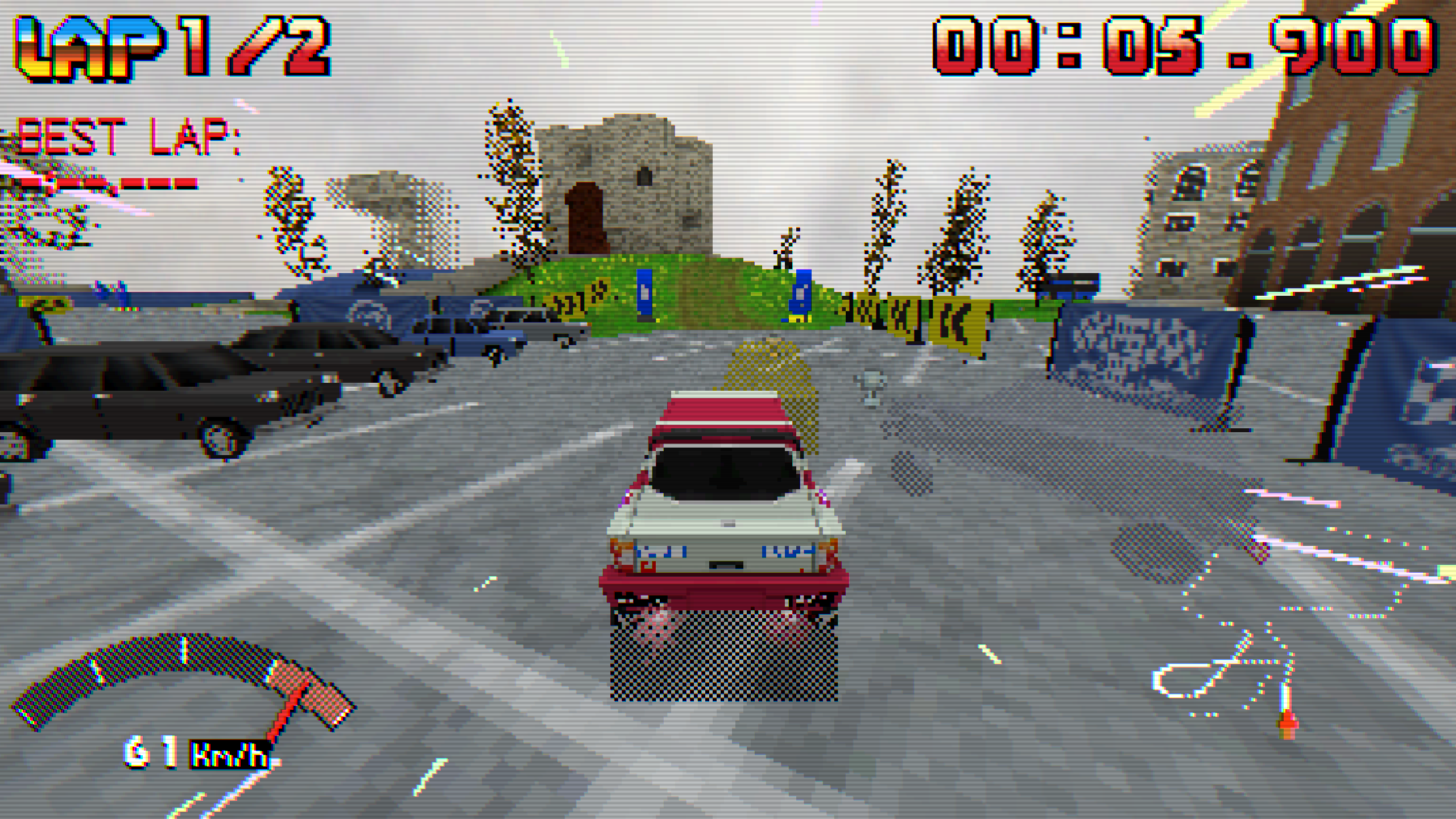
It’s been a while since we last checked in on Parking Garage Rally Circuit, the indie racing title that captures the essence of arcade classics from three decades back in a way that many attempt, but few succeed. When we first tested it before its launch back in 2024—which seems hard to grasp—the game had only half the tracks it eventually released with, no multiplayer mode, and not even a background score. Lately, it has expanded even further, thanks to the release of the European Tour DLC that doubles the number of available racing parking lots from eight to 16, and includes a wealth of new tunes from ska-punk group The Holophonics.
If you haven’t tried PGRC, now is the perfect opportunity to dive in. Your mission is to achieve the fastest time through quirky tracks within parking garages. The handling is somewhat akin to Mario Kart’s, being fairly straightforward most of the time with the inclusion of a drift feature, and letting you boost if you maintain a drift for an extended period. Solo, you won’t find yourself racing against any bots. However, online, you can pit your skills against friends and adjust car contact settings.
The new set of eight tracks features locations such as the charming York Castle Car Park and Hamburg Concert Hall. It also includes a track inspired directly by Fiat’s renowned Lingotto facility in Turin—the one boasting the banked test track atop its roof. This gives you a fair sense of the charm and creativity that PGRC offers, but don’t let that mislead you into thinking it’s not demanding in terms of skill. Similar to Mario Kart, it can be quite punishing for those who are less experienced when facing tough competition.
The interesting part about drift boosting in PGRC is that there’s actually no limit to how much faster your car can go if you keep chaining boosts. For instance, the standard top speed of the light-class Tatsugi Zippi is merely 34 mph. However, if you drift boost, you can exceed that speed. And if you continue stacking boosts at your already elevated speed, you can potentially double or even triple the Zippi’s limit during normal driving.
The takeaway is that this game doesn’t impose a skill ceiling; you are restricted only by your reflexes. High-level players will nearly always be drifting—even on straight paths—to take every chance to boost, reminiscent of those who were exceptionally skilled at Mario Kart DS in its heyday. The video below illustrates my point.
Uncapped Boost Chaining
To be honest, I find racing games that function this way somewhat frustrating, as I prefer drifting only in turns where it is logical. If you’re similar to me, you might resist the gameplay style that PGRC demands. You could struggle to achieve gold-medal times in the single-player mode, but you can choose not to participate. I simply wish the standard straight-line speed of the Zippi wasn’t so darn low when not chaining.
Nonetheless, even for an aging, non-competitive gamer like myself, PGRC remains incredibly gratifying. The visuals resemble a Sega Saturn-like aesthetic (check out my prior article on the game for insights on how the developer accomplished this), featuring low frame rates and limited draw distances, although there are numerous options available for a more contemporary look. While ska might be akin to cilantro and sound unpleasant to my ears, I cannot overlook the vibrant, exuberant energy The Holophonics bring to PGRC. The game is also packed with delightful visual surprises, like how the standard “Parking Garage Rally Circuit” title card transforms into “Multi-Storey Carpark Rally Circuit” if you backtrack to the main menu after selecting the European Tour.
It’s simply an exceptionally high-quality, golden-age-inspired arcade racer crafted with care, and it’s affordable too: The complete game along with the DLC is priced at just $13 at the time of this writing, and the DLC itself is a mere $4. When was the last occasion you encountered an expansion pack for any game priced at $4? PGRC currently can be accessed on PC and Mac via Steam and through the web-based platform Wavedash, though console versions are anticipated later this year.
Got a lead? Contact [email protected]
**Race on the Fiat Factory Roof Test Track in This Captivating Indie Game**
In the world of indie games, original concepts often take the spotlight, mesmerizing players with distinct environments and gameplay mechanics. One notable title invites players to race on the legendary Fiat factory roof test track, merging automotive culture with engaging gameplay. This article delves into the game’s premise, mechanics, and the cultural importance of its setting.
**Game Synopsis**
Set against the historic backdrop of the Fiat factory in Turin, Italy, this indie title gives players the chance to experience high-speed racing in a unique setting. The factory roof test track, recognized for its architectural importance and sweeping views of the city, provides an ideal playground for adrenaline-pumping competition. Players can select from a range of customizable vehicles, each embodying Fiat’s rich legacy and the automotive field.
**Gameplay Mechanics**
The game encompasses a combination of arcade-style racing and simulation features, allowing players to relish both rapid action and a lifelike driving encounter. Players navigate tight turns, steep slopes, and distinctive obstacles that echo the trials faced by engineers testing automobiles in reality. The controls are designed to be user-friendly, catering to both casual gamers and racing aficionados.
**Customization and Advancement**
A vital element of the game is vehicle customization. Players can modify their cars’ performance traits, including speed, handling, and acceleration, as well as design elements like paint colors and decals. As players advance through various racing competitions, they receive rewards that can be utilized to unlock new components and upgrades, enhancing their vehicles’ abilities and personalizing their racing experience.
**Cultural Importance**
Choosing the Fiat factory roof as a racing locale is not solely aesthetic; it pays tribute to the rich legacy of automotive engineering in Italy. Fiat, established in 1899, has been a significant force in the automotive sector, and the factory itself stands as a beacon of innovation and craftsmanship. By racing on this iconic circuit, players connect with a piece of automotive heritage, nurturing a deeper respect for the engineering achievements that have shaped contemporary vehicles.
**Multiplayer and Community Participation**
The game also incorporates multiplayer modes, letting players compete against friends or join global rankings. This community aspect enriches the experience, promoting social interaction and friendly rivalry. Players can celebrate their racing accomplishments, customize designs, and even devise unique challenges for others to complete.
**Final Thoughts**
This indie title, set on the Fiat factory roof test track, distinguishes itself with its inventive premise and captivating gameplay. By merging racing mechanics with a culturally meaningful backdrop, it offers players a distinctive experience that honors automotive history while providing exhilarating competition. As indie games continue to challenge norms, this title illustrates how original ideas can result in enthralling gaming experiences.