
Mercedes-Benz is prepared to fully immerse itself in the future of steering and is adapting insights from the aviation sector simultaneously.
On Thursday, Mercedes-Benz launched an optional steer-by-wire system that will be integrated with a yoke when the updated EQS electric flagship hatchback makes its way to the U.S. later this year. It’s cutting-edge and, in a few aspects, advances previous systems and yokes. Whether the EQS is the best fit for this is a separate discussion.
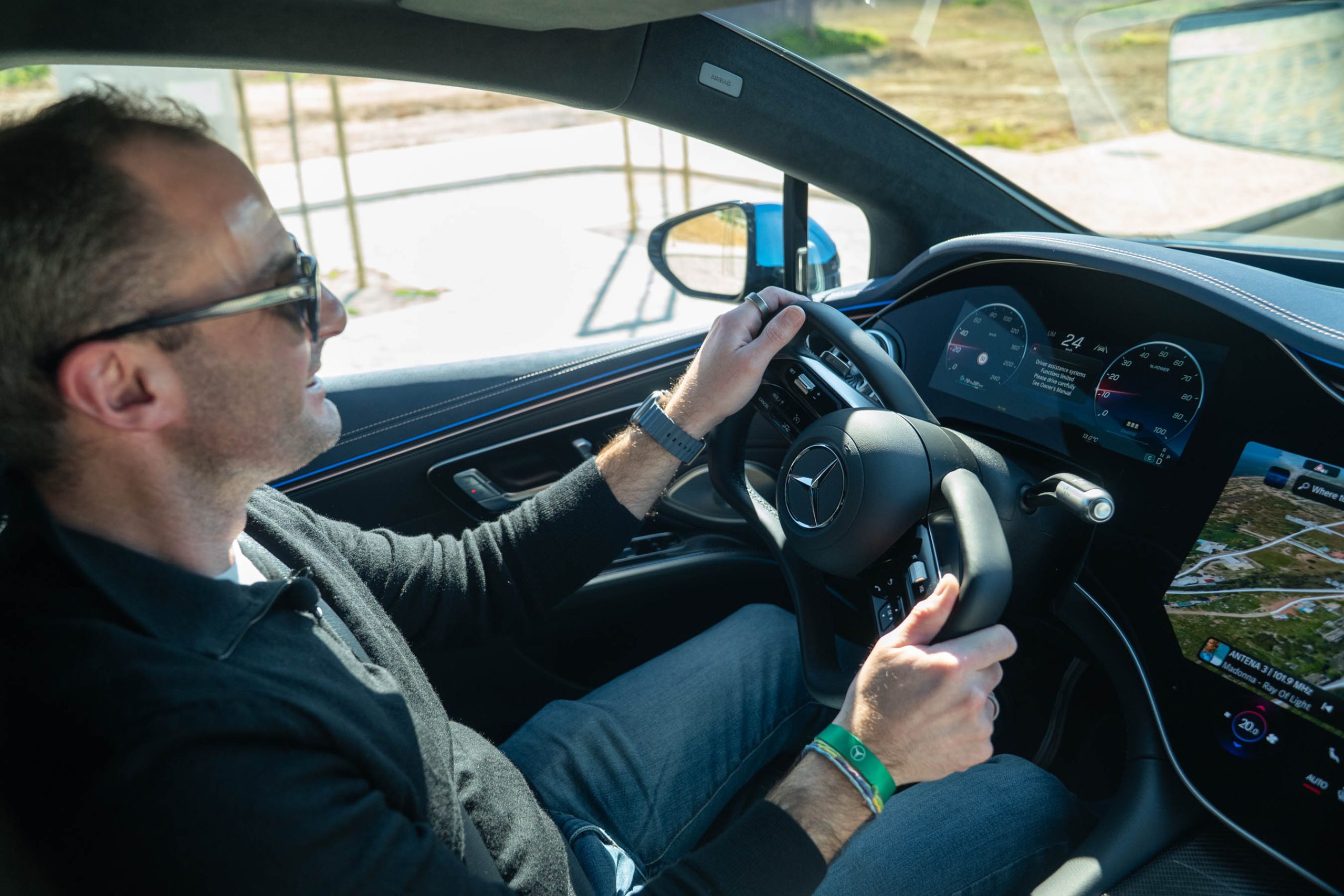
In March, during the Mercedes-Benz GLC electric launch in Faro, Portugal, I had the chance to get behind the wheel of a pre-production updated EQS, which was camouflaged externally, to test the new steer-by-wire system and yoke. To summarize? The system is more refined than the Lexus steer-by-wire setup and yoke, which never reached the U.S. market (at least thus far), yet, the EQS both does and does not feel like the ideal model for this feature.
The steer-by-wire system employs two parallel signal input channels for redundancy, akin to an aircraft. If one signal channel malfunctions, the second immediately takes over, ensuring the driver maintains steering control. It serves as a temporary, yet crucial, backup intended to allow a driver to pull over safely if an issue arises. In the event both signal channels fail, the system is complemented by Mercedes’ rear-wheel steering option, which engages up to 10 degrees of rear wheel steering input, and a third input will activate to assist the driver in pulling over slowly.
The system operates on a variable speed-dependent ratio, meaning as the vehicle accelerates, the steering response slows down, and vice versa. Unlike Tesla’s system, but similar to the Lexus configuration, there are only 180 degrees of steering input. No one will face a hand-over-hand scenario like in a Tesla, with its poor yoke implementation.
The design of the yoke varies from what Tesla CEO Elon Musk attempted but did not succeed in selling, and what Lexus launched but failed to provide to the U.S. market. Unlike the butterfly shape of the Lexus yoke and Tesla’s half-rectangle design, Mercedes has eliminated both the upper and lower halves of a standard round steering wheel and enclosed both sides of the grips. The outcome? A yoke that essentially forces the correct nine-and-three hand positioning, and imparts a feel reminiscent of a race car. The central connecting twin spokes are an upgraded version of the steering wheel found in many Mercedes models, featuring silver hard toggles complemented by annoying touch-sensitive buttons. These should have been redesigned alongside the yoke.
Mercedes provided three scenarios to evaluate the steer-by-wire and yoke arrangement. The first involved a brief slalom; the second was a tight maneuver around a stationary vehicle; the third was a simple roundabout. These tests brought to light several initial observations. Primarily, the system, in my very limited experience, felt more refined than the Lexus steer-by-wire system I tried years ago. There was no jitter or odd feedback during quick steering movements, and the system felt intuitive, smooth, and as anticipated. However, meaningful speeds were not reached, so it’s premature to assess if Mercedes has effectively simulated steering feel.
Measuring 17.25 feet in length and weighing between 5,400 and 5,900 pounds (depending on the configuration), the EQS is neither compact nor light. The faster ratio combined with the 10 degrees of rear steering input at lower speeds resulted in small inputs creating rapid large movements. I needed some time to adjust my response accordingly. Initial attempts led to abrupt handling and significant body roll. There will certainly be a learning curve for users.
This prompts me to question if the EQS is truly the optimal application for this technology. The EQS essentially serves as Mercedes’ showcase for cutting-edge technology, demonstrating its capabilities. While that is accurate and reasonable, a hatchback measuring 17.25 feet and exceeding 5,000 pounds might not be the ideal scenario to showcase this new steer-by-wire system and yoke.
Depending on how the system performs at higher speeds with the slower ratio, how much road feedback can be replicated and communicated to the driver through the yoke, and how well it coordinates with rear-wheel steering inputs at speed, this could be exceptional in an AMG sports car on a racetrack or in mountainous terrain. I can only envision the AMG owner who, if executed well, finds this in a sports car feeling like a hero from F1, perhaps that’s the goal? We’ll have to wait and see how developments unfold, but there’s potential here if implemented correctly in the right context.
Have a tip about upcoming technology? Reach out to us at [email protected]