
The Italian entrepreneur Romano Artioli’s ability to resurrect Bugatti in the 1990s, let alone challenge the elite with the EB110, was astonishing. So astonishing that it’s arguably not surprising the entire venture fell apart before long, leaving some incomplete projects behind.
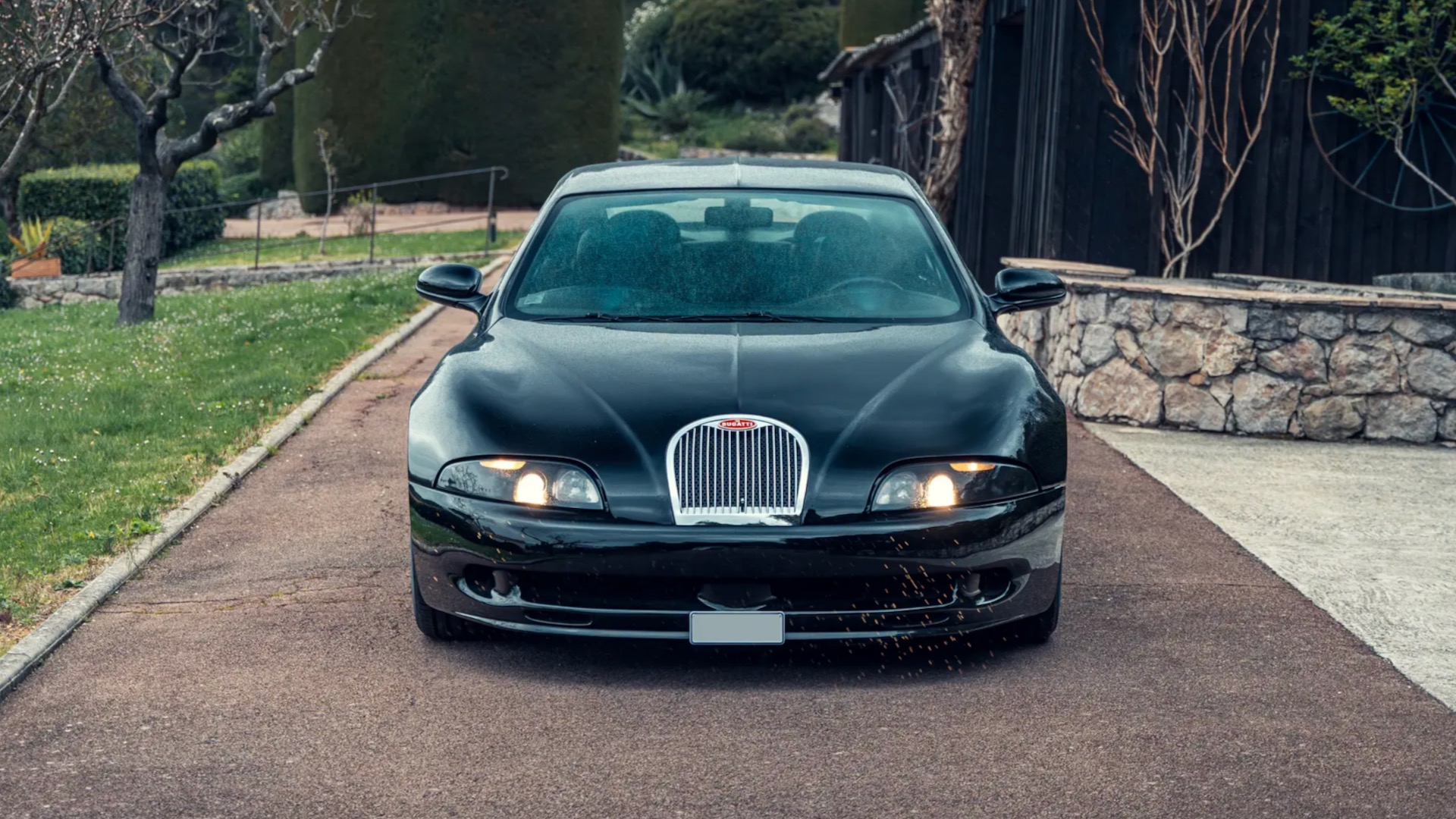
The Bugatti EB112 was a luxury sedan constructed on a carbon-fiber monocoque borrowed from the EB110, but it never went into mass production. Three operational prototypes were finished, one of which will be auctioned at RM Sotheby’s Monaco event in 2026, taking place on April 25. The auction house anticipates it will fetch between 1.5 million and 2 million euros, roughly translating to $1.7 million to $2.3 million at today’s exchange rates. So if the $4.6 million cost of a Tourbillon was out of reach, this might be worth considering.
Debuting at the 1993 Geneva Motor Show, the EB112 featured V12 power like the EB110, which had first been presented to the public about two years prior. However, unlike the supercar’s quad-turbocharged 3.5-liter engine, the EB112’s V12 had a displacement of 6.0 liters and was naturally aspirated. Positioned ahead of the cabin but behind the front axle, it generated 460 horsepower and 435 pound-feet of torque.
The V12 was paired with a six-speed manual transmission and an all-wheel-drive system (with a torque distribution of 38% front and 62% rear), akin to the EB110. Bugatti claimed it could sprint from 0 to 62 mph in 4.3 seconds and achieve a top speed of 186 mph. Impressive for a sedan accommodating four passengers in leather-lined luxury.
That powerful drivetrain is enveloped in bodywork designed by the legendary Giorgetto Giugiaro, featuring more pronounced allusions to Bugatti’s heritage compared to the EB110. A noticeable spine and split rear window pay homage to the Type 57 Atlantic; the wheels draw inspiration from the Type 41; and the Bugatti horseshoe grille is restored to its prewar size. The EB110 was fitted with a scaled-down version that gave it an unusual appearance.
Bugatti produced one operational prototype (the vehicle displayed in Geneva) and two styling models, alongside several chassis and other components before ceasing operations in 1995. Monegasque entrepreneur Gildo Pallanca Pastor later acquired the company’s assets and had two complete EB112s constructed from that stockpile of parts. This represents the second of those vehicles, hence its classification as a 1999 model despite Bugatti’s closure by then.
Pastor occasionally drove the car around Monaco until he sold it in 2015, but it still shows just 241 miles on the odometer. It underwent a significant refurbishment in 2021 and 2022, addressing the brakes, suspension, emissions control system, and new tire installation, with a separate engine overhaul in 2022. Thus, anyone daring enough to take this rare piece of automotive history onto the road should have no issues adding a few more miles to it.
As per the auction house, the other EB112 crafted by Pastor is still privately held, while the original prototype resides in ItalDesign’s collection. They remain just as captivating today as they were when they were first introduced. While the Volkswagen Group has revitalized Bugatti, even attempting to create its own Bugatti sedan in the form of the 16C Galibier, even this automotive titan hasn’t been able to realize that aim.
Have a lead? Send it to: [email protected]
### Bugatti EB112 Sedan Overview
The Bugatti EB112 is a luxury sedan that marks an important phase in the history of the Bugatti brand, recognized for its high-performance sports cars. Launched in the mid-1990s, the EB112 was intended to demonstrate Bugatti’s ambition to penetrate the luxury sedan market, merging performance with luxury.
#### Design and Features
The EB112 was crafted by the esteemed Italian automotive designer Giorgetto Giugiaro. Its design boasts a sleek, aerodynamic profile typical of Bugatti’s style. The front features a distinctive grille and sharp headlights, while the rear presents a smooth, refined line that accentuates its sporty look.
The EB112’s interior is meticulously designed with high-end materials including leather, wood, and aluminum. The cabin offers generous space, aimed at ensuring comfort for both the driver and passengers. Innovative technology for its time, comprising a premium sound system and climate control, was integrated into the vehicle to elevate the driving experience.
#### Performance
Beneath the hood, the Bugatti EB112 is powered by a 4.0-liter W12 engine, which was an innovative configuration during its era. This engine produces about 450 horsepower, enabling the sedan to accelerate from 0 to 60 mph in just approximately 4.5 seconds. The EB112 features an all-wheel-drive system, providing exceptional traction and stability, making it adaptable to various driving conditions.
The sedan is outfitted with an advanced suspension system that harmonizes comfort and performance, ensuring a smooth ride even at elevated speeds. The braking system is equally sophisticated, featuring large disc brakes for dependable stopping power.
#### Production and Legacy
Despite the Bugatti EB112 receiving favorable reactions in its conceptual phase, it never achieved full-scale production. Only a handful of prototypes were created, making it a rare collector’s item today. The development of the EB112 was part of Bugatti’s initiative to revitalize the brand after its acquisition by the Volkswagen Group in the 1990s.
The EB112 paved the way for future Bugatti models, influencing the design and engineering of later vehicles, including the Bugatti Veyron. Its combination of luxury, performance, and pioneering design continues to be appreciated by car enthusiasts and collectors.
#### Conclusion
The Bugatti EB112 stands as an intriguing instance of automotive design and engineering. Although it never reached mass production, its legacy lives on as a symbol of Bugatti’s quest to diversify its product offerings beyond just high-performance sports cars. The EB112 serves as a testament to the brand’s dedication to excellence and innovation within the automotive industry.