
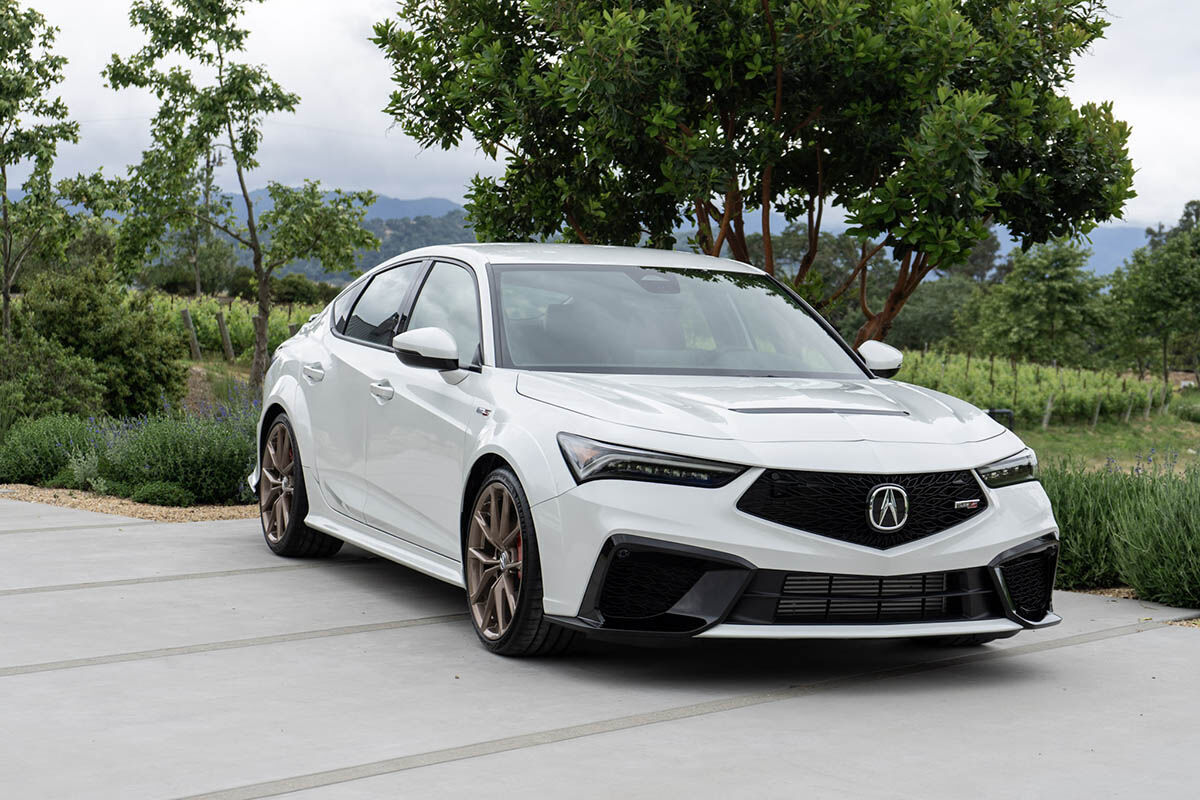
I was fortunate (or perhaps unfortunate, depending on your viewpoint) to evaluate a 2026 Acura Integra Type S while fitted with Bridgestone Blizzak winter tires for a week. “I really hope we get some weather to properly test this setup,” I said to myself when I received the vehicle. Well, Kuraokami must have eavesdropped, because my area got inundated with snow in the following days.
After hours of shoveling, I extricated this striking blue ITS from Frosty’s icy grasp and took it for a spin to assess how it fared against the conditions.
I thoroughly enjoyed the previous-gen FK8 Honda Civic Type R on backroads—more so than on the track—while the 2024 Acura Integra Type S provided one of my all-time favorite driving experiences. Swerving around the Möbius-strip roads in the highlands near Santa Barbara when that vehicle debuted was an absolute thrill. The car felt spot on.
The current DE5 Integra Type S hasn’t significantly changed since my earlier drive years back; it remains a fantastic front-drive platform, powered by a commendable K20C8 2.0-liter DOHC VTEC turbo engine boasting 320 horsepower and 310 lb-ft of torque, mated to a close-ratio six-speed manual gearbox.
Reassessing the ITS a few years later has refined my perceptions of the vehicle. It remains fundamentally an exceptionally well-crafted sport compact car featuring a superb manual gearbox and excellent handling. However, surveying the cockpit this time, the atmosphere seemed much more “compact” than “sport.” And “luxury” barely registers. The car doesn’t feel cheap, but it possesses an almost aggressively simplistic vibe.
Regarding cold-weather features, you can opt for a heated steering wheel ($485 option) if you forgo the Alcantara steering wheel, and an OEM engine block heater ($92) if you reside in particularly icy regions. You may also want to abstain from the stylish $209 titanium shift knob—even the top of the aluminum one in this test vehicle felt extremely chilly in the morning! The cabin heater is sufficient, and the heated seats perform well with three temperature levels. Unfortunately, the seats are not particularly comfortable. I find this surprising, as Acura’s design team emphasized their hard work on seat design, and the seats in the previous-gen Civic Type R were genuinely great.
Having a straightforward cockpit is not necessarily detrimental for the ITS. In certain respects, a barebone interior makes sense for the sporty variant of an everyday vehicle like this. However, considering the price Acura asks for these—around $55,000—you should realize there are numerous more luxurious options available.
Concerning the drive itself, on snow-laden roads with winter tires, the outcomes were somewhat mixed. And indeed, we faced much worse weather than depicted in these images; I was not about to abandon the warmth of the heated seat during the worst of the storm to take more pictures.
Initially, the vehicle felt impressive. At what I considered a sensible speed for the conditions (sometimes below the limit), I experienced excellent traction, smooth steering, gentle acceleration, and effective braking. The ITS strikes a good balance between responsiveness and comfort for its class, though it certainly feels a bit firmer than your typical Acura. That was a bit more uncomfortable on the bumpy wintry roads of New York than on the smooth, sweeping routes of California.
At a more enthusiastic pace, I still had a fair degree of confidence that I wouldn’t be pushed toward the outside of a corner by understeer. Adhering to the basic tenets of winter driving, the vehicle was willing to cut through the powder. Handling still felt proficient when braking and steering were managed with due caution.
As I charged hard into boost and VTEC territory, things unraveled a bit. The Blizzak tires, which I adore, spun into oblivion during a launch in first gear. I would reach approximately 3,000 rpm, and then the tach would surge as the front tires lost grip. And that was on dry spots—I wasn’t keen on exhibiting such behavior in the harshest weather. If I really pushed it, which I attempted a few times, I could also achieve wheelspin in second gear.
That made me a bit reluctant to test the limits of cornering grip, but in a vast, unoccupied parking area, I prodded the car a bit and felt mostly satisfied. For a 320-hp front-drive vehicle, it felt pretty stable as I tossed it around. However, if you go looking for understeer, you’ll definitely find it.
Although acceleration traction was likely the most underwhelming aspect, winter braking on Blizzaks was impressive. The ITS is equipped with powerful Brembo four-piston monobloc aluminum calipers gripping 13.8-inch rotors on the front axle, and even under low traction, the Bridgestone tires allowed the vehicle to rein itself in quickly and steadily, which I greatly appreciated.
There’s much to admire about the Integra Type S. The exterior design remains appealing, and it drives quite well, particularly for those who enjoy manual gear shifting. Its performance in snow was adequate. Sufficient for everyday use—you can confidently own one of these in a snowy environment, but it lacks the snow-beast qualities of something like an all-wheel-drive Audi RS3 or Subaru WRX. A more mature evaluation of the vehicle has tempered my initial over-enthusiasm. The ITS is an excellent sport compact car; it’s just sort of frustratingly pricey for how it feels.
The Double Apex Blue Pearl paint scheme certainly looked stunning against the snow, though. Swipe through here to view the remainder of my photos of the vehicle in cold weather:
Acura provided The Drive with a seven-day loan of this vehicle for the purpose of conducting this review.
**2026 Acura Integra Type S Winter Performance Evaluation: Front-Wheel Drive in Snowy Conditions**
The 2026 Acura Integra Type S has created considerable buzz among automotive fans, especially regarding its functionality in winter scenarios. As a front-wheel-drive (FWD) model, the Integra Type S exhibits distinct qualities that can affect its handling and traction on snow-covered thoroughfares. This article explores the performance characteristics of the Integra Type S in winter, benchmarking it against other vehicles in its category and underscoring critical features that enhance its drivability in snow.
**Front-Wheel Drive Characteristics**
Front-wheel drive vehicles, such as the Integra Type S, direct their engine’s power to the front wheels. This setup provides various advantages in winter driving situations. The engine’s weight over the front wheels can enhance traction, vital for maintaining control on slippery surfaces. Moreover, FWD models often experience understeer, which can be more predictable for drivers navigating through snow.
**Tire Choice and Effectiveness**
A significant element influencing winter performance is tire selection. The Integra Type S is fitted with performance tires optimized for dry and wet conditions, but these might not perform adequately in snow. Upgrading to winter-specific tires can greatly improve traction and handling in snowy environments. Winter tires utilize specialized rubber compounds and tread designs that enhance grip, enabling the Integra Type S to handle better in snow and ice.
**Handling and Stability Features**
The 2026 Acura Integra Type S incorporates advanced handling and stabilization technologies that elevate its winter capabilities. The vehicle features an adaptive suspension system that adjusts based on road conditions, enhancing stability on slippery surfaces. Additionally, the Integra Type S is outfitted with electronic stability control (ESC) and traction control systems that help prevent wheel spin and ensure control during acceleration and cornering.
**Engine Performance and Power Distribution**
The Integra Type S is powered by a turbocharged engine that delivers strong performance. While this power may be beneficial in dry conditions, it can become a challenge in snowy situations. The vehicle’s power management is critical; smooth and gradual acceleration is necessary to retain traction. The Integra Type S offers driving modes that alter throttle response, allowing drivers to select a more conservative option for winter driving, aiding in managing power delivery and improving control.
**Comparative Perspective Against Rivals**
In comparison to rivals within the compact performance segment, such as the Volkswagen Golf GTI and Subaru WRX, the Integra Type S remains competitive. The WRX, equipped with its all-wheel-drive system, delivers superior traction in snow, making it a preferred choice for those frequently driving in harsh winter climates. Nonetheless, the Integra Type S provides a more refined driving experience and enhanced fuel efficiency, making it an appealing choice for individuals who value everyday usability with winter performance.
**Driver Experience and Comfort**
The 2026 Acura Integra Type S interior is crafted for comfort and practicality, which is vital during winter months. Features such as heated seats, an intuitive infotainment setup, and advanced driver assistance technologies contribute to a favorable driving experience even in poor weather. Driver visibility is also improved, promoting greater awareness of road conditions.
**Conclusion**
The 2026 Acura Integra Type S serves as a solid alternative for drivers seeking a performance-oriented vehicle capable of managing winter conditions. While its front-wheel-drive layout provides certain benefits, such as enhanced traction from weight distribution, the overall winter performance can be substantially improved with suitable tire selection and driving methods. For those who seek a balance of performance and everyday functionality, the Integra Type S stands out, though drivers in regions experiencing severe winter weather might want to explore options with all-wheel drive for peak performance.
 admin
admin