
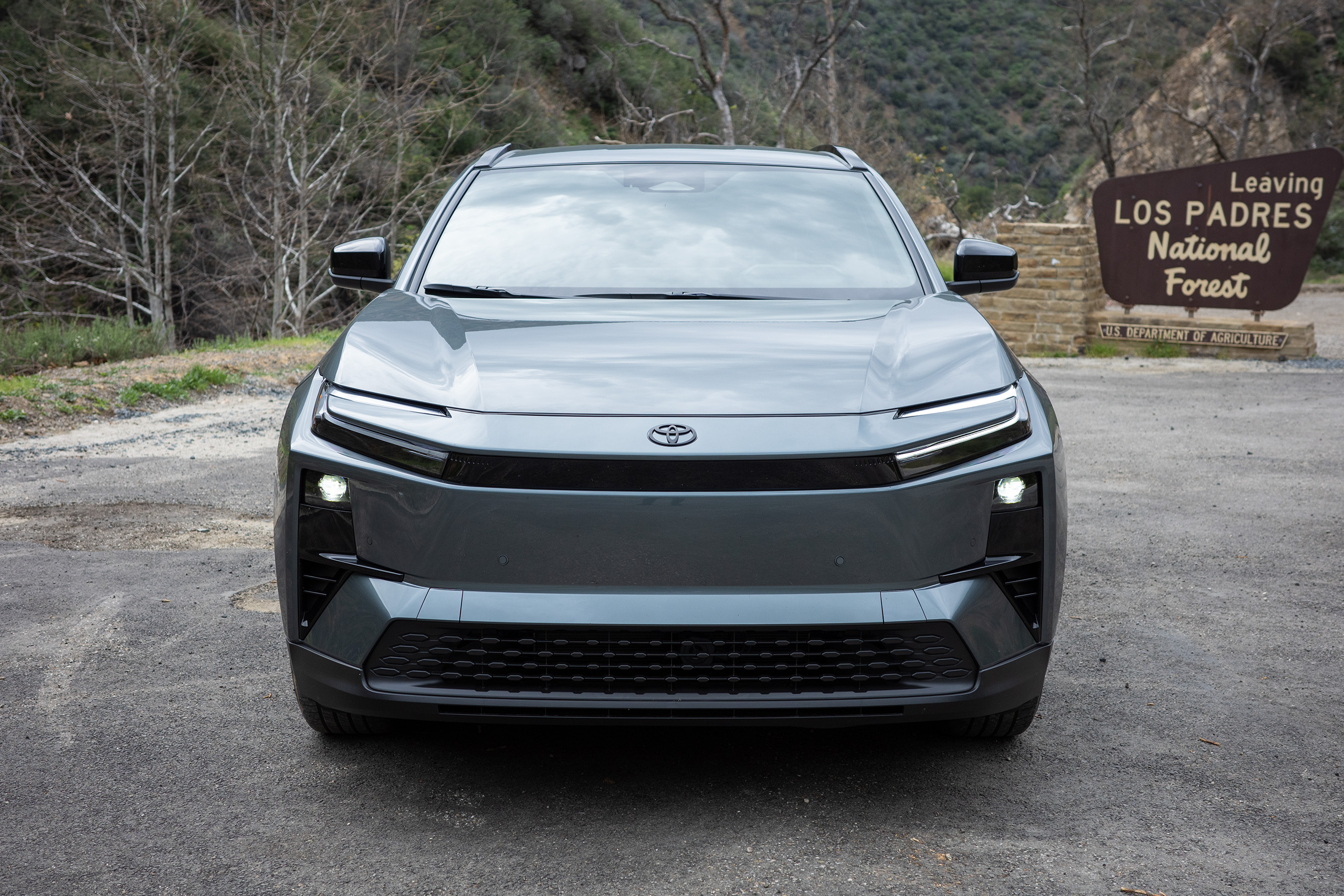
Four years after the fairly forgettable Toyota C-HR exited the U.S. market, it has now made a comeback as an electric vehicle. It still features a high stance and a coupe-like silhouette, but this iteration aims to leave a stronger mark. Priced at $38,450, it comes equipped with standard dual-motor all-wheel drive, generating a total of 338 horsepower and 323 lb-ft of torque.
That translates to 130% more power compared to the previous C-HR. This version also boasts improved aesthetics, adopting the refined design cues of Toyota’s core electric SUV, the bZ, while shortening the wheelbase for a sportier look. The outcome is an entry-level EV that may surprise many—especially if they discover a clear stretch of road to test out the C-HR’s five-second 0-60 mph acceleration.
The Basics
Initially, the C-HR might appear to be the entry-level option for Toyota’s EV lineup, with the larger bZ and adventure-friendly bZ Woodland wagon situated above it. However, the C-HR comes equipped with that considerable power and an impressive 287 miles of range, sacrificing some cargo space and utility for quicker acceleration and a more spirited driving sensation. It begins at $38,450 for the base SE model, escalating to $40,450 for an XSE featuring synthetic leather, an electric driver’s seat, and extra driver-assist technology, including a 360-degree camera.
It also has an impressive appearance. I’ve enjoyed Toyota’s recent design language in its smaller models. While split headlights may be overdone these days, Toyota’s daytime running light signature can remain. It’s deliberate yet tidy, avoiding being stark or unnecessarily aggressive.
This reflects the entire exterior. Toyota refined some of the unique features from the initial bZ4X, which was a wise decision, but there are appealing elements here that attract attention, like the rear light bar that protrudes and separates from the tailgate. When equipped with the large 20-inch wheels found on the XSE trim and paired with a short wheelbase, it resembles a concept vehicle. Bystanders in Southern California appeared to admire it.
Additionally, while it seems peculiar that Toyota isn’t offering a front-wheel-drive C-HR, its counterpart at Subaru will. The Uncharted is Subaru’s rendition of the C-HR, also arriving soon, and it will start at roughly $2,000 less with a 221-hp front motors only. An all-wheel-drive variant will also be available, priced at $41,245.
Inside, the C-HR closely resembles the bZ and bZ Woodland, featuring a large 14-inch central infotainment screen and a somewhat unconventional instrument cluster setup. Yes, Toyota opted not to revise that contentious design element in the C-HR or updated bZ, and I would argue that this decision was flawed. The dashboard sits quite low in these vehicles, but the steering wheel position often obstructs visibility to the instrument cluster. You can adjust your seating to mitigate this, but then you are altering your ergonomics to fit the vehicle, which is not something drivers should have to contend with.
Apart from that, the C-HR’s interior is unique and surprisingly spacious, yet a bit of a hodgepodge of materials. Some elements, like the nearly suede-like door armrests and even the basic cloth upholstery in the SE trim, are appealing, giving the C-HR a more upscale feel. However, from the driver’s perspective, you are mainly confronted with a plethora of plastics of various textures and quality, from the steering wheel to that oddly-positioned digital cluster. Much of it appears quite cheap, and none of it really harmonizes.
In a typical vehicle with a conventional dashboard, all of these aspects would be mostly hidden behind the cluster and fairly out of sight, or overlooked. But the C-HR’s unconventional layout highlights these features that serve as reminders that this is quite an economical car.
The large screen includes climate adjustments with limited physical controls, apart from two sizable dials for dual-zone temperature configurations. The user interface itself is rather basic and unadorned, as is the case with most modern Toyotas, but it’s not very appealing nor the most responsive. Certain menus have cramped text and oddly blurry graphical switches; additionally, when trying to access more detailed climate control settings, multiple taps were sometimes necessary. This isn’t the latest software that appears in the new RAV4 or upcoming Highlander, which is somewhat disappointing. But at least it includes CarPlay.
The center console allocates an excessive amount of space to side-by-side wireless device chargers. As someone who typically avoids wireless charging in any vehicle I drive, I find little value in this. Nevertheless, credit where it’s due: These pads did efficiently recharge my iPhone’s battery and kept it secured. Beneath them is extra storage and USB-C ports, which is fortunate because the C-HR, similar to the entire bZ range, does not feature a glove compartment.
I commend Toyota for creating a highly accommodating back row, despite this vehicle’s seemingly narrow dimensions. With about 37 inches of headroom and 32 inches of legroom, the space is quite adequate, and at 5’10”, I found myself comfortably seated in the rear. In contrast, the cargo area behind the seats is certainly superior to that in, for instance, a Corolla hatch, but if storage is a top priority, you’ll be better off with one of Toyota’s larger electric vehicles. Note: There is no frunk in any of those models, even though it would be most suitable.
Driving the 2026 Toyota C-HR
However, you’re not seeking out maximum space; you desire a reasonably priced EV that offers a touch of excitement, and the C-HR delivers on that promise. This is certainly not a performance car, but with a 223-horsepower motor in the front and a 116-hp one in the rear, along with compact dimensions, the C-HR is well-suited for lively driving compared to other EVs in Toyota’s lineup.
The C-HR will indeed accelerate to 60 mph from a standstill in 4.9 seconds, which matches, according to the manufacturer’s own testing, the performance of the GR Corolla, so it’s definitely quick. The electric power steering has also been adjusted to be a bit heavier, compared to what you would encounter in other bZ models. The steering aligns well with the vehicle’s character; it’s sharp enough and slightly heavy without necessitating excessive effort, which is exactly what one desires in a fun commuter.
The suspension is also firmer compared to the bZ’s, but rest assured, the ride remains smooth and generally comfortable, and this vehicle doesn’t shy away from leaning in turns. Navigating the winding Route 33 in California’s Ojai Valley, the C-HR felt responsive, but the lateral rolling at higher speeds, combined with a 4,300-pound curb weight, discourages aggressive pace entering corners. Once again, I believe anyone in search of an enjoyable everyday vehicle will appreciate what they discover here, but those yearning for a dynamically agile Toyota EV may be better off waiting for a GR version. For what it’s worth, I suspect the GR variant would be an absolute blast.
Range and Competition
The C-HR’s single powertrain option guarantees an EPA-anticipated range of at least 287 miles on a full charge of its 74.4-kWh battery. That number decreases by 14 miles for the top-tier XSE model, which swaps standard 18-inch wheels for 20-inch ones. A standard NACS charging port makes Tesla Supercharger access straightforward, although limited to 150 kW, and a CCS adapter is included for use at other stations.
Over a Level 3 DC charging system, the C-HR is reported to go from 10% to 80% in 30 minutes—under optimal conditions and with a reliable charger, of course. Toyota also took lessons from the bZ4X and upgraded the SUV’s previous 7.6-kW onboard AC charger to 11 kW for more efficient home charging.
The range, which falls just short of 300 miles, may not seem particularly remarkable, but it is arguably the best you’ll find for an all-wheel-drive electric vehicle at this price. The most affordable AWD Ioniq 5 that Hyundai offers can cover 290 miles on its slightly larger 84-kWh battery, but it also carries a significantly higher price tag than the base $38,450 C-HR, retailing at $42,600. Conversely, the Ioniq 5 can recharge much quicker, at rates of up to 350 kW.
Then we have the Chevrolet Equinox EV, which is more spacious but less performance-oriented than the C-HR. It excels with 307 miles in its most affordable AWD configuration, but is listed at $40,095. Additionally, the less said about the $43,535 Ford Mustang Mach-E Select AWD—rated to deliver a meager 240 miles from a battery that’s effectively the same size as the C-HR’s—the better. Tesla, predictably, still reigns as the range leader in this “segment,” if we generously include low-slung sedans. However, even then, you cannot enter a 343-mile Model 3 AWD for under $49,000.
Early Verdict
Toyota is presenting a distinct offering with the C-HR’s resurgence. While most EVs in the sub-$40K bracket focus on space or range, this one genuinely emphasizes driving fun with unexpectedly robust performance and an appealing exterior, which also happens to deliver commendable range.
No, the C-HR isn’t as practical a vehicle as the Equinox EV, nor does it prioritize swift charging like Hyundai’s EV lineup. The interior design is admittedly a bit chaotic. But not everyone needs those elements, and now, halfway through the 2020s, it’s refreshing to see the mainstream EV market expand to cater to customers beyond the general average. It’s also encouraging to witness Toyota finally getting its EV strategy on track, four years after the bZ4X made its debut. If you want to illustrate to anyone how rapidly the technology is evolving, just direct them to this vehicle.
| 2026 Toyota C-HR Specs | |
|---|---|
| Base Price | $38,450 |
| Powertrain | 74.7-kWh battery | dual-motor all-wheel drive |
| Horsepower | 338 |
| Torque | 323 lb-ft |
| Seating Capacity | 5 |
| Curb Weight | 4,510 pounds |
| Cargo Volume | 25.3 cubic feet behind second row | 59.5 cubic feet behind first row |
| Ground Clearance | 8.3 inches |
| 0-60 mph | 4.9 seconds |
| EPA-rated range | Up to 287 miles |
| Score | 7.5/10 |
Quick Take
The Toyota C-HR may have its flaws, but it serves as an excellent counter to mundane entry-level EVs, emphasizing performance and design over practicality while maintaining respectable range.
Toyota provided The Drive with travel and accommodations, along with the use of a vehicle for the purpose of writing this review.
**2026 Toyota C-HR First Drive Review: A Fun and Accessible Entry-Level Electric Vehicle**
The 2026 Toyota C-HR signifies a noteworthy advancement in the compact SUV category, especially as it enters the electric vehicle (EV) market. Its bold styling, cutting-edge technology, and user-friendly features aim to draw in a younger audience seeking an accessible entry into electric mobility.
**Design and Aesthetics**
The 2026 C-HR presents a contemporary and sporty exterior that differentiates it from its predecessor. The assertive front end showcases a prominent grille and sleek LED lights, giving the vehicle a unique appearance. The sculpted body lines and a tapered roofline add to its dynamic silhouette, while the rear features a distinctive taillight design that boosts visibility and style. Offered in an array of vivid colors, the C-HR appeals to consumers desiring a vehicle that signifies their individuality.
**Interior Comfort and Technology**
Inside, the 2026 C-HR emphasizes comfort and practicality. The cabin is spacious, providing generous headroom and legroom for both front and rear occupants. High-quality materials and a modern design create a welcoming environment. The heart of the interior is the advanced infotainment system, featuring a large touchscreen display that is compatible with both Apple CarPlay and Android Auto. This system allows for seamless smartphone integration, enabling drivers to easily access navigation, music, and communication applications.
Safety is also a primary focus, with Toyota’s Safety Sense suite included as standard. This extensive package offers features like adaptive cruise control, lane departure alert, and automatic emergency braking, ensuring reassurance for both drivers and passengers.
**Performance and Driving Experience**
The 2026 C-HR is equipped with an efficient electric motor that provides an exhilarating driving experience. With immediate torque and smooth acceleration, the C-HR feels nimble and responsive on the road. The vehicle’s low center of gravity enhances stability, making it enjoyable to maneuver through city streets and winding backroads.
The C-HR also boasts an impressive range on a single charge, making it suitable for both daily commutes and weekend excursions. Regenerative braking technology helps maximize efficiency, allowing drivers to extend their range while promoting energy conservation.
**Charging and Efficiency**
Charging the 2026 C-HR is simple, with compatibility for both standard home charging and rapid-charging stations. Toyota has made it convenient for owners to keep their vehicles charged, effectively alleviating range anxiety. The C-HR’s energy efficiency ratings are competitive within its segment, making it an economical choice for cost-conscious consumers.
**Conclusion**
The 2026 Toyota C-HR emerges as an appealing choice for those entering the electric vehicle arena. With its stylish design, comfortable cabin, and engaging driving experience, it successfully blends enjoyment with functionality. As manufacturers expand their EV offerings, the C-HR stands out as a viable option for a new generation of drivers seeking an eco-friendly yet entertaining driving choice.