
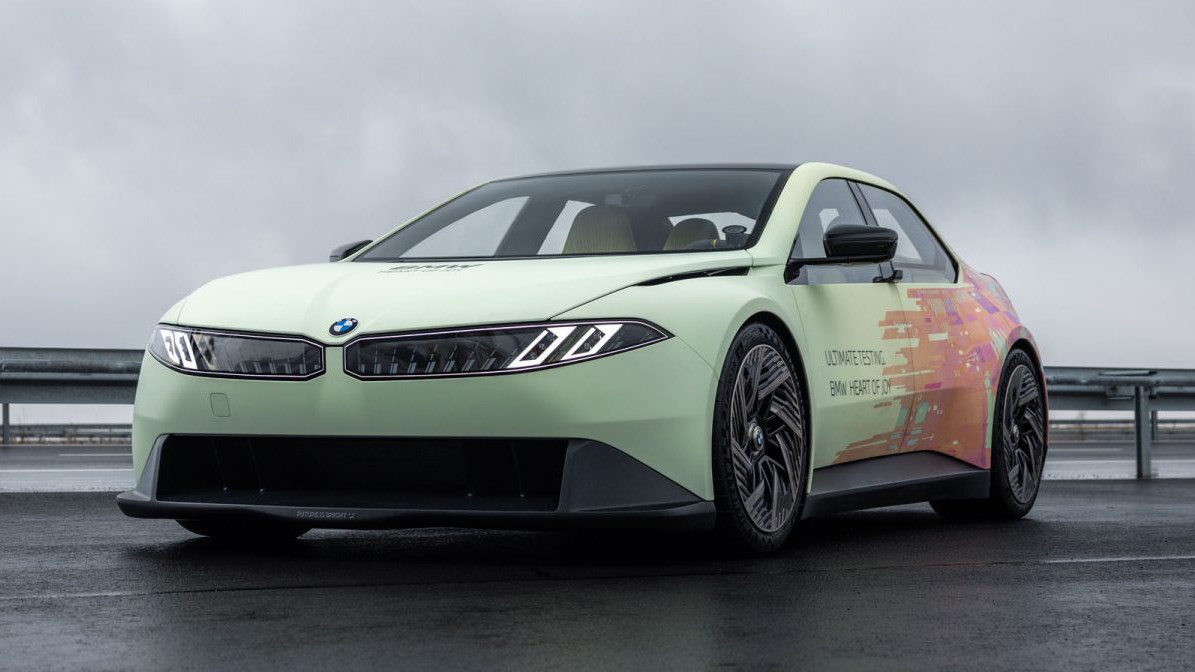
BMW’s first M Neue Klasse models aren’t set to hit the streets until 2027, but today the manufacturer revealed additional essential details about them, especially regarding how they will differ from non-M versions. Nowadays, “performance” models of EVs are often enhanced with software tweaks, but BMW is eager to clarify as it enters the Neue Klasse era that these upcoming M vehicles will incorporate distinct hardware as well, all aimed at delivering a driving experience meant to compete with any gas-powered vehicle.
The M Neue Klasse sedan showcased here is a prototype, likely indicative of the production M-branded i3 sedan, while the foundation of its design will be relevant to all electric M vehicles. At the core of this system lies a dual drive-unit powertrain. Each unit is positioned on an axle and features two motors—one for each wheel—permitting the Heart of Joy ECU to control torque distribution at all four wheels. The rear axle can also operate entirely independent from the front, offering the driver a choice between the strong grip of all-wheel drive or the oversteer preference of rear-wheel drive.
However, one might expect a high-end, performance-oriented EV to dynamically allocate torque when and where it’s most needed. What sets BMW’s approach with M Neue Klasse apart is that it hasn’t merely enhanced power delivery at the final stage—it has revitalized the entire system. To meet the peak and sustained performance goals the M division required, BMW had to create a distinct cell chemistry specifically for these models. Consequently, the M Neue Klasse will not only generate more power than the Neue Klasse but will also charge faster and recover more energy.
This system operates at 800 volts, with a “capacity exceeding 100 kWh,” stated BMW in vague terms. All components are managed through a simplified network of four control units, aptly dubbed “Superbrains,” which decreases the intricacy of modern high-performance EV frameworks.
The battery casing has been affixed to the vehicle’s suspension and body in ways not seen in the standard Neue Klasse, boosting overall rigidity. Additionally, BMW has enhanced the lightweight “natural fiber” material it has been refining via motorsport since 2019, to the extent that it is now prepared for widespread use. BMW claims it “provides similar characteristics to carbon fiber but can be manufactured with roughly 40% fewer CO2e,” or carbon dioxide equivalent emissions.
It seems like we’ve been anticipating BMW’s initial true electric M car for quite a while. With production of the Neue Klasse sedan expected to commence in Munich this summer, it shouldn’t be long before we witness the final, road-legal version of the base model, followed by its more assertive sibling landing sometime next year. Surprisingly, it’s already 2026—what’s an additional 12 months?
Have a tip? Reach out to us at [email protected]
**BMW’s Electric M3 Features Four Motors and an Innovative Battery System**
The automotive sector is experiencing a remarkable shift with the advent of electric vehicles (EVs), and BMW is leading this charge with its latest version of the legendary M3. The new electric M3 aims to provide not just the performance characteristic of the M series, but also groundbreaking technology that distinguishes it from traditional combustion engine versions. A notable aspect of this electric M3 is its four-motor configuration paired with an innovative battery system.
**Four-Motor Setup**
In contrast to standard electric vehicles that generally use a single motor or dual-motor configurations, BMW’s electric M3 is outfitted with four independent motors—one for each wheel. This arrangement grants exceptional control over power distribution and torque vectoring. Each motor can be regulated independently, allowing the vehicle to maximize traction and stability across various driving situations. This sophisticated arrangement enhances the M3’s performance, leading to more precise handling, faster acceleration, and superior cornering abilities.
The four-motor configuration further enhances the car’s agility, enabling it to execute dynamic maneuvers with accuracy. By directing power to the wheels that require it most, the electric M3 can skillfully navigate tight corners and challenging landscapes, making it a formidable competitor on both the road and the racetrack.
**Innovative Battery System**
Accompanying the four-motor setup is BMW’s pioneering battery system, crafted to enhance efficiency and performance. The electric M3 is equipped with a high-capacity battery pack that not only offers an impressive range but also boasts rapid charging capabilities. This enables drivers to relish extended driving periods without the fear of depleting their power supply.
The battery system is strategically located within the vehicle’s chassis to lower the center of gravity, improving stability and handling. Moreover, BMW has integrated advanced thermal management technology to guarantee optimal battery performance, even under strenuous conditions. This system aids in maintaining the battery’s efficiency and longevity, ensuring it remains a dependable choice for performance aficionados.
**Performance and Range**
With the combination of four motors and a state-of-the-art battery system, the electric M3 is poised to deliver exhilarating performance metrics. Initial predictions suggest the vehicle may sprint from 0 to 60 mph in under three seconds, rivaling some of the quickest sports cars on the market. The accurate power delivery from the four motors facilitates instantaneous acceleration, providing a thrilling driving encounter.
Regarding range, the electric M3 is expected to offer competitive numbers, making it suitable for both everyday commuting and long-distance journeys. Its ability to charge quickly enhances its practicality, enabling drivers to spend less time at charging stations and more time driving.
**Conclusion**
BMW’s electric M3 signifies a considerable advancement in the world of performance electric vehicles. Featuring its innovative four-motor configuration and remarkable battery system, it merges the brand’s rich performance legacy with leading-edge technology. As the automotive environment continues to evolve, the electric M3 stands as proof of BMW’s dedication to delivering exciting driving experiences while embracing sustainability. Both enthusiasts and eco-conscious motorists can eagerly anticipate a game-changing addition to the M lineup.