
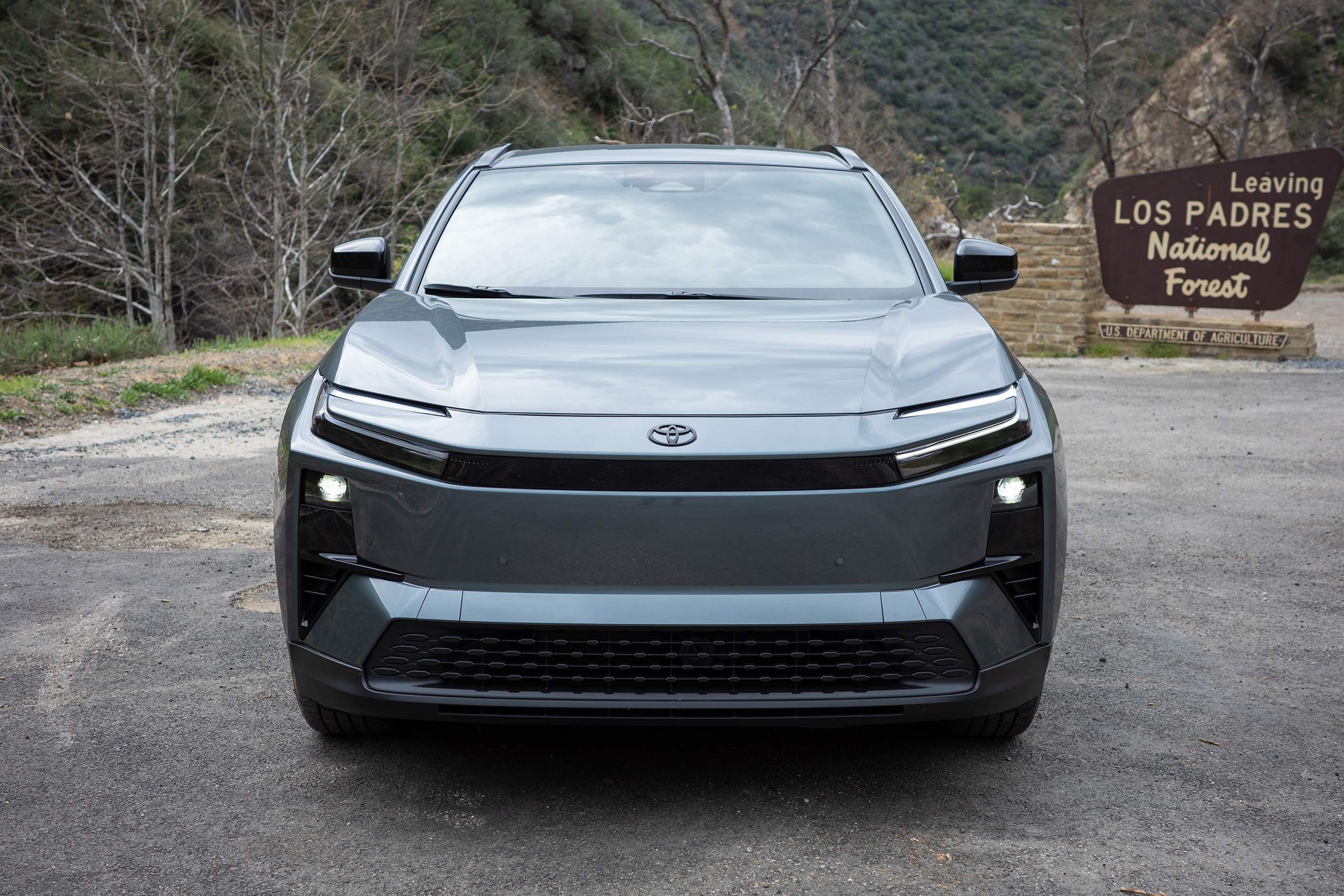
After four years of the rather unremarkable Toyota C-HR exiting the U.S. market, it has made its return as an electric vehicle. It remains a high-seated compact crossover with a coupe-like silhouette, but this version aims to leave a stronger impression. Priced at $38,450, it features dual-motor all-wheel drive as standard, providing a combined output of 338 horsepower and 323 lb-ft of torque.
This translates to 130% more power compared to the previous C-HR. Additionally, this model boasts a more appealing design, integrating the refined styling elements of Toyota’s flagship electric SUV, the bZ, while shortening its wheelbase for a sportier aesthetic. The outcome is a budget-friendly EV that is set to catch many off guard—especially when they find an open road to experience the C-HR’s five-second 0-60 mph sprint.
The Essentials
Initially, the C-HR might appear as the starting point for Toyota’s electric range, with the larger bZ and more adventurous bZ Woodland wagon positioned above it. However, the C-HR comes equipped with robust power and a 287-mile range, sacrificing some space and versatility for superior acceleration and an engaging drive. Starting at $38,450 for the base SE trim, it goes up to $40,450 for the XSE, which includes synthetic leather seating, a powered driver’s seat, and enhanced driver-assist technologies, such as a 360-degree camera.
Its appearance is also striking. I’ve appreciated Toyota’s recent design approach in its smaller models. While split headlights have been done extensively, Toyota’s daytime running light signature is a welcome addition. It’s purposeful and sleek, rather than severe or overly aggressive.
This observation captures the essence of the entire exterior. Toyota has refined some of the bZ4X’s peculiarities, which was wise, while incorporating appealing details that draw attention, such as the rear light bar that protrudes and distinguishes itself from the tailgate. When equipped with the large 20-inch wheels, as seen on the XSE trim, combined with the shorter wheelbase, it almost resembles a concept car. Onlookers in Southern California appeared to admire it.
Additionally, while it may seem unusual that Toyota isn’t offering a front-wheel-drive variant of the C-HR, Subaru is stepping in to provide that option. The Uncharted is Subaru’s interpretation of the C-HR, set to launch soon, and will start at around $2,000 less, featuring a 221-hp front-motor setup. An all-wheel-drive edition will also be available for $41,245.
Inside, the C-HR closely resembles the bZ and bZ Woodland, from its expansive 14-inch central infotainment display to its unconventional instrument cluster setup. Yes, Toyota opted not to adjust that debated design feature in the C-HR or updated bZ, a choice I would argue isn’t ideal. The dashboard is notably low in these vehicles, but the position of the steering wheel can obstruct visibility of the cluster. You can adjust your seating position to mitigate this, but it ultimately requires altering your ergonomics to fit the vehicle—a situation that shouldn’t be necessary for drivers.
Aside from that, the C-HR’s interior is unique and unexpectedly spacious, though rather disjointed in terms of materials. Some elements, like the nearly suede-like door armrests and even the basic cloth upholstery in the SE trim, are quite pleasant, giving the impression that the C-HR is aiming higher in terms of quality. However, from the driver’s perspective, one is essentially confronted with a sea of various plastics with differing textures and quality, from the top of the steering wheel to that oddly placed digital cluster. Much of it appears rather cheap, and the overall cohesion is lacking.
In a typical vehicle with a conventional dashboard, all these elements would usually be hidden from view or ignored. However, the C-HR’s unique layout highlights features that remind you that you’re dealing with quite an economical vehicle.
The large display contains climate controls with minimal physical controls available, besides two sizable dials for dual-zone temperature adjustments. The user interface is fairly straightforward and basic, consistent with most contemporary Toyotas, but it lacks visual appeal or quick responsiveness. Some menus feature tight text and oddly blurry graphical toggles; moreover, accessing more detailed climate settings often requires multiple taps. This software isn’t as advanced as what’s seen in the new RAV4 or the forthcoming Highlander, which is somewhat disappointing. However, at least it supports CarPlay.
The center console occupies a disproportionate amount of space for side-by-side wireless phone charging pads. As someone who generally steers clear of wireless charging in the vehicles I drive, I find little benefit to this feature. Nonetheless, credit where it’s due: These pads successfully charged my iPhone and kept it secure. Beneath them exists additional storage and USB-C ports, which is quite fortunate since the C-HR, like the entire bZ line, lacks a glove compartment.
I must give credit to Toyota for creating a surprisingly accommodating second row, despite this car’s seemingly tricky dimensions. With about 37 inches of headroom and 32 inches of legroom, the space is commendable, and at 5’10”, I comfortably fit in the back seat. On the other hand, the rear cargo capacity surpasses that of a Corolla hatch, yet if storage behind the seats is crucial, opting for one of Toyota’s larger electric models would be wiser. A word of caution: None of them include a front trunk, which seems like an oversight.
Experiencing the 2026 Toyota C-HR
You’re not looking for maximum space, though; your focus is on an affordably priced EV that offers some excitement, and the C-HR certainly meets that demand. This is clearly not a sports car, but featuring a 223-horsepower front motor and an 116-horsepower rear motor, alongside compact dimensions, the C-HR easily facilitates spirited driving better than any other electric model in Toyota’s lineup.
The C-HR will indeed accelerate to 60 mph from a complete stop in 4.9 seconds, matching the GR Corolla in performance per the company’s own testing, demonstrating it has some speed. Furthermore, the electric power steering has been calibrated to be somewhat weightier compared to what you experience in other bZ models. The steering aligns well with the vehicle’s character; it is precise and slightly heavier while still remaining effortless, just what you desire for an enjoyable daily drive.
The suspension is also stiffer than that of the bZ models, but the ride remains supple and generally cozy, with this car unhesitatingly swaying in tight turns. Navigating the twisty Route 33 in California’s Ojai Valley, the C-HR felt agile; however, the side-to-side motion at speed, along with a curb weight of 4,300 pounds, discourages reckless pacing into corners. Again, while those seeking a pleasant commuter will likely enjoy their experience, enthusiasts hoping for a dynamically capable Toyota EV should hold out for a GR variant. For what it’s worth, I suspect a GR version of this vehicle would be thrilling.
Range and Rivals
The C-HR’s singular powertrain configuration ensures an EPA-estimated range of at least 287 miles on a full charge of its 74.4-kWh battery. This number decreases by 14 miles for the top-tier XSE variant, which swaps standard 18-inch wheels for larger 20-inch options. Equipped with a standard NACS charging port, Tesla Supercharger compatibility is easy, though limited to 150 kW, and a CCS adapter comes included for other charging stations.
When utilizing a Level 3 DC fast charger, the C-HR is reported to charge from 10% to 80% in around 30 minutes—given ideal circumstances and a robust charging unit. Toyota has also adapted from the bZ4X, enhancing the SUV’s previously 7.6-kW onboard AC charger to 11 kW for quicker home charging.
With the range just under 300 miles, it may not sound exceptionally impressive, yet it’s actually among the best you’ll find for the dollar if you’re seeking an all-wheel-drive electric vehicle. The least expensive AWD Ioniq 5 from Hyundai can achieve 290 miles with its slightly larger 84-kWh battery, but it’s also notably pricier than the base $38,450 C-HR, priced at $42,600. Conversely, the Ioniq 5 has superior recharge speeds, reaching up to 350 kW.
Additionally, there’s the Chevrolet Equinox EV, which offers more interior space but is less nimble compared to the C-HR. It boasts 307 miles in its lowest-priced AWD trim, though it starts at $40,095. The underwhelming $43,535 Ford Mustang Mach-E Select AWD, which can barely manage 240 miles despite having a comparable battery size to the C-HR, hardly garners any praise. Unsurprisingly, Tesla continues to lead the range segment within this grouping, particularly if we consider the category to include lower-sitting sedans. However, in that case, you won’t find a 343-mile Model 3 AWD for less than $49,000.
Initial Conclusion
Toyota is presenting a distinctive option with the revival of the C-HR. While most EVs priced under $40K focus on space or range, here’s one that is genuinely fun to drive, boasting impressive performance and a visually appealing design, all while offering a commendable charge duration.
No, the C-HR does not match the practicality of the Equinox EV, nor does it emphasize rapid charging like Hyundai’s lineup. The interior design is admittedly a bit scattered. However, not everyone requires those features, and at this point in the 2020s, it’s refreshing to see the mainstream electric vehicle market expand to cater to audiences beyond just the average consumer. It’s also reassuring to see Toyota finally getting its electric strategy aligned, four years after the launch of the bZ4X. If you want to showcase to anyone the speed at which technology is progressing, simply point them towards this vehicle.
| 2026 Toyota C-HR Specifications | |
|---|---|
| Base Price | $38,450 |
| Powertrain | 74.7-kWh battery | dual-motor all-wheel drive |
| Horsepower | 338 |
| Torque | 323 lb-ft |
| Seating Capacity | 5 |
| Curb Weight | 4,510 pounds |
| Cargo Volume | 25.3 cubic feet behind second row | 59.5 cubic feet behind first row |
| Ground Clearance | 8.3 inches |
| 0-60 mph | 4.9 seconds |
| EPA-rated range | Up to 287 miles |
| Score | 7.5/10 |
Quick Overview
The Toyota C-HR may not be flawless, but it serves as a remedy for dull entry-level electric vehicles, focusing on performance and aesthetics over practicality while maintaining an acceptable range.
Toyota facilitated travel and accommodations for The Drive, as well as providing a vehicle for the purpose of this review.
**2026 Toyota C-HR First Drive Assessment: An Engaging and Affordable Entry-Level Electric Vehicle**
The automotive scene is swiftly transforming, and the 2026 Toyota C-HR stands out as a formidable option in the entry-level electric vehicle (EV) category. With its combination of affordability, design, and enjoyable driving characteristics, the renewed C-HR seeks to capture the attention of younger users and novices in the electric driving sphere.
**Design and Appearance**
The 2026 C-HR displays a bold, contemporary design that signifies Toyota’s dedication to innovation. Its exterior incorporates sharp contours, a unique front end, and a sloping roofline, imparting a sporty look. LED front and rear lights improve visibility while lending a sophisticated touch. The compact size is perfect for city driving, and the overall style ensures it stands out amidst competition.
Inside, the C-HR presents a driver-focused cockpit featuring premium materials and a modern arrangement. The infotainment system is user-friendly, boasting a touchscreen that supports both Apple CarPlay and Android Auto. Sufficient cargo space coupled with comfortable seating makes it functional for daily use, appealing to both solo drivers and small families.
**Performance and Driving Feel**
Under the hood, the 2026 C-HR is equipped with an efficient electric motor delivering lively performance. With a 0-60 mph acceleration time that challenges many gasoline rivals, the C-HR offers a thrilling driving experience. The electric powertrain supplies immediate torque, facilitating effortless city maneuvers and highway merges.
The suspension is calibrated to strike a balance between comfort and sportiness, providing assured handling on twisting roads. Its regenerative braking system bolsters efficiency while ensuring a familiar driving sensation, easing the electric transition for newcomers.
**Range and Charging Capability**
A vital element for any EV is its operational range, and the 2026 C-HR excels in this area. With an estimated range of up to 250 miles on a single charge, it’s well-suited for both everyday commutes and weekend getaways. The C-HR supports rapid charging, enabling drivers to recharge to 80% in roughly 30 minutes at compatible charging locations, providing convenience for longer journeys.
**Safety and Technological Offerings**
Toyota has outfitted the 2026 C-HR with an array of advanced safety features, including adaptive cruise control, lane departure alert, and automatic emergency braking. The Toyota Safety Sense suite is standard equipment, offering reassurance for both drivers and passengers.
In terms of technology, the C-HR features a digital instrument cluster and an optional heads-up display, equipping drivers with critical data without distractions. The audio system delivers high-quality sound, enhancing the overall driving experience.
**Pricing and Market Position**
With a competitive starting price, the 2026 Toyota C-HR is designed to be accessible to a broad spectrum of consumers in the entry-level EV arena. Toyota’s reputation for dependability and low upkeep costs further heightens its appeal, making it an enticing option for individuals transitioning to electric vehicles.
**Final Thoughts**
The 2026 Toyota C-HR symbolizes a notable advancement in the entry-level electric vehicle landscape. Its blend of stylish design, engaging performance, and cutting-edge technology positions it as an appealing choice for those contemplating a shift to electric driving. As the automotive world continues to move towards sustainability, the C-HR shines as an enjoyable and affordable option for a new wave of drivers.