
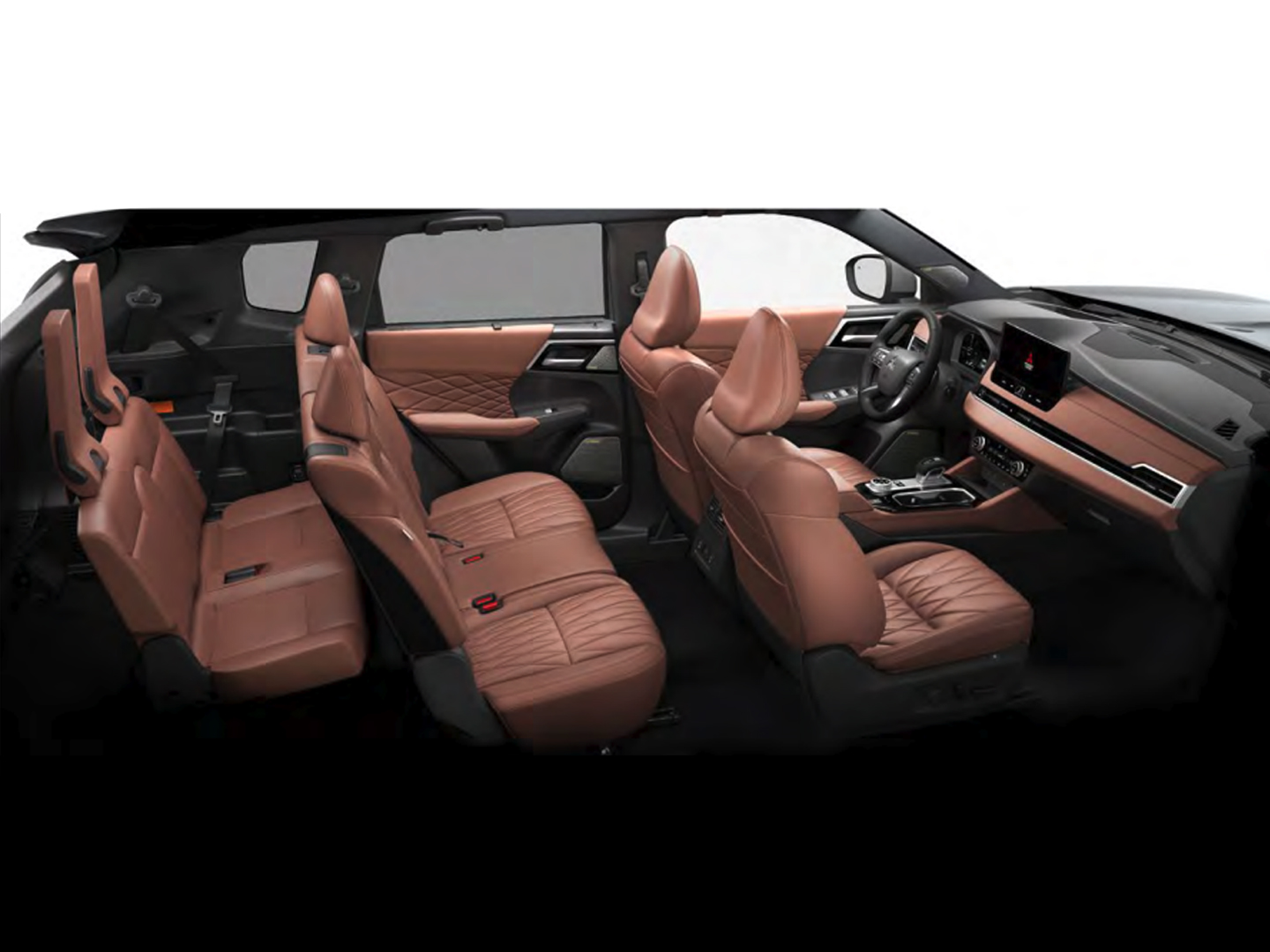
The 2026 Mitsubishi Outlander PHEV (plug-in hybrid) has carved out a small niche in the new vehicle marketplace. Boasting an enhanced battery, the SUV now offers 45 miles of EV range, surpassing nearly every other PHEV in its category. Moreover, unlike its competitors, it retains three rows of seating.
The pricing for the Outlander PHEV has risen significantly for 2026 (now starting at $43,245 before additional charges; the 2025 model began at $40,445). However, Mitsubishi provides a 10-year/100,000-mile powertrain limited warranty, a five-year/60,000-mile new-vehicle limited warranty, five years of roadside assistance, and complimentary two-year 30,000-mile maintenance. This package presents a substantial value.
Here’s a little comparison grid I created to illustrate where the new Mitsubishi PHEV stands relative to other comparable plug-in hybrids. (Each of these models also has much less expensive non-plug-in variations.) Though the starting price of the 2026 Outlander is a bit higher than other similar vehicles, its new 45-mile EV-range specification places it in a favorable zone of (theoretically) reduced gas-engine operation and high seating capacity. The Mazda CX-90 isn’t a direct rival (it’s larger), but I’ve included it here since there are scant three-row PHEVs in this pricing range. While there are many other hybrid SUVs, fewer plug-in models exist that can function like pure battery EVs as these do.
| Model | Seating | MPGe | EV Range | Approximate Starting Price including Fees |
|---|---|---|---|---|
| 2026 Mitsubishi Outlander PHEV | 3 Rows | 73 | 45 Miles | $44,990 |
| 2026 Toyota RAV4 Prime (PHEV) | 2 Rows | 102 | 50 Miles | $42,950 |
| 2026 Kia Sportage PHEV | 2 Rows | 84 | 34 Miles | $41,985 |
| 2026 Hyundai Tucson PHEV | 2 Rows | 77 | 32 Miles | $42,425 |
| 2026 Mazda CX-90 PHEV | 3 Rows | 56 | 27 Miles | $52,620 |
What stands out to me is the parental appeal—my mother would have been the ideal customer for this vehicle when I was younger. She was perpetually driving my friends and me around sprawling neighborhoods. Having 45 miles of electric range and capacity for six kids would have made for an excellent low-cost running car; she was always on the go but seldom covered more than 50 miles in a day.
The new Outlander PHEV’s extended range results from a battery upgrade (now 22.7 kWh, increasing from 20 kWh in the 2025 model). Mitsubishi revealed that the new battery “…provides a 15% capacity increase, but the combination of a new cooling system and improved thermal regulation yields a 60% boost in power output. The electric range rises to 45 miles, total system power output increases to 297 horsepower, MPGe elevates to 73, and electric operation is now accessible in more driving situations.”
The vehicle has a total range of 420 miles; the fuel tank was reduced to just 14 gallons to accommodate the new battery. Nevertheless, Mitsubishi asserts that the battery does not encroach upon cabin space as it is positioned beneath the floor between the vehicle axles.
Frustratingly, Mitsubishi has very few usable images of its products on its media platform. However, here’s some additional technical information that the manufacturer provided about the new powertrain:
“The Outlander Plug-in Hybrid is equipped with two electric motors, one for the front axle and one for the rear. Rear drive in the Super-All Wheel Control all-wheel-drive system operates purely on electricity, with no mechanical link between the front and rear wheels. The internal combustion engine and electric motor hybridized operation is exclusively on the front wheels. Each Outlander PHEV features three rows of seats, made possible by integrating the rear motor control unit with the rear motor to ensure adequate space for the installation of the third-row seat. Placing the rear motor controller and the motor itself outside the passenger compartment minimizes the system’s inherent high-frequency noise, resulting in a quieter interior.”
The brand also mentioned that the Outlander PHEV “can function as both a series or a parallel hybrid. Series mode uses the gasoline engine to generate power that charges the drive battery while powering the vehicle with the electric motors. Parallel mode employs the gasoline engine’s power to drive the vehicle, supplemented by the electric motors.”
There are seven driving modes in this vehicle—Mitsubishi still brands its all-wheel drive system as “Super-All Wheel Control (S-AWC)” which is touted to excel in snowy conditions. The new Outlander does feature an “Innovative Pedal” mode that is allegedly “similar” to one-pedal EV driving and should aid in low-traction scenarios, but we’ll need further information to evaluate that.
Some of my industry peers regard Mitsubishi as an “also-ran.” I possess some superfan bias due to my affection for Mitsubishi’s 1999 lineup (Montero, 3000GT VR-4, Eclipse GSX?!). But aside from that, I’m optimistic about the brand’s potential in the near future. Whispers suggest the firm is considering developing a legitimate off-road 4×4 based on a Nissan platform, and if it can introduce some innovative features (possibly surprisingly efficient fuel economy?), it may set the stage for a comeback.
2026 Outlander PHEV Charging Speeds
These are the charging speed specifications claimed by Mitsubishi; we have yet to verify them.
- Level 1 charging (from standard 120-volt power, using the included charging cable): Charge time from fully depleted is around 16.5 hours
- Level 2 charging (from a 240-volt outlet using a J-1772 plug): Charge time is roughly 6.5 hours
- Level 3 charging (DC fast charge on the CHaDeMo network): Charge time is approximately 29 minutes to reach 80% state-of-charge
Have a tip? Get in touch at [email protected].
### 2026 Mitsubishi Outlander: A Well-Rounded PHEV Choice Compared to Toyota RAV4 and Mazda CX-90
As the automotive landscape increasingly transitions towards electrification, the 2026 Mitsubishi Outlander stands out as an intriguing plug-in hybrid electric vehicle (PHEV) option in the competitive compact SUV segment. This article examines how the Outlander compares to two of its major competitors, the Toyota RAV4 and the Mazda CX-90, centering around performance, efficiency, technology, and overall value.
#### Performance and Powertrain
The 2026 Mitsubishi Outlander incorporates a robust PHEV powertrain that merges a gasoline engine with electric motors, offering a balanced blend of power and efficiency. It is outfitted with a 2.4-liter four-cylinder engine combined with dual electric motors, delivering a cumulative output of around 248 horsepower. This arrangement allows for a smooth driving experience, with the capacity to switch effortlessly between electric and gasoline power.
In contrast, the Toyota RAV4 PHEV, known as the RAV4 Prime, features a more potent 2.5-liter four-cylinder engine coupled with electric motors, achieving up to 302 horsepower. This translates to quicker acceleration and a sportier driving experience. The Mazda CX-90, while mainly a gasoline-powered vehicle, boasts a turbocharged inline-six engine that offers impressive performance but lacks a PHEV option, rendering it less competitive in this niche.
#### Efficiency and Electric Range
One of the primary benefits of the Outlander is its efficiency as a PHEV. It provides an electric-only range of roughly 38 miles, sufficient for most daily trips. When the battery runs low, the gasoline engine takes charge, ensuring that drivers do not suffer from range anxiety.
The Toyota RAV4 Prime excels in electric range, offering around 42 miles on a full charge, making it an appealing option for those who prioritize electric driving. However, the Mazda CX-90 does not offer a PHEV variant, limiting its attractiveness to eco-conscious consumers seeking hybrid choices.
#### Interior and Technology
Inside, the 2026 Mitsubishi Outlander presents a roomy and comfortable cabin, accommodating up to seven passengers. The interior design is contemporary, featuring high-quality materials and an intuitive layout. The Outlander is equipped with a comprehensive infotainment system that includes a sizable touchscreen, smartphone integration, and advanced safety features.
The Toyota RAV4 also offers a well-designed interior with plenty of cargo space and a suite of technological offerings, including an easy-to-use infotainment system and advanced driver-assistance features. The Mazda CX-90, celebrated for its upscale interior quality, provides a more luxurious atmosphere but at a higher price point.
#### Value and Pricing
Pricing for the 2026 Mitsubishi Outlander is anticipated to be competitive within the PHEV market, rendering it an appealing choice for cost-conscious buyers. The Outlander aims to provide a well-balanced mix of features and performance without overextending the budget.
The Toyota RAV4 Prime, while delivering superior performance and electric range, comes at a steeper price, which may dissuade some purchasers. The Mazda CX-90, marketed as a more premium alternative, generally commands a higher cost due to its luxurious features and performance capabilities.
#### Conclusion
The 2026 Mitsubishi Outlander distinguishes itself as a well-rounded PHEV option in the compact SUV arena, especially when contrasted with the Toyota RAV4 and Mazda CX-90. With its efficient powertrain, practical interior, and competitive pricing, the Outlander attracts a broad spectrum of consumers seeking a versatile and environmentally friendly vehicle. While the RAV4 Prime presents enhanced electric range and performance, the Outlander delivers a robust alternative for those in search of a comprehensive PHEV experience without the elevated price tag. As the automotive world continues to evolve, the Outlander establishes itself as a worthy selection for both families and individuals.